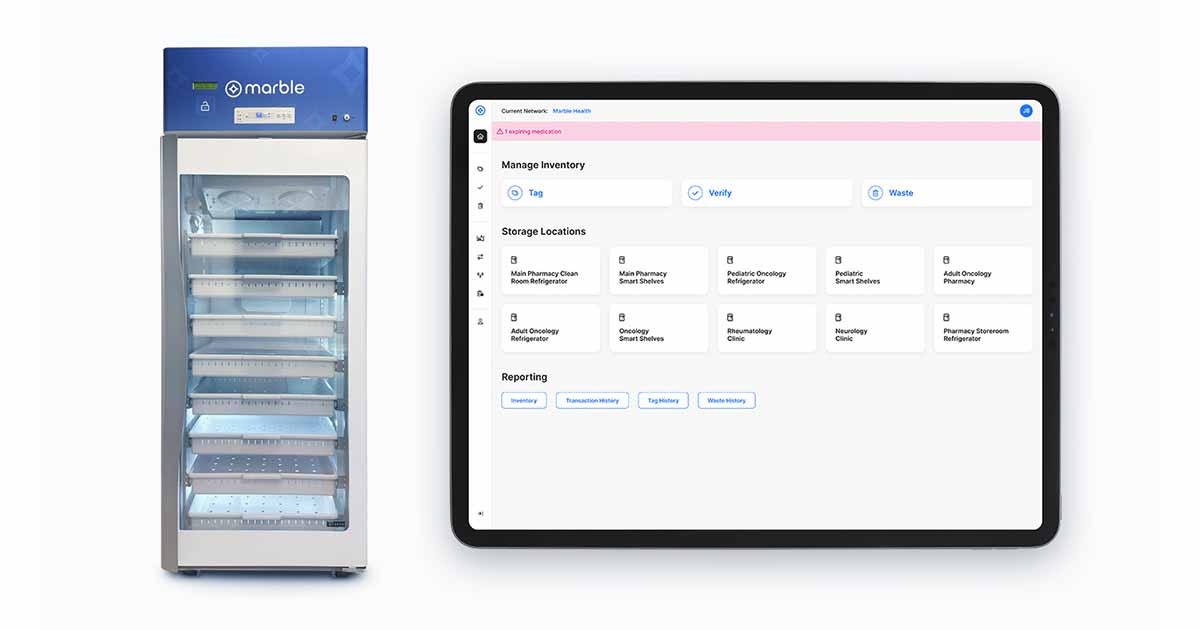
Patients with bleeding disorders like hemophilia rely on life-saving clotting factors to keep their disease in check. These costly biologic treatments are produced by specialized pharmaceutical manufacturers. Keeping track of these products can be a challenge since concentrate vials may have unit assay amounts that differ in small increments due to manufacturing variability, said David Aguero, Director of Medication Systems and Informatics at St. Jude Research Hospital.“Those differences in assay quantity (units) impact which specific vials a pharmacist chooses for a patient. Unfortunately, that means someone from the home infusion pharmacy must go and physically lay hands on the product to check what we have because inventory management only happens at the vial level,” he explained.To automate inventory management of clotting factor products at St. Jude, Aguero and his team are working with Marble AI, a medication management solutions provider, to develop a new radio-frequency identification (RFID) solution.“Any time medications are stored out of eyesight in the pharmacy, inventory visibility is incredibly important,” he said. “This new system will allow us to make sure we have the clotting-factor products we need on hand to support excellent patient care.”A new use case for RFIDWith the new solution, each clotting-factor product is tagged, complete with the necessary asset information, when St. Jude staff receive it. When the product is placed in refrigerated storage, the tag automatically updates the quantity number in the inventory management system. It also allows pharmacists to easily see the assay unit amounts for each product without having to put hands on it. And, when the product exits or is returned to the refrigerator for whatever reason, inventory is updated in real time.“Eventually, the product will go below periodic automatic replenishment (PAR),” said Aguero. “That will queue up an order to the supplier, which is reviewed before it goes out the door, so fulfillment will happen and new product will be received in the Home Infusion Pharmacy.”This new solution not only provides critical visibility of the products on hand to the home infusion pharmacy as well as to the pharmacy organization but also streamlines the procurement process to make sure that doctors always have the right medications on hand for patients.RFID innovation requires standardsAguero noted this is just one new use case that can be facilitated by RFID technologies. In the future, he hopes to see wider integration between asset management systems, inventory management systems and the electronic health record (EHR) using RFID solutions.“You can imagine a case where you’ve tagged medication items in a tray, they are put in a crash cart and then the crash cart is sent off somewhere in the facility,” he said. “If the location tracking system and the RFID inventory system communicate, we can know exactly where medication products are at any given time and whether they’ve been consumed or are about to expire.”But expanding RFID capabilities in this way, Aguero added, requires the adoption of global standards. Without them, he said, you can’t adopt innovative technologies to streamline the medication use process while safely and reliably supporting patient care.“As we get new solutions, I want to know that if we tag an anesthesia product, it can be read it with any cart, tray or refrigerator we use and then send that same information over to my inventory system and into the EHR,” he said. “GS1 standards support that kind of interoperability at all levels.”As a result, Aguero hopes that more pharmaceutical manufacturers will start providing RFID-enabled healthcare products. He believes this will help get the industry to adopt global standards and support interoperability across all pharmacy solutions and systems. This is what is required to support pharmaceutical products being shipped, received, stored and consumed in the safest, most cost-effective manner.“There is an inflection point — and I’m not sure where it is — when it will make sense for the vast amount of products above a certain price threshold to be tagged by the manufacturer,” he said. “There’s a huge opportunity for all of us from both a safety and efficiency perspective once pharmacies can get pre-tagged products encoded on a production line and consumed in an interoperable way. Once that happens, we’ll see huge savings in time and costs — and significant improvements in patient safety.”
How St. Jude uses RFID to track critical biologics in real time
When a vital medication leaves the pharmacy shelf, it shouldn't disappear from the hospital’s sight; at St. Jude, a new RFID pilot is helping to ensure that visibility remains constant from the warehouse to the bedside.
705 words~3 min read