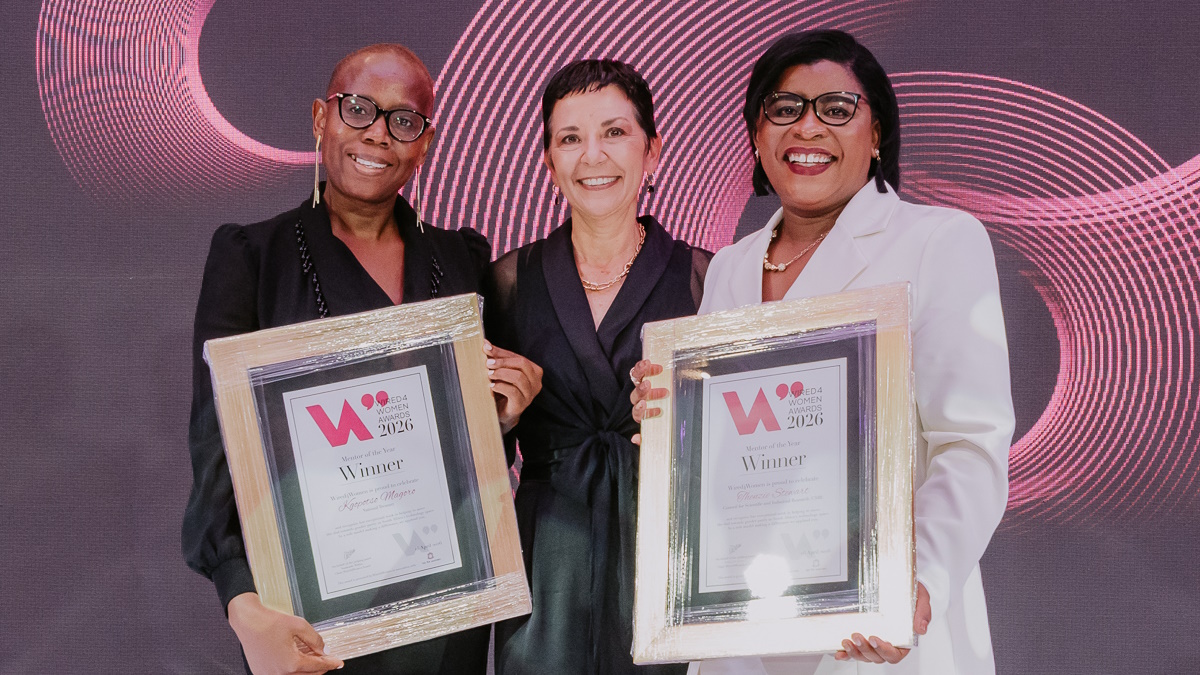
Kgopotso Magoro, Seugnette Van Wyngaard, head of First for Women, and Thenzie Stewart. Kgopotso Magoro and Thenzie Stewart share a vision of a more inclusive digital future for girls in SA. Throughout their careers, they have supported young women – especially in townships and rural communities – helping to make technology and opportunity more accessible.Magoro, director of learning and innovation at National Treasury, and Stewart, senior manager of financial systems at the Council for Scientific and Industrial Research (CSIR), were recently named joint winners of the Wired4Women Mentor of the Year 2026 Award for their role in guiding and uplifting future female tech leaders.Reflecting on her win, Stewart says her work comes from a genuine place. “Mentorship and advocacy are not things I do because they sound good on paper or are attached to a title; they are things I live every day. I enjoy and love it. It’s so beautiful seeing someone bloom and grow, and knowing you have played a part in that.”Stewart’s community-driven approach to mentorship was shaped by her own journey into IT at the age of 19, during the Y2K era, without funding, connections or privilege. Over the years, she has mentored over 100 students and young professionals through talks, webinars, one-on-one sessions and structured mentoring programmes focused on confidence-building, career growth and workplace readiness.As former chairperson of the IITPSA Women in IT Chapter, she helped revitalise the platform to support women’s leadership and development, and launched initiatives such as the Muted Mics webinar series and a speed mentoring toolkit for young professionals.I care deeply about making sure that the girl in the township, the young woman in a rural community, and those without networks or exposure are not left behind in the digital world.Thenzie StewartStewart’s passion goes beyond corporate spaces. “For me, empowerment means making technology feel possible and accessible for everyone, not only for those who already have access and privilege.” Her deepest motivation: that a girl from her community looks at her and says: "That's Thenzie, she works with computers. I want to be like her. I want to be better than her."Thenzie Stewart, senior manager of financial systems, at the CSIR. SA still faces a significant digital divide, she says. “I would love to see more collaboration between industry, schools, universities and initiatives like Wired4Women to help bridge that gap. Whether through digital skills initiatives, exposure to AI and technology, career guidance or community outreach, we have an opportunity to help more young women see technology as something they can belong in too.”Driven by her own lived experience of digital exclusion, Magoro has built a self-sustaining digital mentorship ecosystem in her rural Limpopo. In 2018, she launched community WiFi initiatives and later established a tech hub in her village, training young people as “digital pioneers” who could educate others about the internet and digital tools. The initiative continues to grow independently of her physical presence.Magoro says her mentorship work takes place in a resource-constrained environment where opportunities are often limited. “My journey unfolded academically in ways that enabled me to support others who are coming after me.”If more learners and young women could see these stories up close, it would motivate them to imagine themselves in the tech space.Kgopotso MagoroHer impact is reflected in the success of her mentees, including women who have gone on to start community training centres and work as international consultants, as well as young people who have built sustainable careers through digital skills and online networks.“I experienced a remarkable level of humility from the very beginning. Being shortlisted and eventually selected as one of the winners made me realise that my work is valued, even though it takes place in a village context. This was meaningful for me because it showed that the judges recognise excellence regardless of where it is located, whether urban or rural, corporate or community, academia or public sector.”Kgopotso Magoro, director of learning and innovation at National Treasury. Magoro says Wired4Women could expand its impact by incorporating more community outreach, especially school and university engagements, alongside the awards.“Early exposure plays a significant role in shifting narratives and broadening aspirations. By continuing to profile women in ICT, you are already showcasing the critical role women play in shaping South Africa’s digital future.“If more learners and young women could see these stories up close, it would motivate them to imagine themselves in the tech space.”She adds that attending the awards ceremony broadened her perspective.“My work is deeply rooted in community spaces, and I serve within the public sector. Being in the same room with women from corporate, hearing their stories, their challenges and their achievements, was profoundly inspiring. It affirmed that women across all sectors are shaping South Africa’s digital future in powerful ways.”Presented by ITWeb Brainstorm in partnership with the Wired4Women Tech Forum, the Wired4Women Awards celebrate the achievements of women across 13 categories – from emerging talent to top executives. The Mentor of the Year Award, sponsored by First for Women, honours women who demonstrate sustained commitment to mentorship through hands-on guidance, structured programmes and measurable impact.Besides Magoro and Stewart, the 2026 finalists were Kershnee Ballack, technology executive: employee and workforce enablement at Old Mutual; Monique Botha, lead solution analyst: cloud adoption office at Absa; and Mokete Moetela, at the time strategic projects manager at Tracker Connect.Jill Mulligan, head of marketing at First for Women, says by sponsoring the Mentor of the Year Award, First for Women champions women supporting women, creating opportunity and driving meaningful change.The winners were announced on 16 April at the recent Wired4Women Awards gala ceremony.
From rural communities to boardrooms: Award-winning mentors inspire women in tech
Kgopotso Magoro and Thenzie Stewart believe no girl, regardless of where she comes from, should be left behind in the digital world.
928 words~4 min read