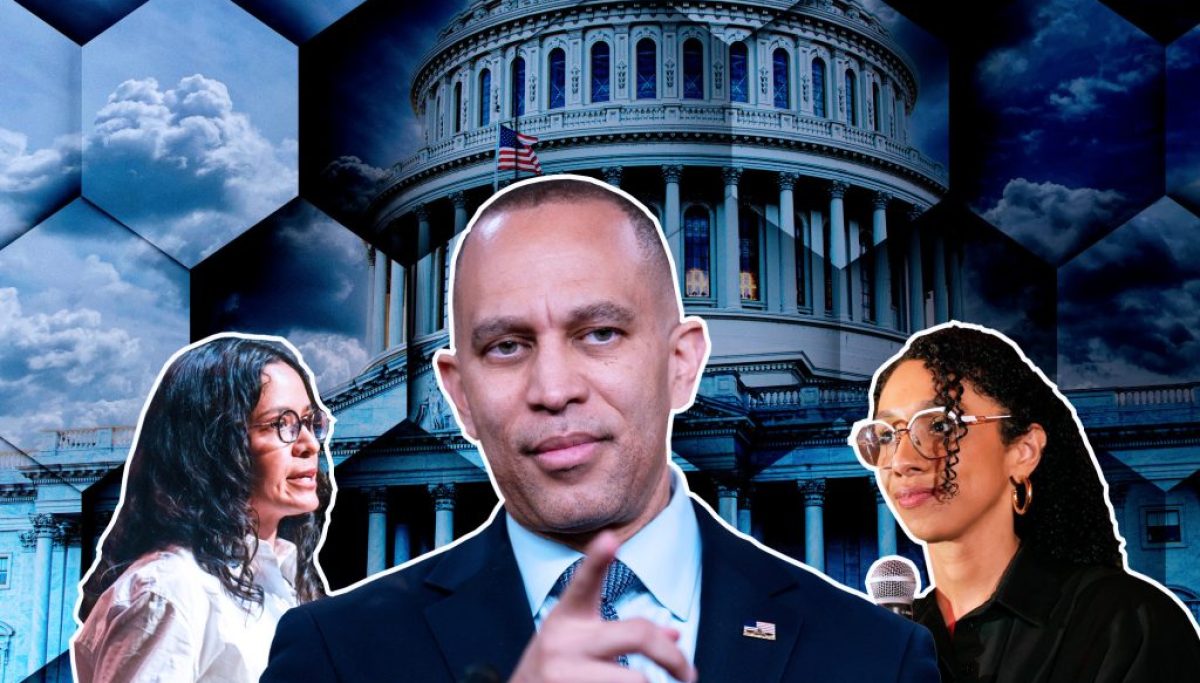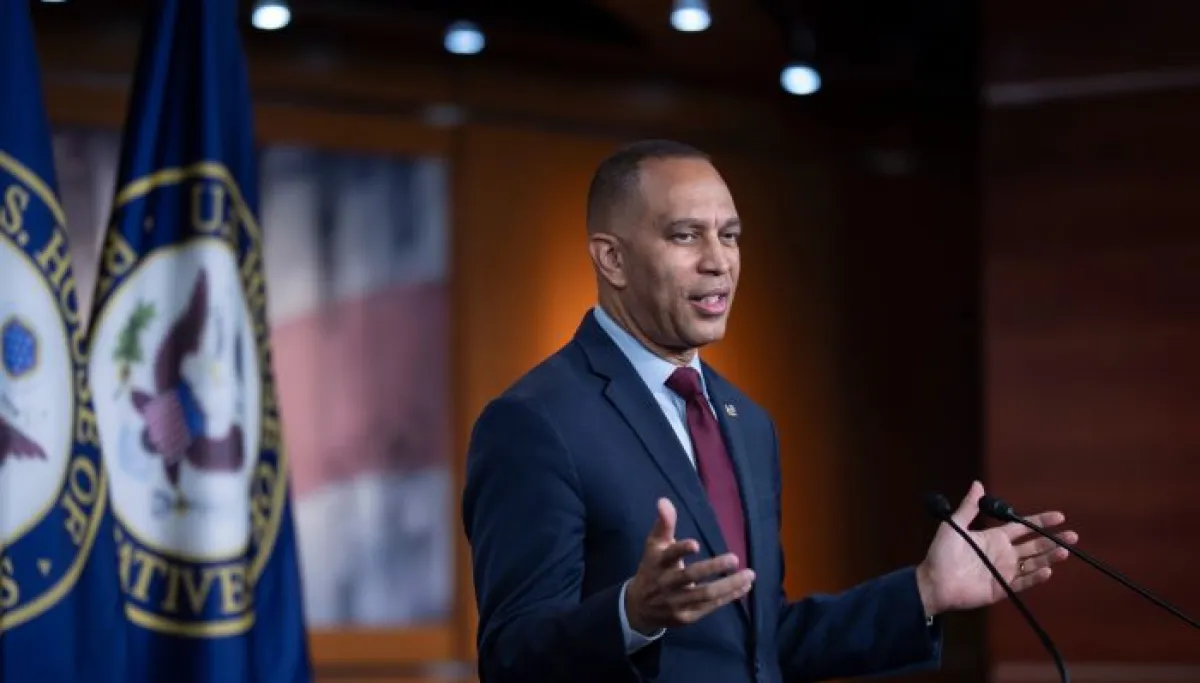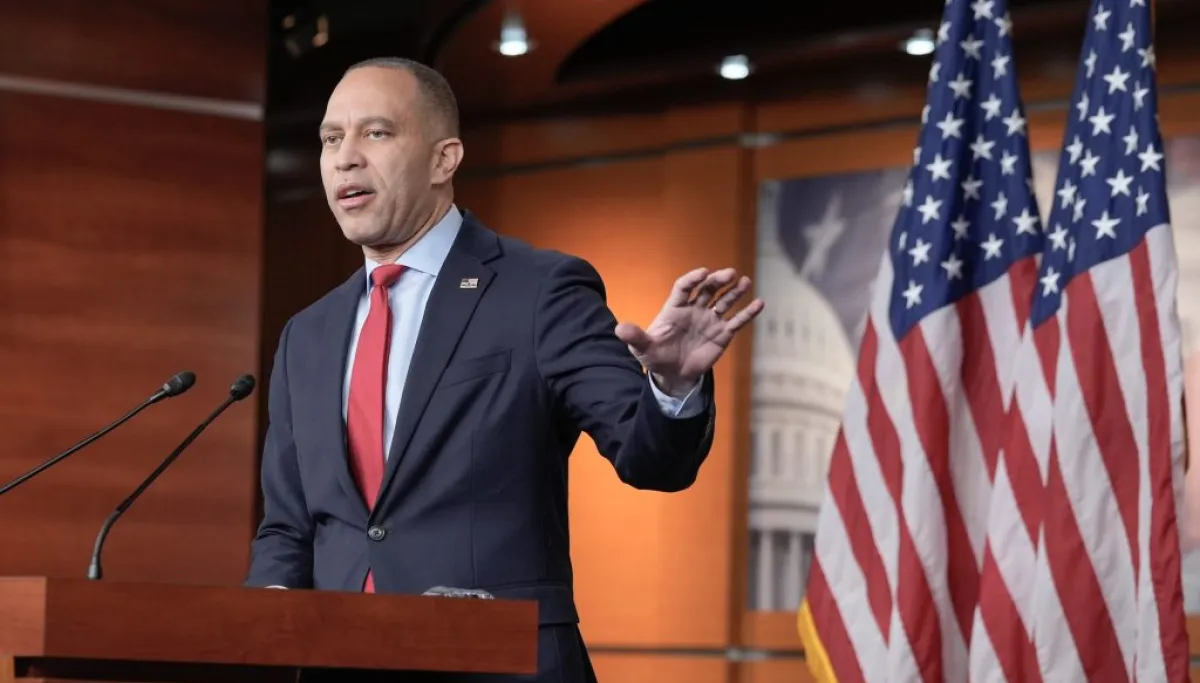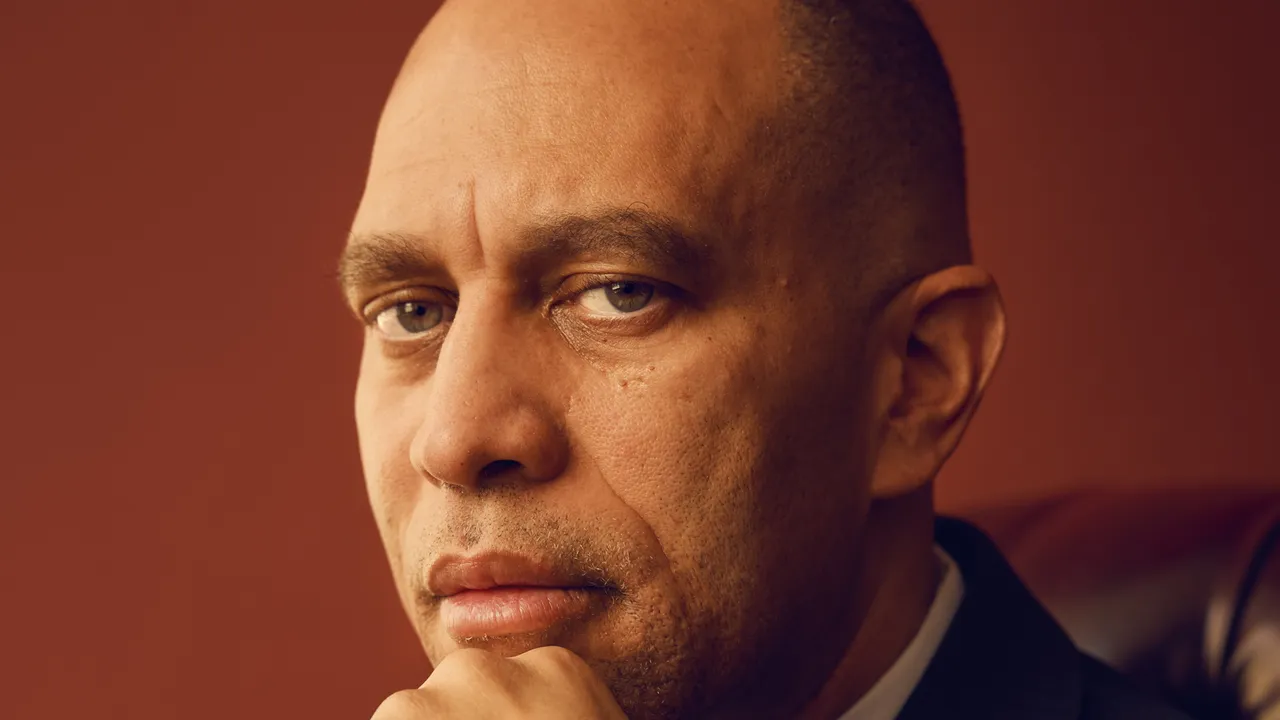
Earlier this year, Hakeem Jeffries, who represents New York’s Eighth Congressional District, was headed to a meeting with a Democratic donor in Palm Beach when he checked his phone. As the House Minority Leader, Jeffries has spent much of the past eighteen months hopscotching across blue America’s high-income Zip Codes, soliciting campaign contributions in Palo Alto and Palm Desert, Martha’s Vineyard and Greenwich. The evening before, he had headlined a Democratic Party fund-raiser at a lobbyist’s office in Miami. Now, as he was being driven north, in a Capitol Police S.U.V.—a staple of the twenty-four-hour security detail provided to congressional leaders—Jeffries saw that one of his staffers had alerted him to a video on Donald Trump’s Truth Social account. The clip, which promoted various conspiracy theories about the 2020 election, included a depiction of Barack and Michelle Obama as apes.Jeffries, who is the highest-ranking Black elected official in the United States, had criticized Trump for what he once called “a troubling pattern of racially insensitive and outrageous at times behavior.” He’d branded the President a “racial arsonist” and the “birther-in-chief.” At the same time, he had steadfastly refused to call Trump a racist. In 2019, when CNN pressed Jeffries on another remark—he’d dubbed Trump “the grand wizard of 1600 Pennsylvania Avenue”—he replied, “I did not use the word ‘racist’ in any of my comments.” But as Jeffries watched the video from Trump’s feed he seethed. “The guy is so disgusting and out of control in so many different areas,” he told me. “My reaction was visceral.”Anger is not an emotion typically associated with Jeffries. His favorite mantra, one he frequently repeats to colleagues and staffers, is “Calm is an intentional decision.” This has not always endeared him to some Democratic partisans. In the early months of Trump’s second term, when Jeffries held readings in several cities to promote “The ABCs of Democracy”—a children’s book he wrote that contains lessons such as “American values over autocracy,” “benevolence over bigotry,” and “the Constitution over the cult”—he was often greeted by protesters from local progressive groups who chanted “Grow a spine!” and carried signs that read “Jeffries! Be Ruthless” and “Book Tour? NOW?” This past February, after Jeffries asked Democratic members of Congress to sit in “silent defiance” during Trump’s State of the Union address, Stephen Colbert cracked that “silent defiance” was “a bold rebrand of doing jack squat,” adding, “As Martin Luther King once said, ‘Sh-h-h.’ ” Amanda Litman, the head of the liberal group Run for Something, offered a “Godfather” reference, complaining to the Times that Jeffries “is not well suited to being a leader of the opposition—a wartime consigliere.”Jeffries maintains that he and the House Democrats have stood up to Trump plenty. He points to their decision to trigger government shutdowns to protect health-care benefits and to protest the White House’s immigration-enforcement tactics, their multistate campaign to offset Republicans’ gerrymandering efforts, and their repeated use of so-called discharge petitions, which has allowed them to force floor votes on bills opposed by the Republican leadership, including one that led to the release of the Department of Justice’s files on Jeffrey Epstein. “From the standpoint of House Democrats, I certainly think that we’ve proceeded with a level of ruthless intensity,” he told me.Still, Jeffries knew that he needed to strongly condemn Trump’s video. Even Republicans, who usually feigned ignorance about the President’s social-media outbursts, were weighing in. “I do not feel the need to respond to every inflammatory statement made by the White House,” Representative Mike Turner, a Republican from Ohio, wrote on X. “However, the release of images of former President Barack and First Lady Michelle Obama is offensive, heart breaking, and unacceptable. President Trump should apologize.” Jeffries didn’t think that a post on X would suffice—“I wanted to do a direct-to-camera on this,” he said—but he wasn’t about to commandeer the living room of a donor’s Palm Beach mansion. He asked his security detail to take him to a public park. “The question was: Am I just gonna say what I’m really feeling about it?” he recalled. “I decided, you know, I’m not gonna hold back.” Standing beneath a sea-grape tree, his suit jacket buttoned and a wireless lavalier microphone attached to his lapel, Jeffries looked into an aide’s iPhone and said, “Fuck Donald Trump!”Almost immediately, Jeffries began to waver. He instructed staffers back in Washington to bleep the word “fuck.” A few younger aides objected to the self-censorship but didn’t press the point. Jeffries then asked his team to hold off on posting the video until he was done tending to the donor; he wanted to see how things played out. Later that day, when he learned that the White House had claimed that a staffer, not Trump, had “erroneously” made the post, his anger returned. “I think that’s what probably put me over the edge,” he said.He gave his team the green light to post the video on Instagram. The response was immediate. Popular liberal accounts on Bluesky and X—not always the safest spaces for Jeffries—reposted the video. “🚨HUGE: Leader Hakeem Jeffries says ‘FUCK DONALD TRUMP,’ ” @CalltoActivism, which has 1.2 million followers, wrote on X. “His ENTIRE statement is 🔥.” That evening, MS NOW led with the video on its prime-time show “The Weeknight.”When I visited Jeffries in his office at the Capitol six days later, he still seemed to be savoring the moment. “There were pastors and other civil-rights leaders that I ran into that just said, ‘Thank you for saying that, because that’s what we all were feeling,’ ” he told me. Yet, as he sat in a silk-upholstered chair in front of a fireplace, he also couldn’t quite hide some discomfort. Jeffries, who is fifty-five, with hazel eyes and a warm smile, is friendly but guarded; in interviews and even in casual conversation, he speaks in the same studied, staccato style that he uses on the House floor. Discussing the episode, he avoided repeating the phrase “Fuck Donald Trump,” instead referring to “those three words.” “It’s not like I’m gonna adopt the practice of regularly speaking in this way,” he said. Jeffries steepled his hands and let out a small sigh. The praise from the internet was nice. The praise from the pastors was even nicer. But, he said, “I haven’t heard from my mother yet, so I’m a little concerned about that.”As the leader of the minority party in the House of Representatives, a fundamentally majoritarian institution, Jeffries has little ability to get anything done. Speaker Mike Johnson and his fellow-Republicans control the chamber’s agenda, schedule, and procedures—and, as a result, can dictate most of its outcomes. The main thing Jeffries can do as Minority Leader is to help Democrats get back into the majority. Representative Jared Moskowitz, a Florida Democrat, told me, “Hakeem is singularly focussed. I mean, he’s focussed on many things, but he’s literally focussed on one thing—and that’s becoming Speaker.”The other thing Jeffries can do as Minority Leader, which is in service of the first, is to keep the peace within his caucus. “He’s very attuned to different voices and different factions within the Democratic coalition,” Representative Jamie Raskin, a Democrat from Maryland, told me. Jeffries hosts a weekly sit-down, called the Crescendo Meeting, with the heads of nearly a dozen Democratic sub-caucuses, from the Blue Dogs and the progressives to the Black, Hispanic, Asian Pacific American, and women’s caucuses. According to John Leganski, who served as the deputy chief of staff to the former Republican House Speaker Kevin McCarthy, Jeffries once explained to McCarthy, “You have five families, Kevin. I’ve got eleven.”Jeffries is an inveterate texter and typically responds to messages within an hour. “Most people, if you ask them, ‘Do you have a good relationship with Hakeem?,’ they’d say, ‘Yeah, I have a great relationship with Hakeem,’ ” Josh Gottheimer, a Democratic House member from New Jersey, said. “Everybody feels like they’re in the inner circle.” Jeffries told me, “The most important words that I can say to any member of Congress on any given issue are ‘What do you think?’ ”Not every House Democrat is a fan of this approach. “He’s got to listen to people, but then he’s got to say, ‘This is what we should be doing,’ ” one Democratic member told me. Another said, “I think he views his role as entirely oriented around member management, and everything is viewed through the lens of keeping the different caucuses happy with him. I don’t think he’s really here to be a leader. I think he’s here to become Speaker.”Multiple members pointed to an episode from last September, after the assassination of the conservative activist Charlie Kirk. Mike Johnson introduced a ceremonial measure that hailed Kirk as a “courageous American patriot” and called upon “all Americans—regardless of race, party affiliation, or creed—to reject political violence.” But the resolution also described Kirk—who had claimed that “prowling Blacks go around for fun to go target white people” and that “Islam is the sword the left is using to slit the throat of America”—as someone who was known for “engaging in respectful, civil discourse” and “always seeking to elevate truth, foster understanding, and strengthen the Republic.”Jeffries believed that the resolution was designed as a trap for so-called frontline Democrats—two dozen or so vulnerable incumbents who represent purple or red districts. In a caucus meeting a few hours before the measure came to the floor, Jeffries and his leadership team announced that they would vote for the resolution, to provide cover for the frontliners, but that every member should feel free to “vote their conscience.”In the end, ninety-five Democrats voted for the Kirk resolution. The majority of Democrats who opposed it—fifty-eight in total—belonged to the Congressional Black Caucus. As the group explained in a statement after the vote, its members considered the measure “an attempt to legitimize Kirk’s worldview—a worldview that includes ideas many Americans find racist, harmful, and fundamentally un-American.” White progressive Democrats who voted for the resolution felt blindsided by the C.B.C.’s opposition; C.B.C. members felt that Jeffries and his leadership team, by failing to provide specific voting instructions, had hung them out to dry. “They need to say, ‘We understand that it’s a gotcha resolution, so there’s no right answer, but here’s the answer,’ ” one Democrat told me.In a subsequent ninety-minute Zoom call, C.B.C. members vented their frustrations to Jeffries; at least one of them was openly crying. “It became very toxic, volatile, and emotional,” Joyce Beatty, a Democrat from Ohio and a former C.B.C. chair, said. But, she went on, the caucus’s members ultimately felt that Jeffries had understood their concerns: “It takes a stronger and greater leader that can call all those people back together and work through the tears and the emotion and say, ‘I handled it wrong.’ ”Jeffries’s “light touch,” as several members described his leadership style, has also had some success. On February 26th, two days before Trump launched Operation Epic Fury, a joint assault with Israel on Iran, Jeffries announced that he planned to force a vote on a war-powers resolution that would prohibit further military force against the Islamic Republic without congressional approval. The onset of hostilities was enough to persuade around a hundred and eighty Democrats to support the measure. But there were still as many as thirty Democrats, many of them staunch supporters of Israel, who were not yet on board. On March 3rd, Jeffries invited several of the holdouts, including Gottheimer, Debbie Wasserman Schultz, of Florida, and Greg Landsman, of Ohio, to his office for a meeting. Gottheimer and Wasserman Schultz explained why they were still undecided; Landsman laid out his opposition to the resolution. Jeffries argued that, whatever members thought of Israel, or even of Iran, this was a vote for Congress’s constitutional checks on the President. He later told me, “My view is that the best possible communication with people is to hear their thoughts, concerns, and ideas, if they’re in a different place initially. And then just to make the case.”“Who’s to say which of us is living life to the fullest, though?”Cartoon by Harriet BurbeckThe war-powers resolution was ultimately defeated, but only four Democrats, including Landsman, voted against it. Jeffries told me that it was probably his “most aggressive whip effort” as leader. I mentioned that Gottheimer—who, along with Wasserman Schultz, ended up supporting the measure—had said he didn’t feel like he’d been whipped especially hard. (“I walked away feeling heard, not pressured, if that makes sense,” Gottheimer told me.) Jeffries responded, “And how did he vote?”Jeffries has been the House Democratic leader for three and a half years, but he initially gained national attention in 2020, during Trump’s first impeachment. On the opening day of the trial in the Senate, Trump’s personal lawyer, Jay Sekulow, demanded, “Why are we here?” Jeffries, who was serving as a House impeachment manager, posited an answer. Standing in front of the Senate’s marble rostrum, he launched into a minute-and-a-half recitation of the charges against Trump, who, in a phone call with the Ukrainian President, Volodymyr Zelensky, had appeared to solicit foreign interference in the 2020 election, threaten to withhold vital military aid, and subordinate the national-security interests of the United States for his own personal gain. “That is why we are here, Mr. Sekulow,” Jeffries said. “And if you don’t know, now you know.”The last line—a quote from the 1994 hip-hop classic “Juicy,” by the Notorious B.I.G.—earned plaudits in a Maureen Dowd column (headlined “Notorious D.J.T. on Trial”) and inspired a “Daily Show” joke about a rapping Mitch McConnell. (“My name is Mitch, and I don’t have a jaw. I love the Senate and saying, ‘Maaaw.’ ”) But, for some Democrats, Jeffries’s mike-drop moment—which has been commemorated with an “IF YOU DON’T KNOW, NOW YOU KNOW” throw pillow that sits on a couch in his D.C. office—prompted eye rolls. “I was, like, ‘What are we doing?’ ” a Democratic strategist said. “Do we think this is cool? No, this is embarrassing.”Yet even Jeffries’s detractors acknowledge that his hip-hop references—he’s similarly fond of quoting Jay-Z, Salt-N-Pepa, and Naughty by Nature, among others—are an authentic expression of self. He was raised in Crown Heights during both the advent of hip-hop and the arrival of the crack epidemic; he is a product of what he has called “old-school Brooklyn, not gentrified Brooklyn.” His parents, who met as students at Central State University, a historically Black college in Ohio, were both social workers. Jeffries remembers that, in his preteen years, his mother, Laneda, was often mugged on her way home from work. On one occasion, his father, Marland, went out with a saw to hunt down the culprits. “I don’t know what happened with that saw,” Jeffries said. “Whatever did happen, the statute of limitations is over.”Inside the Jeffries family’s modest brownstone, Marland emphasized Afrocentrism and academic achievement. He wore dashikis and practiced Universal Shorei-Goju, a form of martial arts developed on the South Side of Chicago in the nineteen-sixties. Hakeem’s middle name is Sekou, an homage to the Guinean statesman Ahmed Sékou Touré; his brother, Hasan, who is three years younger, was given the middle name Kwame, in honor of Kwame Nkrumah, the first President of Ghana. Marland held up his own brother, Leonard, who chaired the Black Studies Department at the City College of New York, as a role model, telling his sons, “Whatever you’re going to be, you’re going to be beyond a master’s degree.”Laneda made Cornerstone Baptist Church another pillar of Jeffries’s upbringing. Situated in Bedford-Stuyvesant, Cornerstone was one of Brooklyn’s largest and most influential Black churches. Its longtime pastor, Sandy Ray, had been an adviser to Martin Luther King, Jr., who called him Uncle Sandy. Laneda taught Sunday school, and her sons were Cornerstone ushers, wearing white gloves and delivering a welcome address to visitors at the start of Sunday services. “Mom would never let us read our part,” Jeffries recalled. “You had to memorize it. And we would just practice—boom—practice, practice, practice to get up there. And you’re young, you’re speaking in front of hundreds.”At Midwood High School, Jeffries hung out with a crew of boys who wore Lee jeans and leather bomber jackets, and he once engaged in an after-school rap battle with a classmate. But Jeffries, an outstanding student who typically went straight home from baseball practice to study, remained more of a spectator than a participant in the borough’s burgeoning hip-hop scene. Five miles away, the Notorious B.I.G., Jay-Z, and Busta Rhymes all attended Westinghouse, a vocational high school in downtown Brooklyn. I asked Jeffries what alumni Midwood, a highly competitive public school, could claim. “Woody Allen?” he offered.In the fall of 1988, Jeffries arrived at the State University of New York at Binghamton. He found the school’s distance from the bustle and violence of Brooklyn liberating—he joined a Black fraternity, Kappa Alpha Psi, eventually serving as its president, and later met the woman who would become his wife. In his junior year, Jeffries, who majored in political science, began devoting the bulk of his extracurricular energies to the university’s Black Student Union. After he was elected as the group’s political correspondent, he made weekly presentations on topics that ranged from South African apartheid to police brutality. “Hakeem was in charge of going over political and social situations around the world or in the country that affected Black students and the Black community,” Carlos Pimentel, who was the B.S.U.’s president at the time, said. “And he was great at it.”But nothing prepared Jeffries for the tumult that engulfed SUNY Binghamton in the winter of 1992, his senior year, when the B.S.U. invited his uncle to campus. By then, Leonard Jeffries was one of the most controversial college professors in the country. In his classes at City College, he taught that people of European ancestry, whom he called “ice people,” were fundamentally greedy and materialistic and that people of African descent, whom he called “sun people,” were essentially generous and humanistic. He theorized that melanin gave Black people intellectual and physical superiority over whites. The previous summer, while speaking at a Black-arts-and-culture festival in Albany, he had endorsed the claim that “rich Jews helped finance the slave trade,” described a George H. W. Bush Administration critic of Afrocentrism as a “Texas Jew,” and alleged that a conspiracy against Black people had been “planned and plotted and programmed out of Hollywood” by “people called Greenberg and Weisberg and Trigliani.”Jewish students at SUNY Binghamton responded to the news that Leonard Jeffries would speak at their school by calling on the B.S.U. to rescind the invitation. The B.S.U. refused. It fell to Hakeem, as the group’s political correspondent, to explain the reasoning. At a press conference, wearing a dashiki and sitting in front of a mural of Malcolm X, he made a free-speech argument. “The proper way to debate scholarship is with scholarship,” he told reporters. But in an article for the B.S.U.’s publication, the Vanguard, he provided a more strident defense. “Dr. Jeffries has challenged the existing white supremacist educational system and the longstanding distortion of history,” he wrote. “His reward has been a media lynching complete with character assassinations and inflammatory erroneous accusations.” He cited the Nation of Islam minister Louis Farrakhan as another Black figure who, like his uncle, had been maligned by “the white power structure and their propaganda emissaries, the media.”Leonard Jeffries ultimately gave his speech, urging an audience of more than eight hundred students to study African history and insisting that he was not an antisemite. (A month later, City College removed him as the head of the Black Studies Department.) Hakeem’s brother, Hasan, now a history professor at Ohio State University, dedicated a book he published in 2009 about the early Black Power movement in Alabama to “Uncle Lenny, For Everything.” But Hakeem rarely mentions his uncle. When I asked him about the Binghamton episode, he downplayed the Vanguard article. “It wasn’t a central part of my four-year journey in college,” he said. “It was a snapshot in time that I had long forgotten about.” His most significant experience as an undergraduate, he went on, came two months later, during the Los Angeles riots in the aftermath of the Rodney King verdict: “It was at that moment that I became committed to going to law school and to trying to be part of elevating this concept, to the greatest extent possible, of liberty and justice for all in the face of clear injustice.”Jeffries attended law school at N.Y.U. While there, he sought out the counsel of Patrick Gaspard, a New York political operative who later served in the Obama White House. Jeffries told him that he intended to go into private practice but that his real interest was in city politics. “I did not experience him as somebody who was against the system or was anti-establishment,” Gaspard told me. “He struck me as a bit of a young man in a hurry, where he’s already thinking through the next five steps in his life.”In 1998, Jeffries joined the white-shoe New York law firm Paul, Weiss, where he was taken under the wing of Ted Wells, the firm’s only Black partner. “I used to tell him, ‘You look—you’re going to be a partner one day,’ ” Wells said. “And the more I talked about him becoming a partner, the more he kept talking about public service.”Jeffries had lived with his parents during law school to save money. Now, newly married, he bought a co-op apartment in Prospect Heights, Brooklyn. It was in New York’s Fifty-seventh Assembly District, which for nearly two decades had been represented by a former community organizer named Roger Green. In 2000, a few months shy of his thirtieth birthday, Jeffries announced that he was running against Green in the Democratic primary. Wells walked the halls of Paul, Weiss raising money for the campaign. Jeffrey Feldman, then the executive director of the Brooklyn Democratic Party, recalled that he first heard of Jeffries from another Paul, Weiss partner, who did legal work for the state Party. “He said, ‘I have an associate who is just amazing, and we at the firm have agreed we’re going to back him to the hilt,’ ” Feldman told me.One of Green’s top advisers was Letitia James, now the attorney general of New York; she had previously worked for Al Vann, a longtime assemblyman and a power broker among Black Democrats in Brooklyn. “The difference between Hakeem and I is that I was the understudy of a lot of the Black political establishment and Hakeem was sort of on the sideline,” James told me. “Hakeem was an outsider. I was an insider.” Jeffries went on to lose the election by eighteen points. Two years later, he ran against Green again and lost by twenty-four points. James said, “The white-shoe firms don’t have a lot of influence in central Brooklyn.”In 2006, Green announced that he was running for Congress, and Jeffries launched his third campaign for the Assembly seat. The biggest issue in the Democratic primary was the Atlantic Yards project, a multibillion-dollar real-estate-development plan that sought to put a basketball arena and thousands of new apartments in downtown Brooklyn. One candidate ran as a fervent booster, arguing that Atlantic Yards would bring jobs and housing to the area. Another candidate was an outspoken opponent, contending that the project was a sop to developers. Jeffries, who had left Paul, Weiss to work as an in-house counsel at CBS, managed to avoid staking out a strong position, telling the Times, “Essentially, yes to affordable housing, no to eminent domain abuse, no to commercial skyscrapers, and yes to an open process.” Lauren Bierman, who managed his campaign, told me, “Jeffries handled Atlantic Yards the way Jeffries handles most things: very strategically.” He won in a landslide, with sixty-four per cent of the vote.In Albany, Jeffries was part of a group of young Black and Latino lawmakers from New York City who played pickup basketball together and plotted legislative strategy over beers at a Bonefish Grill. New York was in the process of repealing many of the punitive drug laws that were passed under Governor Nelson Rockefeller in the nineteen-seventies. As the most accomplished lawyer in the group—“It was not common for Big Law attorneys to find a career in the legislature,” Jonathan Bing, a former assemblyman, told me—Jeffries often took the lead on criminal-justice issues. He sponsored legislation that made open possession of small quantities of marijuana a violation rather than a misdemeanor and introduced a bill that ended the practice of “prison-based gerrymandering,” in which inmates were counted as voters in the district where they were incarcerated rather than at their home address.Jeffries’s signature legislative effort involved the New York City Police Department’s stop-and-frisk policy. Under Mayor Michael Bloomberg, police officers conducted street searches of hundreds of thousands of New Yorkers each year, the vast majority of whom were Black or Latino and had not committed a crime. Additionally, the N.Y.P.D. maintained a database of the names, addresses, and other personal information of individuals who were subjected to street searches—almost ninety per cent of whom hadn’t been arrested or issued a summons. Jeffries and Eric Adams, a former police officer who was then a state senator from Brooklyn, sponsored legislation that barred the N.Y.P.D. from storing the personal information of those who were stopped and released. The bill, which was signed into law in 2010, was among the first instances of New York taking legislative action to stop racial profiling. “I was doing the marches in the street, and Hakeem was doing the legislation,” the Reverend Al Sharpton told me. “He was the guy to legislate our movement.”But Jeffries was also careful not to run too far afoul of Bloomberg. The stop-and-frisk legislation curtailed only the kinds of information that police could keep after the searches—not the searches themselves. At times, officials in the Mayor’s office viewed Jeffries as an ally. When Bloomberg, a strong proponent of education reform, was seeking to increase the number of charter schools in the city, Jeffries co-sponsored a bill that more than doubled the state’s charter-school cap.By then, Jeffries was eying a run for Congress. In 2008, Kevin Powell, a community activist and a former cast member of MTV’s “The Real World,” launched a primary campaign against Edolphus Towns, a septuagenarian Democratic congressman who’d represented parts of Brooklyn for twenty-five years. A top political adviser for Jeffries went to work on Towns’s campaign—the logic being that, if Towns lost, there was no telling how long Powell, who was just forty-two, might occupy the seat. Towns won, and then won again two years later. But by 2012, when Towns announced that he was running for his sixteenth term, Jeffries was tired of waiting. He mounted his own primary challenge, campaigning on the slogan “We deserve more.”Four months into the race, Towns announced his retirement, and threw his support behind another candidate, Charles Barron, a former Black Panther and a three-term city councilman who had identified the Libyan dictator Muammar Qaddafi as one of his heroes. On Election Day, Jeffries got seventy-two per cent of the vote.A decade ago, Bradley Tusk, a political consultant and venture capitalist, invited Jeffries to his offices on Park Avenue. Tusk, who’d been a top adviser to Bloomberg, was looking for someone to challenge Bill de Blasio in the 2017 Democratic primary for mayor. As he delivered his pitch—the untold millions of dollars the city’s business community was willing to spend to get rid of de Blasio, the power and prestige that come with being the mayor of New York—Tusk thought that he could see Jeffries, who was in his second term in Congress, warming to the idea. “But I made the mistake of saying to him that no New York City mayor has ever been elected to anything after being mayor,” Tusk told me. “And he was pretty much, like, ‘All right, I’m out.’ That was the end of the conversation.”Tusk believes that Jeffries passed on the mayoral run because he already had his sights on the Speakership. Jeffries, for his part, was far too careful to broadcast any grand plans. He had arrived in Congress in 2013 to considerable fanfare—during the campaign, the Washington Post had floated the nickname “Brooklyn’s Barack”—but his new colleagues did not immediately peg him as a striver. The former congressman Denny Heck, of Washington State, who was elected the same year as Jeffries, became one of his earliest friends on Capitol Hill. “Oftentimes, people who have ambition, that want to get to the top of the heap, they’re scratching and clawing all the time,” Heck, who is now Washington’s lieutenant governor, told me. “That’s never the feeling Hakeem leaves you with, ever.”Not long after Jeffries was sworn in, he arranged a meeting with Steve Israel, a House member from New York, who chaired the Democratic Congressional Campaign Committee. “There are some members who come in and say, ‘I’m going to raise a ton of money,’ ” Israel told me. “There are some members who show up and say they want to be involved in having a high profile in the caucus.” But Jeffries, he went on, took a different approach: “My conversation with him was him saying, ‘How can I help?’ ” Israel enlisted Jeffries in the unglamorous work of recruiting candidates. When the D.C.C.C. needed House members to show up at Washington fund-raising events and essentially serve as warm bodies, Israel could count on Jeffries. “He struck me from the beginning as somebody who was perfectly happy working under the hood,” Israel said. “He was one of those rare members who was just willing to be operational.”“My apologies. I intended to take that down before your visit.”Cartoon by Mick StevensJeffries’s colleagues in the Congressional Black Caucus were the first to look beyond his self-effacing, workmanlike manner and see a future Party leader. The C.B.C., which was founded in 1971 with thirteen members, had long sought to elevate Black representatives to chair important House committees or to serve in leadership. In 1993, Ron Dellums, of California, became the first Black chairman of the Armed Services Committee. In 2006, James Clyburn, of South Carolina, became the first Black member to serve as Majority Whip. The following year, John Conyers, of Michigan, and Charles Rangel, of New York, became the first Black chairmen of the Judiciary and the Ways and Means Committees, respectively. And those C.B.C. members paid it forward: Rangel, for instance, mentored Eddie Bernice Johnson, of Texas, and Gregory Meeks, of New York, who eventually became the chairs of the Science and the Foreign Affairs Committees. By the time Jeffries arrived in Congress, the C.B.C.’s growth—it then had forty-two members—and the election of a Black President had awakened the group to larger possibilities. “The C.B.C. has had this burning desire to have a Black Speaker,” a former aide to a C.B.C. member told me.Johnson and Meeks began grooming Jeffries for the job. Joyce Beatty, the congresswoman from Ohio, recalled a time during Jeffries’s first term when Johnson, who passed away in 2023, took him aside and said, “Hakeem, you’re going to go up in leadership, and I’m going to help you.” Meeks told me, “Charlie always tried to think about what you can do and where you could be in the future. He did that for me. So it was the same with Hakeem.”In 2016, after Trump was elected President, House Speaker Nancy Pelosi encouraged Jeffries to run for co-chair of the Democratic Policy and Communications Committee, the House Democrats’ messaging arm. “When she saw somebody who was operational and not showboating, that to her was the gold standard,” Israel, who was then one of Pelosi’s top lieutenants, said. “Hakeem was in that category.” Jeffries used the job to introduce himself to the Democratic caucus; he and his co-chairs held individual “listening sessions” with each sub-caucus—the eleven families—to ask members what the Democrats’ message should be. The result was the 2018-midterms slogan “For the people,” which wasn’t exactly “Change we can believe in” or “Make America great again,” but was still better than the committee’s second choice, “For all of U.S.” That November, Democrats took back the House, picking up forty seats—the Party’s largest gain since the post-Watergate midterms, in 1974. Jeffries was hailed as a messaging genius, and his status as a rising star was cemented.But the most important election result for Jeffries that year may have come months earlier, when Alexandria Ocasio-Cortez, a twenty-eight-year-old bartender with no previous electoral experience, upset Joe Crowley in the Democratic primary for New York’s Fourteenth Congressional District. Crowley, a ten-term incumbent, was the chairman of the Democratic caucus, the fourth-ranking Democrat in the House. The second- and third-ranking Democrats—Steny Hoyer, of Maryland, and Clyburn—were, like Pelosi, in their late seventies. It was therefore assumed that, when Pelosi eventually stepped down as the Democrats’ leader, she would pass the baton to Crowley.Crowley’s defeat set off a scramble among ambitious House Democrats. In the race for caucus chair, Jeffries faced Barbara Lee and Linda Sánchez, two members from California. Initially, it was thought that Jeffries and Lee, who were both members of the C.B.C., would split the Black vote and that Sánchez, who was the fifth-ranking Democrat at the time, would win. But, that November, Sánchez’s husband was indicted for misusing federal funds, and she dropped out of the race. Lee, who was seventy-two, would have been the first Black woman to serve in Party leadership. Jeffries cast himself as the face of generational change. In late November, three weeks after Democrats reclaimed the House, Jeffries prevailed by ten votes—becoming both caucus chairman and Pelosi’s heir apparent.After the 2022 midterms returned the Democrats to the minority, Pelosi announced that she was stepping down as their leader. Two weeks later, Jeffries was unanimously elected as her replacement, culminating “a remarkably frictionless climb of the party ladder,” as Politico put it. But Jeffries’s ascent wasn’t entirely without incident. At one point, it was suggested that Clyburn, a veteran of the civil-rights movement, could replace Pelosi as a “bridge” Speaker, serving for one term while helping to train the next generation of leaders. Meeks worried that, given the Democratic caucus’s complicated racial dynamics, such a move would derail Jeffries’s own chances of one day stepping into the role. He dissuaded Clyburn from pursuing the idea. “Greg was very clear in that period that he was not going to let Hakeem ever be seen as the bad guy in all of this,” a prominent Democrat said. “He told him, ‘I’ll take the heat.’ ”When Jeffries is not in Washington or out raising money, he can often be found in a Brooklyn church. On a blustery Saturday morning in March, I accompanied him as he attended Seventh-day Adventist services in Brownsville and East New York, two predominantly Black and Latino neighborhoods, where he spoke about Medicare and read from the Gospel of Mark. He was dressed in a blue suit, a white shirt, and a periwinkle tie, and his feet were shod in the white-soled black leather sneakers favored by middle-aged men trying to look younger and geriatric men trying to avoid falling down. As a result of the war in Iran, Jeffries’s security detail had been bumped up from four Capitol Police officers to six, and he traversed Brooklyn in a three-S.U.V. motorcade. “In the House, you can’t lose touch with the district you represent, because that’s when the openings come—that’s when people think they can come in,” he told me. “I’m not gonna let that happen.”Ocasio-Cortez’s defeat of Crowley not only opened a path for Jeffries to move up in Party leadership; it also heralded the arrival of a new voting bloc of young progressive New Yorkers—many of whom were associated with the Democratic Socialists of America—that was hostile to establishment figures like Jeffries. Justice Democrats, a progressive group that powered Ocasio-Cortez’s victory, reportedly deemed Jeffries its “highest priority” target to primary in 2020, before abandoning the effort. Last year, Jabari Brisport, a democratic-socialist state senator whose district overlaps with Jeffries’s, said that the congressman was “rapidly growing out of touch with an insurgent and growing progressive base within his own district that he should pay more attention to.”Jeffries shows uncharacteristic emotion when discussing the D.S.A., which, while claiming to organize on behalf of the underclass, has a reputation for being populated mostly by white, college-educated newcomers to the city. “It’s time for the virtue signalers to stop shadowboxing on social media,” Jeffries told The Atlantic in 2021. “Recruit a candidate, put on the boxing gloves, get in the ring, and we can work this out on the ground.” But, absent a primary challenge, he has often taken the fight to the D.S.A., wading into multiple down-ballot races in Brooklyn in recent years. Lupe Todd-Medina, a Democratic strategist and a longtime Jeffries ally, is currently advising a State Senate candidate running against Brisport. “We have to preserve the district,” Todd-Medina told me. “My job is to protect the home base.” But Jeffries’s efforts, which have achieved mixed results, have also elicited concerns from some of his supporters. One Democratic consultant, who has a good relationship with Jeffries, told me, “It’s, like, Dude, why are you fighting in these small wars against fucking losers like Jabari Brisport? Why are you getting involved in these things?”Jeffries’s antipathy toward the D.S.A. stems from a larger concern that many Black working-class people like his parents—“Did they ever make more than fifty thousand dollars a year?” he wondered—can no longer afford to rent apartments, much less buy brownstones, in the neighborhoods where he spent his childhood. Someone close to Jeffries told me, “For a child of central Brooklyn who grew up at a time when, frankly, white people would not dare set foot in Bedford-Stuyvesant or Crown Heights but who now have the temerity to not only want to live there but then be critical of those who stayed there when no one else would—that to him is personal.” At one point, when I was riding with Jeffries through Brownsville, after he’d appeared at a public-housing complex with the district’s assemblywoman, Latrice Walker, I asked if the D.S.A. had ever tried to primary her. He shook his head and gestured at the passing projects. “From a D.S.A. standpoint,” he said, “there’s nothing here for them.”Cartoon by Roland HighJeffries—who likes to describe his caucus as spanning the ideological spectrum from Ocasio-Cortez (its “most progressive member”) to Gottheimer (its “most moderate, centrist member”)—is not perceived as someone who holds strong positions on many issues. “He’s intentionally trying not to stand for anything,” a former Democratic congressional aide told me. “He’s sort of like hotel art. He just is. And it’s satisfactory.”Ironically, one of the few issues that Jeffries is identified with is the very topic that now most threatens to divide the Democratic Party. From his earliest days in politics, Jeffries has been a strong supporter of Israel, taking his first trip there when he was in the State Assembly and visiting five more times with the American Israel Public Affairs Committee, or AIPAC, as a member of Congress. (The radio host Charlamagne tha God, a Jeffries critic, calls the Democratic leader “AIPAC Shakur.”) “I represent the ninth most African American district in the country and the sixteenth most Jewish,” Jeffries boasted on the American Jewish Committee’s podcast in 2023. He frequently jokes that Jerusalem is New York’s “sixth borough.”For most of Jeffries’s career, his pro-Israel position was in line with mainstream Democratic sentiment. When he arrived in Congress, fifty-five per cent of Democrats surveyed by Gallup said that their sympathies lay more with Israelis than with Palestinians. But public opinion has flipped since 2023, when Israel, in retaliation for Hamas’s October 7th attack, launched a military campaign in Gaza. In a recent Gallup poll, sixty-five per cent of Democrats said that they sympathize more with Palestinians. Jeffries appears mindful of the shift: last summer, he skipped the annual trip to Israel for first-term House Democrats, which is sponsored by AIPAC; two years earlier, he’d helped lead it.“I think he realizes how toxic AIPAC has become for Democrats,” Alan Solomont, a former finance chair of the Democratic National Committee, who is a major donor to Jewish causes, told me. Last September, for the first time, Jeffries accepted the endorsement of J Street, a center-left pro-Israel lobbying group that supports a two-state solution and is viewed as a more progressive alternative to AIPAC. “He’s still overwhelmingly committed to the safety and security of Israel,” a Jewish leader involved in Democratic politics said. “Moving to J Street doesn’t diminish that but puts it in a different frame that is more consistent with the view that this government in Israel is doing things that are very dangerous to the safety and security of Israel.”Last year, as Zohran Mamdani gained steam in New York’s Democratic mayoral primary, Jeffries found himself in an increasingly uncomfortable position. Mamdani, then an assemblyman from Queens, was not only a D.S.A. member and a vocal critic of Israel but also a roommate of Brisport’s when the legislature was in session in Albany. Even after Mamdani secured the Democratic nomination, in June—winning more than sixty per cent of the vote in parts of Jeffries’s district—the congressman refused to back him, saying that Mamdani had not done enough to “convince folks that he is prepared to aggressively address the rise of antisemitism.” Finally, in late October, a day before the start of early voting in the general election, Jeffries offered Mamdani his endorsement—something that Chuck Schumer, Jeffries’s fellow-Brooklynite and the Senate Minority Leader, pointedly declined to do. Patrick Gaspard, a Mamdani adviser, served as a liaison between the campaign and Jeffries. “There was never a single moment in that entire period where I believed and was given any impression that the endorsement was off the table,” Gaspard said.Less than two weeks after Mamdani’s victory, Chi Ossé, a twenty-seven-year-old New York City councilman and D.S.A. member, filed paperwork to challenge Jeffries in the 2026 Democratic primary. Ossé, an early Mamdani supporter, declared, “The Democratic Party’s leadership is not only failing to effectively fight back against Donald Trump, they have failed to deliver a vision that we can all believe in.” Two days later, both Ossé and Mamdani went to a Manhattan church to address a contingent of the D.S.A.’s New York chapter. Ossé asked for the D.S.A.’s endorsement in his race, but Mamdani urged the group to withhold it. “The choice before us is not whether to vote for Chi or Hakeem at the ballot box,” Mamdani said, according to the Times. “The choice is how to spend the next year. Do we want to spend it defending caricatures of our movement, or do we want to spend it fulfilling the agenda at the heart of that very same movement?” The D.S.A. ultimately chose not to endorse Ossé, and in mid-December he withdrew from the race.On a recent afternoon, as Jeffries met with me in his D.C. office, he could see a bearded man on the Capitol’s east lawn, sitting next to a sign that read “Remove Senile President. 25th Amendment Now.” Jeffries told me at one point, “We’re living in Alexander Hamilton’s worst nightmare at this moment in time.” When he served as a House impeachment manager, he studied the Federalist Papers and the writings that emerged from the Constitutional Convention. Hamilton’s biggest fear, Jeffries said, “was that one day a demagogue might manage to get elected as President and, over a four-year period of time, try to become a tyrant.”In the early days of Trump’s second Presidency, as the Department of Government Efficiency ran roughshod over the federal government and the White House issued a fusillade of executive orders that sought to, among other things, end birthright citizenship, withdraw the U.S. from the World Health Organization, and ban transgender individuals from military service, Democrats appeared particularly powerless. “I’m trying to figure out what leverage we actually have,” Jeffries said at a press briefing eighteen days after Trump’s Inauguration. “They control the House, the Senate, and the Presidency. It’s their government. What leverage do we have?”That March, he thought he found some. Jeffries believed that a government shutdown would give his party a chance to make its case to the American people—“In a shutdown, you got to cover both sides,” he said of the media—and he and every other House Democrat, save one, voted against a G.O.P. stopgap spending bill to fund the government. But Schumer and nine other Senate Democrats voted to advance the bill, and the shutdown was averted. Jeffries couldn’t hide his frustration. “Next question,” he told reporters when asked if Democrats needed new leadership in the Senate. By late summer, as the government’s funding was set to run out again, Jeffries was working closely with Schumer to make sure that Democrats in the House and the Senate were in alignment.This time, the issue confronting Jeffries and Schumer was not whether to shut down the government—Democratic voters would revolt if they didn’t—but what the funding fight should be about. In September, when House Democrats gathered for a post-recess caucus meeting, several members argued that their message should focus on big themes, such as authoritarianism and corruption. Jeffries pushed back, saying that Democrats should make the shutdown about health care. “The way I characterized it is that health care right now is the first among equals,” Jeffries told me. “We got to fight them on all the things, but we can’t fight them on all the things from a narrative standpoint and think that any one thing is going to break through.”For forty-three days, Democrats insisted that they would not vote to reopen the government unless Republicans agreed to extend Affordable Care Act tax credits, which had helped more than twenty million Americans afford coverage and were set to expire at the end of the year. Jeffries, whose second-favorite mantra is “Simplicity and repetition,” later boasted, “ ‘Health care’ were the two consistent words that we repeated over and over and over again, week after week.” Republicans, by contrast, exhibited much less message discipline, one day arguing that the shutdown was about Democrats trying to give free health care to undocumented immigrants, the next day saying that extending the A.C.A. tax credits would be a boon for the insurance industry. By the time the shutdown ended, in mid-November, when Senate Democrats approved a trio of full-year spending bills in exchange for a promised vote on the tax credits, polls showed that more Americans blamed Republicans for the impasse than Democrats. “It was the first time in American history that the party that was at least perceived as withholding votes by making a demand actually won public sentiment consistently,” Jeffries said. “That’s never happened before.”After the shutdown, Jeffries remained on the offensive. He managed to collect the necessary two hundred and eighteen signatures—including four from Republicans in vulnerable seats—on a discharge petition to force a vote on a three-year extension of the A.C.A. credits. (The measure passed the House but has yet to receive a vote in the Senate.) Indeed, the discharge petition has become one of the Democrats’ favorite tools in this Congress: in addition to using it to force the release of the Epstein files, they’ve used it to hold votes on securing protections for Haitian immigrants and collective-bargaining rights for federal employees. Lauren Bierman, Jeffries’s former campaign manager, recalled how Amanda Litman, of Run for Something, had invoked “The Godfather” to criticize the Democratic leader. “I actually think he is a wartime consigliere,” Bierman told me. “Sonny gets shot. They didn’t watch the movie.”Jeffries’s biggest battle with the White House began last summer, when Trump hatched an audacious plan to have multiple red states redraw their congressional maps to add more Republican seats, six years in advance of the traditional post-census redistricting process. The first target was Texas, where the White House was pushing the state’s Republicans to draw a new map that would create five more G.O.P.-friendly congressional districts.For years, prominent Democrats had fought to eliminate partisan gerrymandering. Jeffries was one of them; he appeared in the 2010 documentary “Gerrymandering” to describe how, a year after his first primary challenge, against Roger Green, the State Legislature had redrawn its election maps to excise Jeffries’s apartment building from Green’s Assembly district. (“Brooklyn politics can be pretty rough,” he said in the interview, “but that move was gangster.”) Now Jeffries believed that Democrats needed to respond in kind to Trump with their own gerrymandering effort in blue states. To do otherwise, he said, would be to “unilaterally disarm.”Jeffries first looked to California, where an independent commission had drawn a map that, in 2024, gave Democrats forty-three of the state’s fifty-two congressional seats. Pete Aguilar, the chair of the Democratic caucus and Jeffries’s No. 3, who represents a district in California’s Inland Empire, determined that Democrats could gain five more seats, offsetting the Texas gerrymander. Jeffries addressed the Democratic members of the California delegation, for whom “redistricting is the most personal thing,” Aguilar said. Eventually, all forty-three California Democrats signed off on a new map. In November, California’s governor, Gavin Newsom, with the backing of a hundred-and-twenty-two-million-dollar campaign, helped persuade a majority of the state’s voters to approve a ballot measure making the map official. “Getting a ballot initiative across the line is huge, and that was Gavin for sure,” a Democratic consultant who worked on the redistricting effort told me. “But the map that was adopted was Hakeem Jeffries’s.”The Texas and California gambits were the first moves in an elaborate game of gerrymandering chess between the White House and Jeffries. Last summer, Trump began leaning on Republicans in Indiana to redraw their congressional maps so that the G.O.P. would gain two seats. Jeffries countered by working with the governor of Illinois, J. B. Pritzker, who threatened to redraw his state’s congressional maps to add two Democratic seats. In December, the Indiana legislature torpedoed the new maps, and Pritzker dropped his threat. After Trump got Republicans in Missouri and North Carolina to push through new congressional maps that gave the G.O.P. an extra seat in each state, Jeffries pressed reluctant Democrats in Virginia to launch a ballot initiative that was expected to net the Party an additional four seats. “He basically just said, ‘Hey, I got you. You got to get it done,’ ” Don Scott, the speaker of Virginia’s House of Delegates, told me. “I just think the man’s got huge cojones.”Earlier this spring, Jeffries told me that he believed Democrats had fought Republicans at least to a draw. He noted that the new maps in Texas were based on the 2024 election, in which Trump posted historic gains among Latino voters, and that, with the President’s approval ratings now cratering, those gains might not hold this fall. “They have overplayed their hand,” Jeffries said. “We are going to win this fight. As we said from the very beginning, they started it, but we will end it.”On Election Night in 2024, as Jeffries monitored the results from a conference room in D.C., he was accompanied by Wilkie Cornelius, a high-school friend who’s now a filmmaker in Brooklyn. Going into the evening, Jeffries was cautiously optimistic, based on reams of internal polling, that House Democrats were going to win enough competitive races to reclaim the majority—which is why Cornelius was there. If Democrats had won, Jeffries would have made history by becoming the first Black Speaker of the House. Cornelius would have captured the moment with his camera.When I asked Jeffries what he thought the Democrats had done wrong in 2024, his response was characteristically conventional. First, Joe Biden’s decision to run for a second term hurt the Party, Jeffries said. (He elided his own role in propping up Biden: when the Wall Street Journal reported, in January, 2024, that the President had been incoherent during a briefing with congressional leaders, Jeffries, at the White House’s urging, had provided a statement describing Biden as “incredibly strong, forceful and decisive.”) Second, Jeffries said that Democrats had “failed to convince the American people” that their party had answers to the country’s two biggest concerns: “inflation and the situation at the border.”Jeffries also maintained that, aside from the Presidential race, Democrats had done well in 2024. “As House Democrats, we actually overperformed the national environment considerably,” he said. “We didn’t lose seats—we gained seats,” cutting the Republicans’ House majority from ten to three. What’s more, Jeffries argued that Democrats had been on a roll since the 2024 election. “There were some folks who were of the view that Democrats were incapable of winning elections,” he told me in early April. “Interestingly enough, for the last fifteen consecutive months, we’ve won every meaningful election that has taken place in this country, up and down the ballot, for all sorts of offices and in all kinds of different states, including deep-red ones.”“It’s not about how hard you hit. It’s about how good you look in shorts.”Cartoon by Matilda BorgströmThe Democrats’ momentum seemed to come to an abrupt halt in the immediate aftermath of Virginia’s redistricting referendum, which passed on April 21st. First, Florida’s Republican governor, Ron DeSantis, unveiled a new map that could give the G.O.P. up to four new congressional seats. Then, on April 29th, the Supreme Court issued a decision in Louisiana v. Callais, which gutted a key provision of the Voting Rights Act; Republicans in Alabama, Louisiana, South Carolina, and Tennessee quickly moved to redraw their congressional maps ahead of the midterms to eliminate at least four majority-Black districts. Finally, on May 8th, the Virginia Supreme Court overturned the state’s redistricting referendum, reducing the Democrats’ potential gains from ten seats to six. Republicans, meanwhile, had managed to redraw as many as fourteen districts in their favor, and were closing in on several more. “The Republican strategy is to cheat to win,” Jeffries said.The events triggered a sense of panic among Democrats. C.B.C. stalwarts, including Clyburn, suddenly faced the prospect of being drawn out of their districts, and the group said that as many as nineteen of its fifty-eight members now might not survive the midterms. Emanuel Cleaver, a Black Democrat from Missouri, declared that his party was in a “battle of life and death” against “a bold and sinister attempt to throw us back into the 1950s.”Jeffries told me that the current estimates of the G.O.P.’s redistricting gains are overblown, and that, given the political climate, Republicans will pick up only “a handful of seats as a result of their gerrymandering.” Still, he conceded that there was little more Democrats could do before the midterms. He had rejected a legal strategy, suggested by some Democrats in Virginia, to replace the members of the state’s Supreme Court in order to revive the redistricting effort there. But he promised to lead an ambitious campaign to gerrymander at least seven more blue states before the 2028 election. “They’re gonna proceed with diabolical intensity,” he said of the Republicans. “And we don’t just have to match it—we have to exceed it with righteous intensity.”Most election analysts still predict that the Democrats will take back the House in November. Amy Walter, the editor of the nonpartisan Cook Political Report, recently likened the new G.O.P. districts to sandbags that coastal residents pile in front of their homes before a hurricane: “The bags may help mitigate the damage, but they can’t completely stop the flooding.”And, despite all the flak directed at Jeffries from his party’s base, most Democrats believe that, if they do win back the House, he will become the Speaker in January. Trump seems to have started to consider this possibility. After ignoring Jeffries for most of his tenure as the Democratic leader—“The first time he uttered my name publicly was probably in the fall of 2025,” Jeffries told me—the President repeatedly posted about Jeffries on Truth Social this spring, deeming him “a low IQ individual” and “a THUG” and calling for his arrest.The question facing Jeffries and House Democrats, should they return to the majority, is what they will be able to accomplish in the final two years of Trump’s Presidency. “Our focus will be to deliver on our promise to make life more affordable for the American people,” Jeffries told me. “We’re going to aggressively move forward with a legislative agenda that is designed to bring down the cost of a house, bring down the cost of health care, and bring down the cost of groceries, along with utility bills and child care.” But even if the Democrats manage to take back the Senate—where they face much steeper odds than in the House—there will still be the matter of Trump’s veto power. A Democratic House’s legislative agenda will inevitably be a series of messaging bills. “It’ll make the case in ’28 for us to say, We’ve passed all this in the House,” Representative Ro Khanna, a Democrat from California, said. “Give us the White House so we can actually make this law.”A more concrete project that a Democratic House could undertake relates to investigations. “One of the lessons of this moment is going to have to be that when we have the ability to advance the ball, certainly on issues that are designed to make life better for the American people, but also in the context of accountability, we’ve got to move fast and aggressively,” Jeffries told me.Since last year, Democrats on the House Judiciary Committee have sent more than a hundred and thirty investigative letters to the Trump Administration, on topics ranging from Department of Justice employees who were fired because they had worked on January 6th cases to the Administration’s handling of antitrust policy. “There’s just a landslide of corruption,” Jamie Raskin, the ranking Democrat on the Judiciary Committee, said. If Raskin becomes the committee’s chairman, many of those investigative letters will become subpoenas. Robert Garcia, the ranking member of the House Oversight Committee, told me that, as chairman, he would dig deeper into the Epstein scandal, while also policing the Trump Administration and going after corporate malfeasance: “Whether it’s a corporation, whether it’s folks trying to harm the American public, we’re going to have the ability to engage anyone, and we’re going to.”Of course, the last time Democrats controlled the House and Trump was President, Nancy Pelosi was Speaker. After Trump’s State of the Union address in 2019, Jeffries marvelled at how Pelosi had quieted rambunctious Democrats during the speech: “She put up a hand, and it was as if the seas parted.” Even Jeffries’s admirers concede that it will take time for him to emerge from her shadow. “By February or March of next year, there’s going to be a lot of ‘Well, she would never do it this way, she did it that way,’ ” one senior congressional aide said. “He’s going to have to contend with that and build his own style.” A House Democrat told me, “He’s going to have to get tougher.”Hovering over all of this is the existential matter of whether Jeffries and a Democratic House majority can begin to shore up their party’s longer-term fortunes. A recent Pew Research poll found that fifty-nine per cent of voters have an unfavorable view of the Democratic Party. In other words, just because voters don’t like Trump doesn’t mean that they like Democrats. “The biggest question now is whether we are just surfing on Trump’s incompetence and Trump’s cruelty,” Gaspard, the political operative, said. “Or whether we have an affirmative vision of the future that will take us beyond the historic, cyclical thing that happens in the midterms toward being able to organize for durable majorities in 2028 and beyond.”Cornelius, Jeffries’s high-school friend, told me that he expects to spend Election Night with Jeffries again this November. He will have his camera with him to document the moment when, he hopes, Jeffries takes his biggest step toward becoming Speaker. But Cornelius acknowledged that the history-making occasion won’t be the same as it would have been in 2024. “There’s such a necessity to win, so it won’t even be a celebration,” he said. “It’ll kind of be, like, O.K., that was great. Now we have work to do.” ♦
Can Hakeem Jeffries Lead a Democratic Takeover of the House?
An unprecedented gerrymandering effort led by Donald Trump—and internal divisions among Democrats—has made the Minority Leader’s path to victory harder than ever.
10,031 words~46 min read