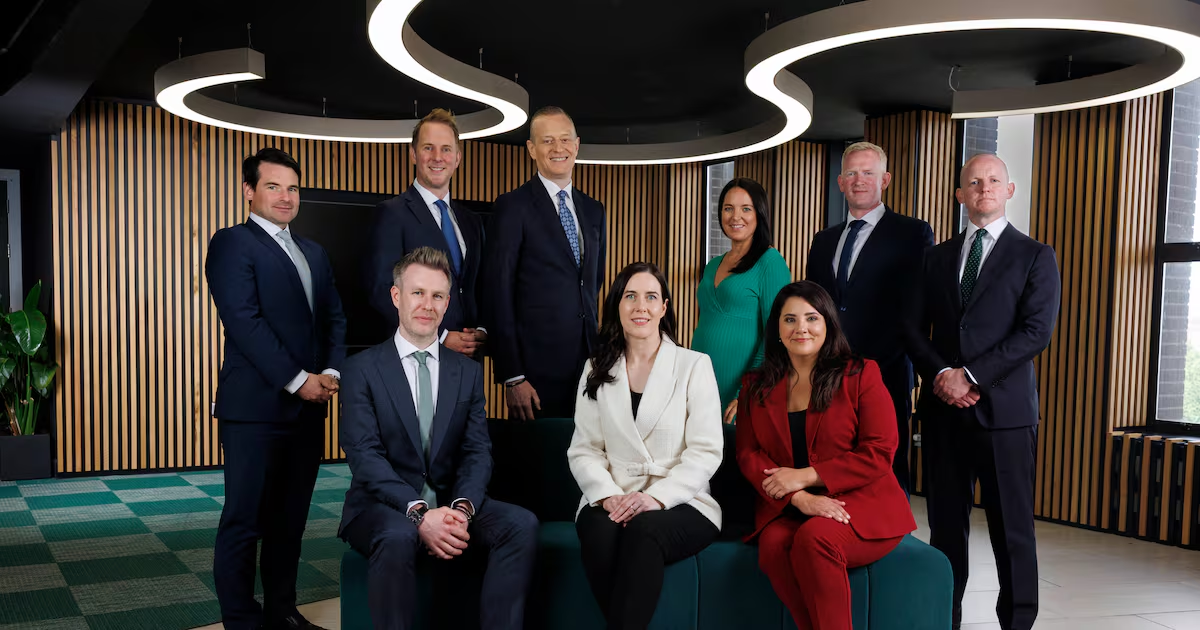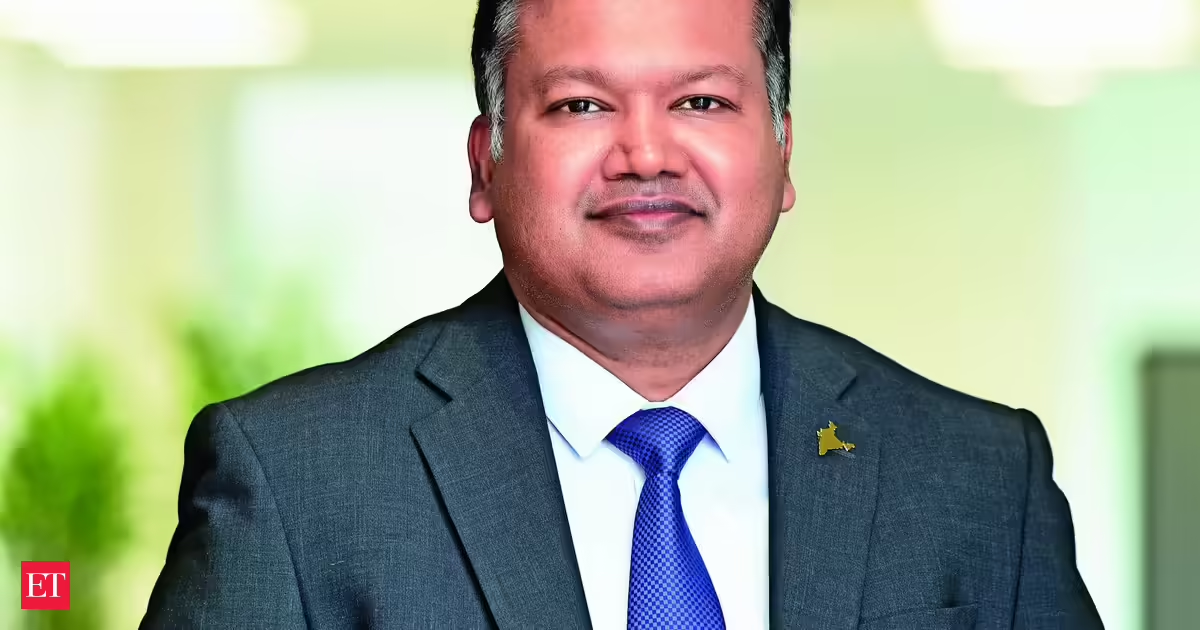
Deloitte India is positioning itself to become the country’s largest professional services firm by 2028 after pivoting over the past decade from an audit-led partnership to a technology- and consulting-driven business that aims to double its workforce to 100,000 and grow revenue to $5 billion within four years, said Romal Shetty, CEO, Deloitte (South Asia) in an exclusive interview with ET.“We are moving rapidly towards becoming the undisputed leader in India’s professional services space,” said Shetty. “We are building the business of tomorrow now.”When Shetty took over about three years ago, Deloitte India ranked 14th within the global Deloitte network; today, it is the sixth-largest member firm worldwide.In a freewheeling chat with ET’s Vinod Mahanta, Shetty discusses his plan to achieve leadership in India’s professional services market, the firm’s transformation from an audit-heavy business to a consulting- and technology-led organisation, the ambitious 5511 growth strategy, the sweeping AI play, and the The Phoenix Encounter exercise that has forced Deloitte to think disruptively. Edited excerpts:Also read | Audit firms count the cost as India looks to tighten rulesWhere is Deloitte today in terms of revenue and people and how should we think about the trajectory from here?We are now at roughly $1.7 billion in revenue at May end (Deloitte closing). We are growing at about 21% and expect to sustain 19-20% growth. When I took over 3 years ago, we were ranked 14th in the Deloitte global network and today, we are number six. In consulting, we are currently ranked third behind only the United States and the United Kingdom.We crossed 50,000 people in March this year, all of them permanent. Of that total, about 29,000 people are in technology consulting and roughly 21,000 are spread across the rest of the firm. The pace of growth has been remarkable. In 2021, we had around 13,000 people. By 2023, that number had risen to 23,000, and in just three years we have more than doubled again to over 50,000 people.Sustaining a 20% growth rate would mean that in the coming 12 to 15 months you will become the largest professional services firm in India?We are moving rapidly towards becoming the undisputed leader in India’s professional services space. It reflects our confidence in the India growth story and in our belief that the future of professional services will go beyond traditional services and move towards solutions, platforms, and innovation-led businesses. We are building the business of tomorrow now.Also read | Trilegal names Ex-Visa India Head Sandeep Ghosh as first CEOFrom being an audit-heavy business to becoming more consulting-led, what is driving this transition? And how has the shift played out so far?When I look at our journey, I see a business that started with a very strong audit heritage and has gradually evolved into something much broader. Deloitte firms in India were for many years, known primarily for audit. Before audit rotation rules came into effect, we audited a significant number of companies in top 50 which materially contributed to India’s total market capitalisation. That gave us a deep understanding of Indian businesses and, more importantly, a reservoir of trust.What changed was India itself. Over the past decade, the economy has become far more dynamic. Global investment accelerated, Global Capability Centers expanded rapidly, private equity became much more active, and multinational companies significantly increased their presence. As a result, clients began asking for a wider variety of services including helping on global transformation. In the past, consulting often meant presenting a strategy in a PowerPoint deck. Today, clients want someone who can help them turn an idea into a working business model.A good example is a tyre company. A traditional strategy firm might suggest a “tyre per kilometre” model. We helped make it real. By embedding IoT sensors in tyres and analysing terrain, driver behaviour and wear patterns, we enabled fleet operators to pay based on actual usage rather than making a large upfront purchase. That effectively converts a capital expense into an operating expense, which can materially improve the economics for customers.Another example is our work with a large global automaker. We digitally simulated an entire manufacturing plant before it was built and demonstrated that, under certain assumptions, a vehicle could not roll off the assembly line every two minutes and 32 seconds – as was originally intended, without changing certain plant specifications. Discovering that before construction begins can save millions of dollars. The automaker was so impressed that this capability, developed in India, is now being used for greenfield plants around the world.Increasingly, our clients are asking a broader question: how do we unlock enterprise value? Two cement companies may look similar on paper, yet one may be worth $6 billion and another $2 billion because of differences in governance, distribution efficiency, forecasting and professionalisation. Our role is to bring together strategy, technology, governance, deals and assurance to help close that gap.Artificial intelligence is adding a new dimension. Gen AI Tools create tremendous opportunities, but they also raise important questions around governance, explainability and intellectual property protection. I was struck by a conversation with the CEO of a major manufacturer who discovered that proprietary designs were finding their way into generative AI systems through vendors responding to requests for proposals. That illustrates both the promise and the risks of this technology.So, the shift for us has been quite profound. We are no longer simply advising clients on what they should do. We are helping them build, implement, operate and govern the businesses of the future.If I look at the revenue mix, Deloitte India appears to have become increasingly consulting-led, even though it remains a multi-service organisation. How are you balancing the various service lines? We were very clear from the beginning that our traditional businesses would remain strategically important, but it would not be our primary growth engine. In these businesses, our objective is quality rather than scale. We want to serve marquee companies in every sector, but we would rather do fewer engagements and deliver exceptionally high-quality work than chase volume.I believe there are certain areas where cost should never be the deciding factor. Audit and cybersecurity are two of them. If organisations treat either as a commodity and award mandates purely on price, the risks can be significant.Tax, by contrast, has become one of our strongest growth engines. We have doubled the size of the practice in the past three years, while building one of the strongest M&A tax teams in the country. Technology is also reshaping the business; in transfer pricing, nearly half of our work is now largely touchless.Our deals practice has undergone a similar transformation. Corporate finance revenues have more than tripled and Private equity has also been a major catalyst. Today, what differentiates us is our ability to integrate strategy, M&A tax, transaction advisory, value creation and post-merger integration into a single offering. We are no longer just helping clients close deals; we are helping them identify opportunities and create value long after the transaction is complete.Let’s turn to technology consulting. What share of Deloitte India’s total revenue does that business account for?Technology consulting is the single largest component of our business today and, in many ways, the engine of our growth. Out of our total topline, about ?9,300 crore comes from technology consulting alone, which means close to two-thirds of the firm’s revenue is now generated by this business. On a like-for-like basis, we believe we are the largest technology consulting businesses in the professional services sector in India. Some report larger consulting numbers, but those often include adjacent practices such as risk advisory and other services. What makes this especially satisfying is how far we have come. When I first led the consulting practice, it generated only about Rs 250 crore in revenue. In just nine years, we have built that into a Rs 9,000 crore-plus business growing at nearly 28% to 29% annually.Equally important, the business is highly profitable and entirely self-sustaining, funding its own growth and fully supporting partner economics.While some firms are laying off staff overseas, others are hiring more cautiously in India. So, what is the thinking behind your plan to add another 50,000 people, and by when do you expect to achieve that? The thinking begins with a simple question: can we reinvent the traditional professional services model? Historically, our industry has operated through a pyramid structure, where one client is served by a large team of professionals. That model works well for large corporations, but it does not scale to India’s vast MSME sector, which includes roughly 75 million businesses and has been largely beyond the reach of firms like Deloitte and it will not serve our needs as technology leads to our business evolving.So we asked whether we could invert the pyramid. Instead of ten people serving one client, could one professional serve ten clients? For that to happen, about 80% of the work must be machine-led and 20% human-led, with professionals validating the output. Take a tax opinion. A large multinational may pay lakhs of rupees, but a small business may be able to afford only Rs 10,000. If Artificial Intelligence performs most of the analysis and a qualified expert reviews the conclusion, the economics change dramatically.That same model can be applied to GST compliance, inventory optimisation, working capital management and other services through our soon to be launched Bharat platform, E-Vardhan. We can also partner with ecosystem players such as the major cloud computing and service providers, banks to reach millions of businesses.That is why we plan to add another 50,000 people over the next three to four years, taking our workforce to around 100,000 professionals. This is not just about scaling the existing firm; it is about building an entirely new model for India.How does Project Bharat fit into your overall growth strategy?Project Bharat is central to our plan to add another 50,000 people because it is designed to open entirely new markets that traditional professional services firms have largely ignored.The first pillar focuses on 100 to 150 founder-led businesses in Tier II and Tier III cities, typically with revenues of $100 million to $200 million. Our objective is to help these entrepreneurs scale to $1 billion and eventually to $3 billion or $4 billion, while serving as their trusted adviser on M&A, succession planning, governance, IPO preparation, fundraising, private equity and private credit.The second pillar is aimed at India’s vast MSME sector. We are building a digital marketplace, similar to the App Store, where small businesses can access services such as GST compliance, reconciliations, tax opinions, inventory optimisation and working capital management through subscription, pay-per-use or transaction-based models. We aim to serve at least one million MSMEs, including through industry associations, Clusters.The third pillar focuses on startups and emerging ventures across smaller towns and cities. We are helping founders scale and, in selected cases, will consider investing in businesses that could become strategic partners, acquisition candidates or independent ventures attractive to private equity and venture capital.A common thread across all three pillars is ecosystem collaboration. We are partnering with Amazon Web Services, Google Cloud, SAP, Oracle Corporation, NVIDIA and several others to build scalable solutions.The same ecosystem approach underpins our GCC offering, where we can work with real estate developers, law firms, executive search firms and alliances to launch operations on a plug-and-play basis. We are also expanding Build, Operate, Transform and Transfer (BOTT) and Build, Operate, Transform, Transfer and Acquire (BOTE) models, where we build and run capabilities for clients under their own brand, with the option to transfer or sell them back later. These are the kinds of new models that are central to our ambition of building a 100,000-person firm.What is the new 5511 firm strategy that was unrolled recently?The 5511 framework is our way of expressing a very ambitious but simple idea. The first “5” represents our goal of building Deloitte India into a $5 billion business from its current scale of about $1.7 billion. The second “5” reflects our aspiration to ensure that we are consistently among the top five firms in Deloitte global network. Scale and influence go hand in hand.The two “1s” are equally important. One is to become the employer of choice for talent; the other is to be the adviser of choice for clients.It is an audacious target. To the best of my knowledge, no professional services firm in a 250-year history has grown from $1.7 billion to $5 billion in four years. I do not pretend to know every step of the journey, but I believe leadership is about setting goals that stretch the organisation beyond what appears immediately possible.The cultural foundation of 5511 is what we call KPI: Kind-Hearted, High-Performance and Innovative. We want to prove that a firm can be deeply caring and relentlessly demanding at the same time.Quality is central to this philosophy. I often draw inspiration from Akio Morita, whose ambition was to redefine global perceptions of Japanese quality, and Lee Kuan Yew, who believed excellence must extend to every detail.That is why we have invested more than 500 people in building future capabilities, including a 300-member disruption team led by Dr. Jagdish Bhandarkar and another 200 professionals in tax technology. In a partnership, the easiest choice is to maximise current profits. Our choice is to invest in the firm of the future.Could you take me through your thinking behind the solutions-centric approach —eg GenW.AI, a homegrown, low-code enterprise AI platform—and the creation of these new-age cutting edge experience centres like Deloitte Centre for Innovation and Technology (DCIT), ConnectSafe, the cybersecurity innovation hub and Quantum Centre of Disruption for Enterprise (QC0DE) at IIT-Bombay?Clients today are no longer satisfied with seeing ideas on a PowerPoint presentation. They want to experience what is possible. More importantly, they want their own imagination to be sparked. That is the thinking behind initiatives such as GenW.AI, our homegrown low-code enterprise AI platform, and innovation centres such as the Deloitte Centre for Innovation and Technology (CIT), ConnectSafe, our cybersecurity lab, and the Quantum Centre of Disruption for Enterprise at IIT Bombay.These centres are not simply showcases of technology. They are designed to help clients visualise the art of the possible. We recently worked with a large multinational bank and invited its teams to a hackathon using GenW.AI. We provided the platform, but they built the solutions themselves. That is the real objective: when clients see what can be done, they begin asking, “Can we apply this in our own business?”The returns from these investments are rarely immediate. A visit to one of our labs does not automatically translate into a contract. But over time, they fundamentally change how clients perceive both Deloitte and their own opportunities.This philosophy is deeply embedded in how we run the firm. I have appointed both a Chief Disruption Officer and a Chief Happiness Officer. The first is responsible for constantly challenging our business model; the second ensures we build a culture where people can thrive.I am optimistic, but I am also acutely aware of the responsibility I carry toward 50,000 employees and their families. My objective is not to use technology to reduce jobs, but to ensure that we continue to evolve and create new opportunities.At the ET Awards, I noted that while Indians are among the world’s most enthusiastic adopters of artificial intelligence, Indian corporations still have significant ground to cover. The companies that succeed will be those willing to disrupt themselves before someone else does. That is the philosophy behind our solutions-centric approach.AI is clearly going to be the major battleground over the next three to four years, both in how firms deliver solutions to clients and in how they run their own operations. How is Deloitte approaching this?Let me give you examples from both inside the firm and from our client work. Internally, we continue to hire about 1,000 people every month, even as we pursue our plan to grow to 100,000 employees. To do that, we process roughly 40,000 job applications every month. Traditionally, that would have required a very large recruitment team. Today, much of our recruitment process for specific high demand skills is powered by generative AI. The system performs CV scoring and parsing, conducts technical assessments and preliminary interviews, and then routes shortlisted candidates to one final interview with a human being. We also use authentication tools to ensure that the same person who applies is the one who actually appears for the interview.Learning and induction have also been transformed. Earlier, new employees had to travel to Bengaluru, Mumbai or Delhi for training. Today, much of the onboarding experience is delivered through immersive digital platforms, including the metaverse, allowing employees to participate from anywhere.As a result, while our workforce has grown from 13,000 people in 2021 to 23,000 in 2023 and more than 50,000 today, our recruitment infrastructure has expanded by only about 10%. I also believe innovation cannot be confined to a few brilliant individuals. Through GenW.AI, teams across Deloitte build tools that solve real business problems. In our A&A business, for example, one internally developed solution is expected to save about 60,000 hours in bank and debtor confirmations, allowing us to redeploy that time to strengthen quality.In client work, we take a pragmatic approach. Rather than relying on a single model, we combine commercial models, open-source LLMs and smaller language models depending on what best serves the client. I increasingly see our role as an orchestrator, bringing together the right technologies to help clients innovate safely and at scale.There has been some talk in the market that Deloitte is winning technology mandates by pricing aggressively. How do you respond to that? My response is quite straightforward. Our consulting business is fully self-sustaining and profitable. It does not depend on subsidies from any other part of the firm. In fact, it generates capital for the partnership. Every year, we reinvest about 9% of our revenue into building new capabilities for the future.What has really changed is our delivery efficiency. Work that previously required 100 hours can now often be completed in 70 hours or less through automation. Over the next two to three years, our goal is to eliminate roughly 30% of manual effort across every service line by shifting that work to machines. At the same time, I expect 40% to 45% of our revenue to come from what I call the “business of tomorrow.” Today, products, platforms and technology-enabled autonomous models account for only about 5% of our revenue. A good example is AI assurance, where we help boards and audit committees determine whether their AI systems are properly governed and functioning as intended. In many of these offerings, 70% to 80% of the work is product-driven rather than purely people-based.This requires us to change our organisational DNA. We are a services firm at our core, but building products and platforms demands different capabilities and different talent. That is why we are hiring software and product professionals, including people from large global technology companies, Start-ups, and rethinking how we price these assets.I want to be very clear: we do not aspire to become a pure product company. Our real strength lies in combining products with services. That hybrid model is what will define the next phase of our growth and ensure that we remain highly competitive in the AI era.As your business model evolves, the competitive landscape is also changing. In many mandates, you are no longer competing only with the Big Four. You are increasingly up against consulting firms, technology companies, and even clients such as Indian software companies. How is that changing the way you think about competition?That is absolutely true. When I think about the future, I am convinced that our competitors will look very different from the traditional Big Four landscape.In many large mandates, we are no longer competing only with other professional services firms. Sometimes we find ourselves up against companies such as large telecom players or cloud service providers.At the same time, I believe the future will be defined by both competition and collaboration. Increasingly, organisations will need to compete and collaborate simultaneously.That is why I place so much emphasis on ecosystems. I often think of it as an orchestra. Four or five organisations working together can solve a client problem far more effectively than any one firm acting alone.Banks are a good example. In the past, the relationship was transactional: we provided services to the bank, and the bank provided banking services to us. Today, I ask a different question: how do we go to market together and combine our strengths to serve shared clients? So, while the competitive landscape is becoming broader and more dynamic, I see that as a very positive development. It is pushing all of us to think more creatively about how we create value.The government and regulators often still appear to view the Big Four primarily through the lens of audit and accounting, even though your business has evolved far beyond that. Some recent provisions under the Corporate Laws (Amendment) Bill, 2026 and a few other regulations seem aimed at limiting the Big Four. How do you view that?The market has evolved significantly beyond traditional perceptions of professional services firms. Many people still view the Big Four primarily through the lens of audit, even though our businesses have evolved far beyond that.Even within audit, the perception that the Big Four dominate the market is not entirely accurate. If you look only at public sector undertakings and public sector banks, of the total audit fee pool the Big Four audit a very small portion.At the same time, India need more large firms. Modern audit increasingly depends on advanced technology, analytics and specialised tools, so scale matters. I would be very supportive of initiatives that help Indian firms consolidate, adopt technology and strengthen their capabilities.Ultimately, the more important question is what best serves India’s economic interests. When a multinational is considering a $2 billion investment, it often wants globally recognised advisers with established cross-border capabilities. Firms like the Big Four help facilitate foreign direct investment and, collectively, employ more than 500,000 people directly in India.In my view, this need not be an either-or choice. India can nurture strong domestic firms while continuing to benefit from global networks. The focus should be on capability and quality, rather than excluding firms by definition.Could you take me through the INSEAD exercise that Deloitte leadership undertook? What exactly was that process?The exercise was built around The Phoenix Encounter Method: Lead Like Your Business Is on Fire, a book about how organisations respond to disruption. Instead of sending 50 leaders to INSEAD in France, we brought the three professors who wrote the book to Bengaluru. That reflected our approach: invest boldly in the future, but do so in a disciplined and efficient way.At an offsite, we asked our leaders to imagine they were building a new professional services firm from scratch, with no legacy systems, silos or cultural constraints. Then we reversed the lens and asked: if you were a formidable competitor, how would you destroy Deloitte? That forced us to confront both our opportunities and vulnerabilities, including reputational risks amplified by social media.The exercise led to seven major workstreams and shaped many of our current initiatives. Our integrated value-unlock proposition emerged from it, bringing together tax, M&A, assurance, governance, technology and consulting. Project Bharat was another outcome, built on the insight that AI and digital platforms could help us serve at least one million of India’s 75 million MSMEs. The broader lesson was transformative: redesign the firm so that 80% of the work is machine-led and 20% human-led.
Deloitte India could lead professional services space soon: Romal Shetty
Deloitte Indias leadership believes that the future of professional services will extend beyond traditional offerings to solutions, platforms and innovation-led businesses — and that it is building the business of tomorrow today.
3,925 words~18 min read