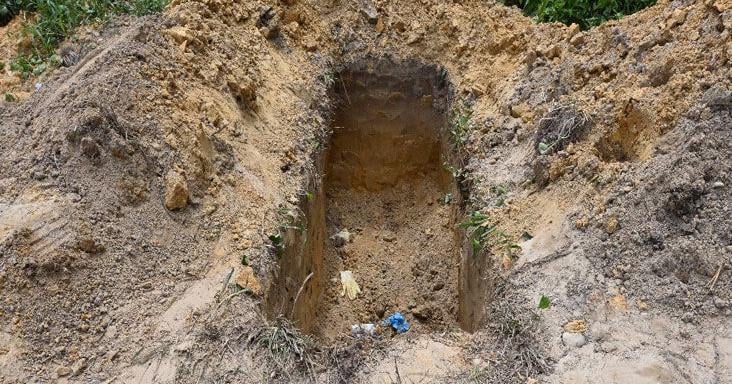
Cutbacks within State agencies and poor oversight of funeral disposal contracts created the conditions that led to the scheduled mass burial of 56 bodies at the Cumuto Cemetery last month.The bodies included 50 infants and six adults.This was stated by Simpson’s Memorial Ltd managing director David Simpson during a telephone interview on Friday, May 8.Simpson, who also serves as an executive member of the Association of Funeral Professionals of Trinidad and Tobago (AFPTT), said cost-cutting measures within hospitals and other State institutions, such as the Forensic Science Centre, have reduced the handling of deceased persons to “the smallest part of the budget”.Also speaking briefly on May 8 via telephone to the Sunday Express about the pauper’s funeral, Keith Belgrove, president of the AFPTT and CEO of Belgroves Funeral Home, confirmed hospitals have been selecting the lowest tenders, “and as such the fees may not be allowing the provider to provide a service of dignity”.Belgrove pointed out that hospitals and regional health authorities (RHAs) also had an obligation to conduct due diligence to ensure the establishments they selected had the facilities, equipment, expertise, manpower and knowledge required under the Burial Grounds Act.According to him, the law requires “one adult to one coffin to one grave. Two persons can be put in the grave. Each one goes at a particular depth. And the infants would be allowed to be more than one infant to be placed in a coffin”.He added that while a mass grave can be dug, each coffin must still be prepared and handled in a proper and dignified manner.Following the discovery of the mass burial, the Trinidad and Tobago Police Service (TTPS) immediately launched an investigation.Last week, Snr Supt of the TTPS Northern Division Sherma Maynard-Wilson told the Sunday Express the probe into the discovery of the 56 bodies was ongoing and that police were working to bring the investigation to a close.Asked whether he expected charges to be laid, Belgrove said from the AFPTT’s observation of the matter, a crime was not committed under the Cemetery Act because the burial was not completed.According to police reports, on April 18, the 56 bodies were about to be disposed of in a mass grave by two men contracted by a funeral home in Arima.Strict protocolsSpeaking with the Sunday Express, Simpson said the process for disposing of unclaimed bodies was supposed to involve strict protocols, including public notices, documentation, and individual burials for all deceased persons.He explained that after bodies remain unclaimed at hospitals for several months, RHAs usually publish notices in newspapers asking whether anyone knows the deceased.“Once you lie there for in excess of three months, and these gazettes come out, after a while, nobody responded. The hospital has the right to dispose,” he said.Financial pressuresHowever, Simpson said financial pressures and competitive low-cost bidding for disposal contracts have resulted in funeral providers cutting corners.“When you cut the budget (at the hospital), the funeral service provider cut the budget, too,” he said, explaining it was one way for RHAs to save money.According to Simpson, each body should have been placed in an individual coffin, registered separately, and buried according to established procedures.Instead, he said, “somebody in the funeral home decided to take all the bodies, bring them to the cemetery, pay two guys to open a grave and put all the bodies in there”.However, Simpson acknowledged that the hospitals’ tendering process for low-cost funeral home operators had long been the norm and did not begin under the present administration.“When they ready for the disposal, they will call who they are accustomed to, or who they believe will treat them fairly and the cheapest one they usually go with,” Simpson said, adding, “So Port of Spain mortuary have their own process, Mt Hope hospital mortuary has their own situation,” suggesting that a uniform protocol could help solve the problem.He lamented that the process among the different RHAs and other State institutions was frustrating, “as competitors never got a return call saying if they had been chosen or not. They just go with whoever they feel will do what they have to do for the money”.Simpson explained that the situation on April 18 became more complicated when the cemetery keeper, unaware of what was happening at the cemetery, contacted the police. He said if the proper procedure had been followed and the cemetery keeper had been informed, the situation might never have become public.He noted that $300 was supposed to be paid to the regional corporation, after which the service provider was required to report to the cemetery keeper.“The corporation will give you an invoice. You go to the bank. You pay the bank and you bring back the receipt. The receipt is shown to the cemetery keeper and the cemetery keeper now shows you a spot where you’re going to dig,” Simpson said.
Cutbacks blamed for Cumuto burial scandal
Cutbacks within State agencies and poor oversight of funeral disposal contracts created the conditions that led to the scheduled mass burial of 56 bodies at the Cumuto Cemetery last month.The
802 words~4 min read