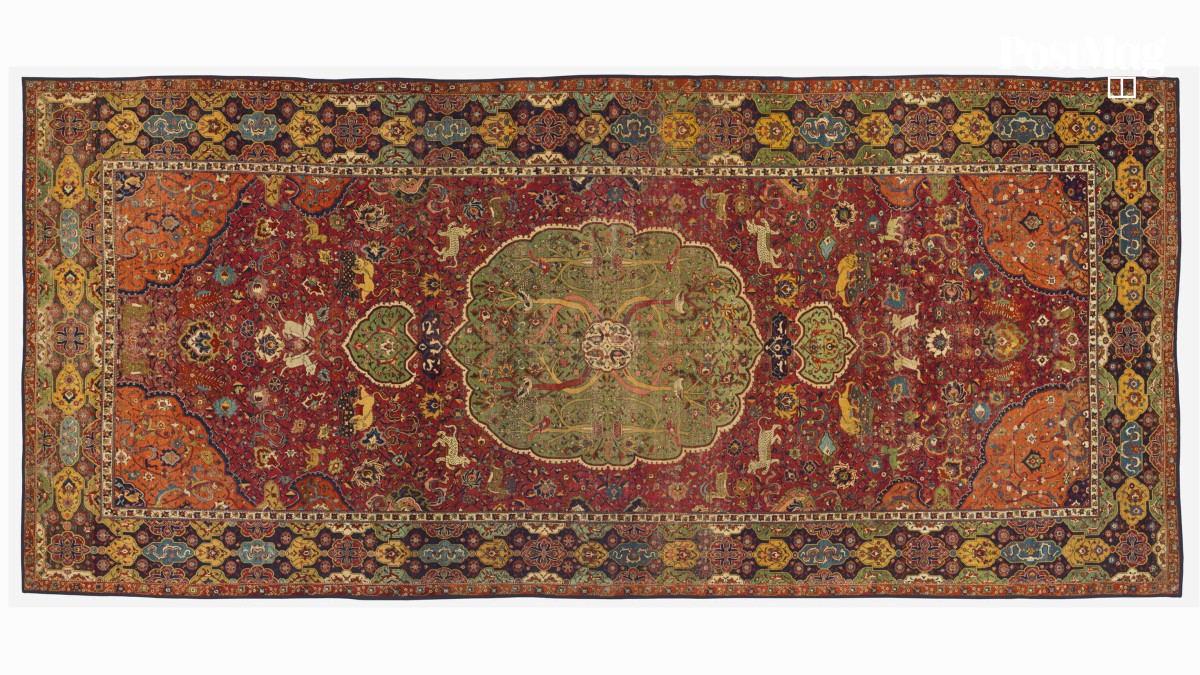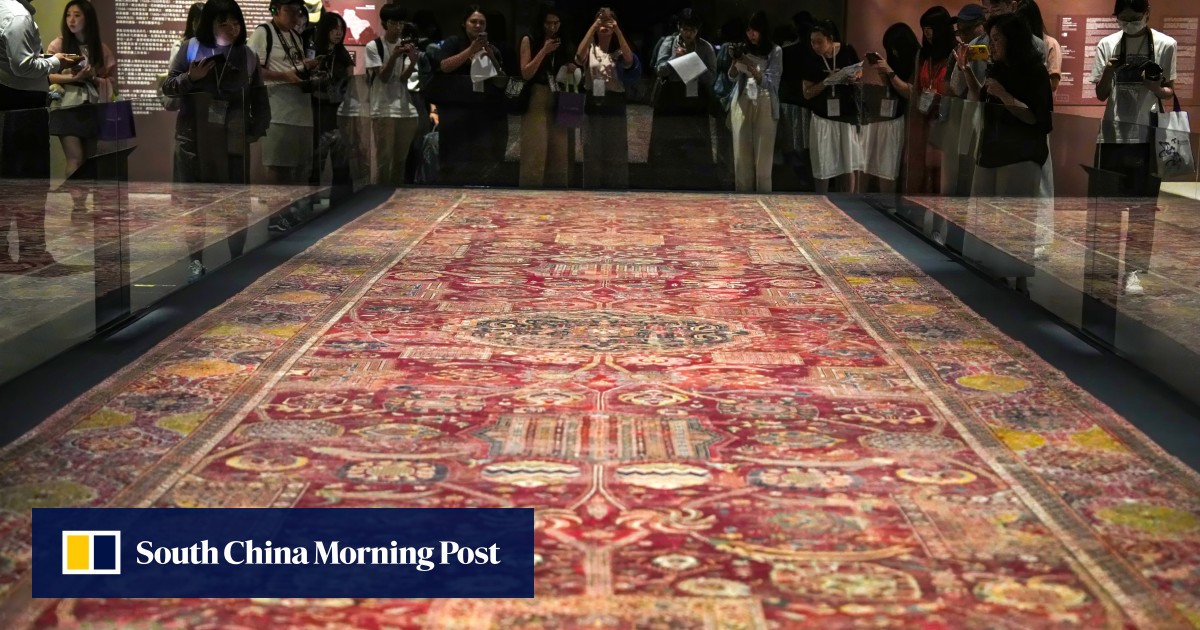
Girdlers’ carpet, manufactured in the 17th century by artisans of the Mughal Empire, is no ordinary piece of furnishing. It was commissioned by Robert Bell, an influential merchant and one of the founding directors of the English East India Company, as a gift for the Worshipful Company of Girdlers during his final tenure as its Master in 1634. Active since the medieval period, the Company of Girdlers specialised in the manufacture of girdles, belts, and associated metal works and received its patent from Edward III in 1327. The thread of Girdler’s carpet bears the imprint of a chequered past: arduously procured from Lahore, it travelled many miles from Surat to reach London in 1634, where it served as a table covering in the courtroom hall of the Company of Girdlers.
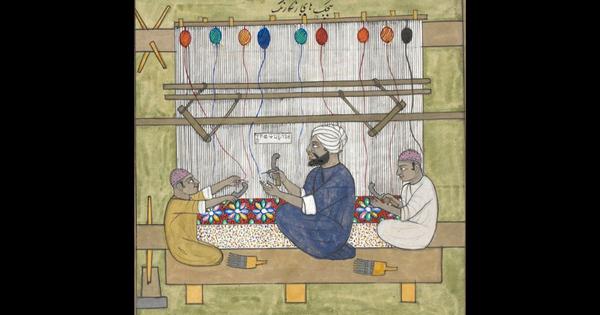
The Girdlers’ carpet. Credit: The Girdlers’ Company.Even though the hall was consumed by the Great Fire of 1666, the carpet was saved by the presence of mind of its caretaker. It would later endure the Blitz of 1940-’41, the sustained campaign of aerial bombing of London and other British cities during the Second World War.Between these two brushes with destruction, the carpet was given a new lease of life in 1899.On the advice of the director of the Victoria and Albert Museum, the Mayor of London, Alfred J Newton – a prominent businessman known for his role in the public listing of the luxury retailer Harrods and Master of the Worshipful Company of Girdlers from 1898 to 1900 – together with the Father and Wardens of the Company, set in motion a careful programme to have it restored.The process involved cleaning, repair and framing: ink stains were removed, tears were mended by the Decorative Needlework Society, and the carpet was returned to the Hall in 1900, set within a large oak frame bearing the inscription, “The Gift of Robert Bell, Master, A.D. 1634, in remembrance of his love”.The carpet is on permanent display at the current premises of the Worshipful Company of Girdlers in East London.On May 16, 1900, a luncheon banquet was held at Girdlers’ Hall in London to celebrate the restored splendour of this remarkable carpet. Attended by the Secretary of State and members of the Council of India, the occasion was presided over by Newton, and toasts were raised to the reigning monarch, Victoria, to Robert Bell, and to the Worshipful Company of Girdlers.The speech accompanying the toast was delivered by George Birdwood, an idiosyncratic advocate of Indian handicrafts over industrial machinery. Born in 1832 in Belgaum, Bombay Presidency, into a family long associated with the East India Company, Birdwood later returned to England as an expert on Indian languages and material culture.At the banquet for the Girdlers’ carpet, he reflected on practices of commemorating the dead across cultures, recalling the “eastern” sweets served at the Parsi festival of Muktad or Farvardin, which he had attended in Bombay, before inviting the audience to raise their glasses to the memory of Robert Bell in accordance with an old ritual:“Ter bibe, vel totiens ternos, sic mystica lex est; vel tria potanti, vel ter tria multiplicanti.”(Drink three times, or three times three; such is the mystic law: either three cups, or thrice three).This couplet is drawn from the fourth-century playful arithmetic poem Griphus ternarii numeri (“Riddle of the Number Three”) by Decimus Magnus Ausonius. Written within the classical Greek and Roman tradition of symposium drinking games, the poem celebrates the symbolic power of the number three through a series of mythological, natural, and philosophical triads.Credit: In public domain, New York Public Library.During his speech, Birdwood described rituals observed by artisan communities in cities such as Ahmedabad, Baroda, Surat and Bombay upon completing a work, where craftsmen publicly displayed the object and celebrated its beauty with fellow artisans by sharing sugared sesame seeds as tokens of goodwill and remembrance.Shortly before concluding, he reflected on the symbolism of carpets in West and South Asia, describing them as representations of the universe or of divine paradise, and observing that many of the names given to these rugs imported into Europe translated as “place of worship”.Here, Birdwood appears to conflate prayer rugs, which often depict a mihrab, a niche or alcove indicating the direction of prayer, similar to those found in mosques, with the carpets used to cover floors, windows, furniture, and even walls.