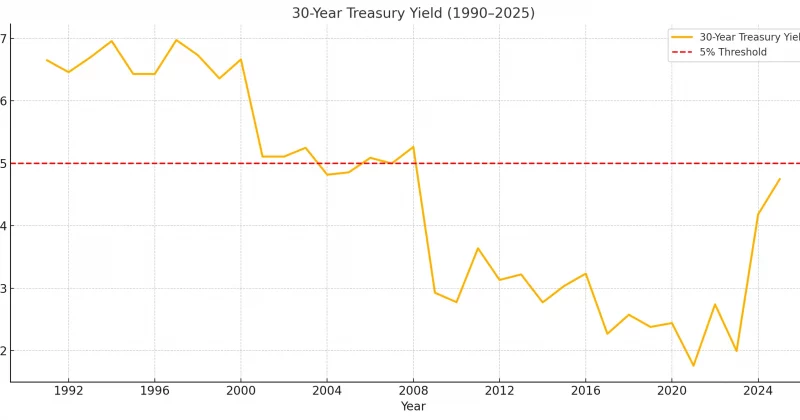
The U.S. Treasury sold $125 billion in new debt during the week of May 11, with buyers demanding the highest yields on 30-year bonds in nearly two decades.
The three auctions, covering 3-year notes, 10-year notes, and 30-year bonds, settled May 15 against a backdrop that few fixed-income investors would call comfortable. April CPI and PPI data both came in hotter than expected. Oil crossed $100 per barrel on Middle East tensions tied to Iran. And the federal government kept borrowing at a pace that gives bondholders little room to relax.
The results were unambiguous. Investors wanted more yield to show up.
On May 11, the Treasury sold $58 billion in 3-year notes at a high yield of 3.965%. The bid-to-cover ratio came in at 2.54, with indirect bidders, typically foreign institutions and central banks, absorbing roughly 63% of competitive awards. Market participants flagged the result as soft, requiring a pricing concession to clear.
The 10-year auction on May 12 drew sharper concern. The Treasury placed $42 billion at a high yield of 4.468%, with a bid-to-cover of 2.40. The auction tailed pre-auction levels by roughly 0.4 basis points or more, meaning buyers demanded a higher yield than traders had priced in beforehand. That outcome pushed the 10-year note yield into the 4.48 to 4.59% range in spot trading after results were published.