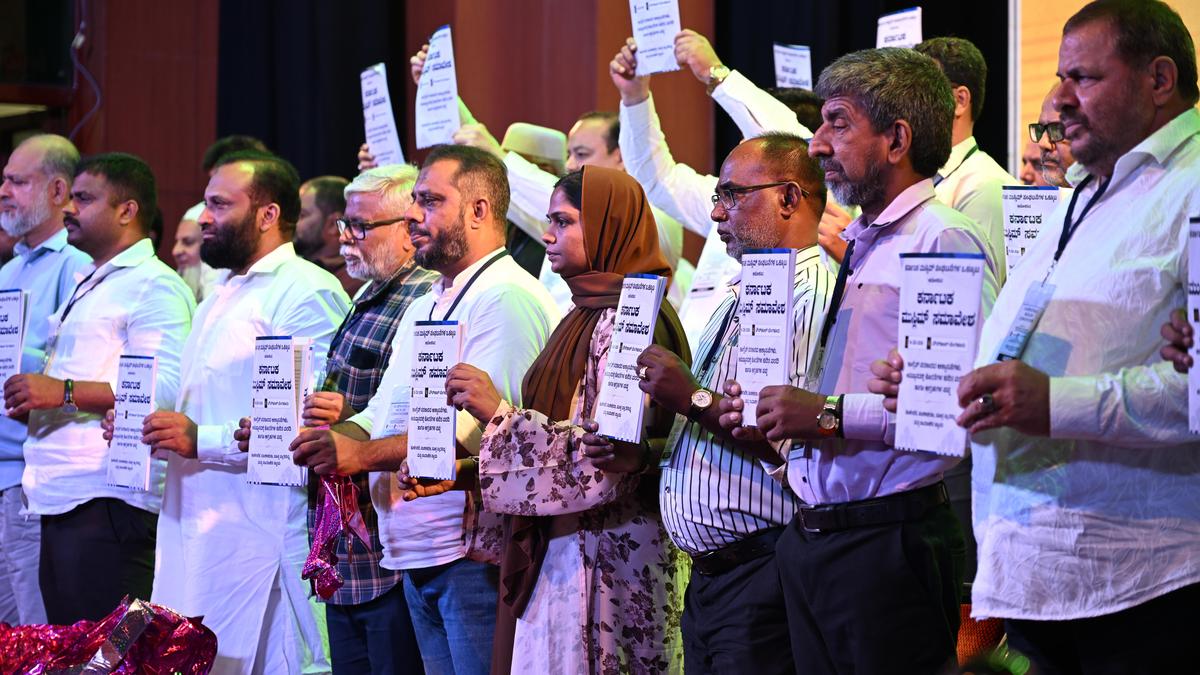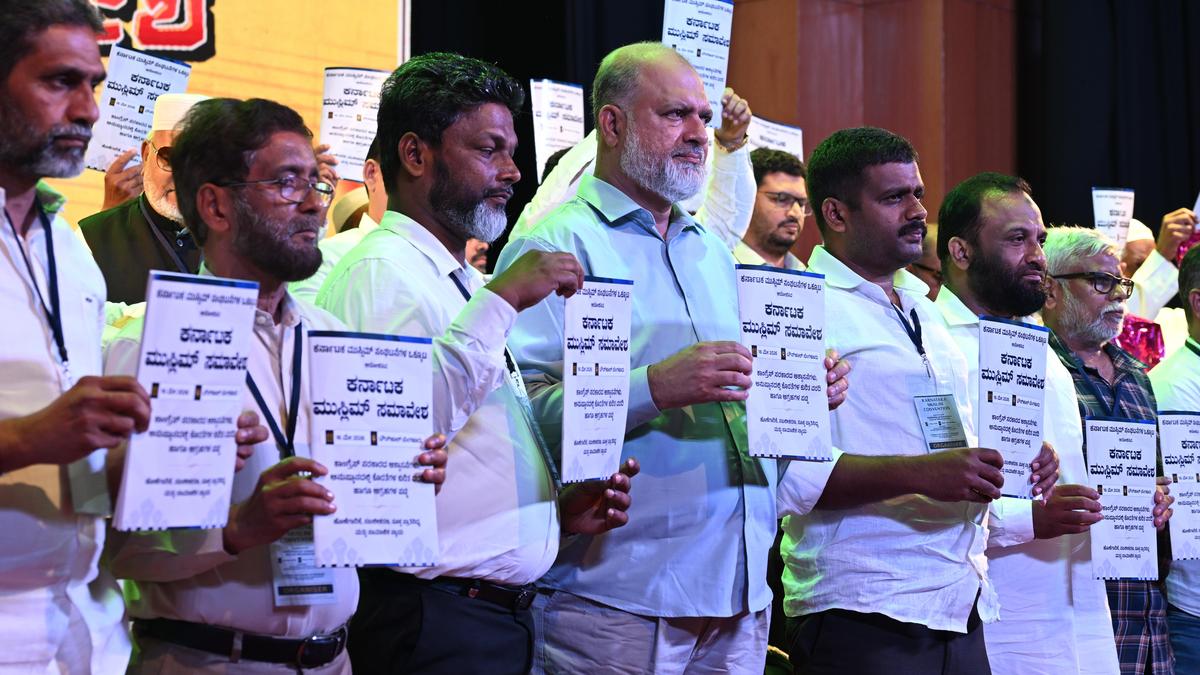
Members of the Federation of Karnataka Muslim Organisations releasing a report during the Karnataka Muslim Convention in Bengaluru on Saturday.
| Photo Credit: ALLEN EGENUSE J.
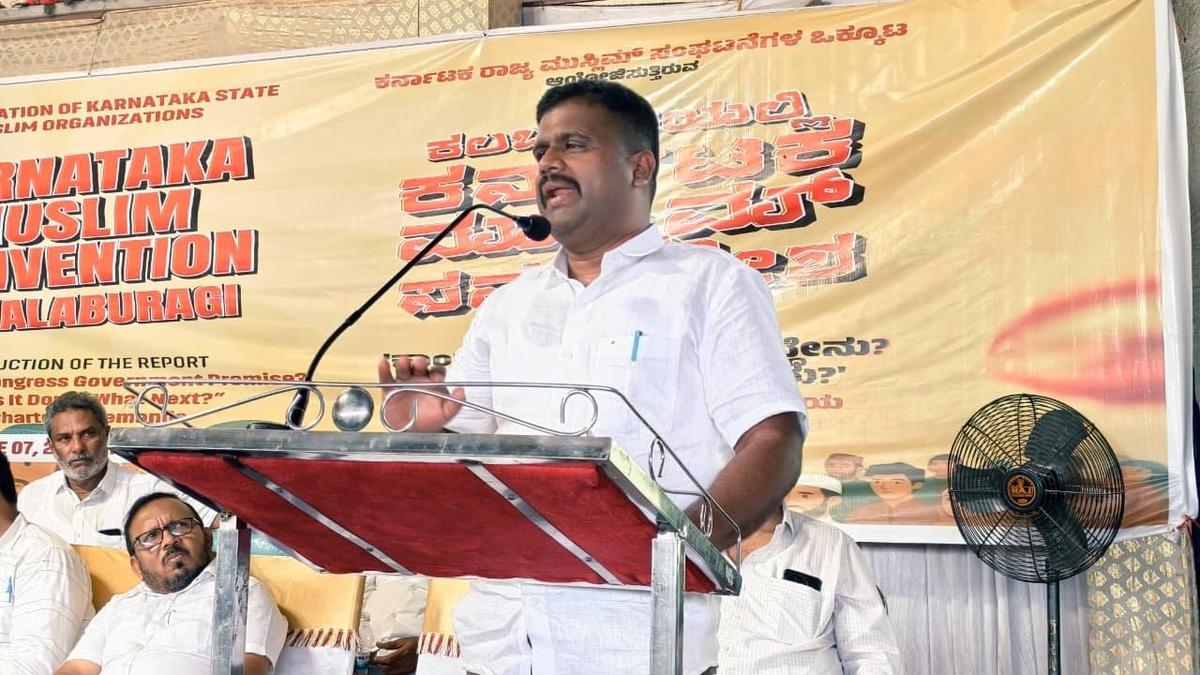
Strong action against communal hate speech, mob violence, vigilante attacks and rolling back cow slaughter law emerged as some of the central demands placed before the Karnataka government by the Federation of Karnataka Muslim Organisations, at a convention held in Bengaluru on Saturday.A 76-page report released at the convention reviewed the status of several promises and pending issues concerning the State’s Muslim community. The report examined the government’s assurances and actions on communal hate organisations, the 4% Category 2B reservation, repeal of the anti-conversion law, ₹10,000-crore minority welfare allocation, protection of Waqf properties, reservation and caste survey-related social justice measures, educational support schemes and concerns surrounding the Special Intensive Revision (SIR) of electoral rolls.Protect communal harmonyPointing out that hate speech and communal mobilisation had continued across Karnataka despite a change in government, the report called for stronger legal, administrative and political intervention to protect constitutional rights and communal harmony. The report documented multiple incidents of alleged hate speech and communal provocation between 2023 and 2026. It referred to calls for violence, threats against mosques and inflammatory communal remarks.Lynching caseThe report particularly highlighted the lynching of Mohammed Ashraf in Mangaluru last June, alleging delays in compensation, pending forensic reports and lack of fast-track trial proceedings despite Supreme Court guidelines on mob violence cases. The report said the incident reflected “systemic failure”.“Since May 2023, Karnataka has witnessed over 130 documented communal incidents in coastal districts alone, while State-wide records show 270 registered hate speech cases between 2022 and 2025 with 259 arrests, yet no structural action has followed,” the report stated.‘Asymmetric enforcement’Community leaders, who spoke at the convention, expressed concern over what they termed “asymmetric enforcement”, alleging that police action was often swift against minorities or ordinary citizens over social media posts, while influential repeat offenders accused of hate speech frequently secured relief or faced weak prosecution.The report claimed that festivals, yatras and religious processions were increasingly being used as platforms for communal speeches and mobilisation.Anti-lynching lawAmong the key demands placed before the government was the enactment of a Karnataka anti-lynching law along with a compensation framework for victims of mob violence. The convention also sought either repeal or amendment of provisions in the Karnataka Prevention of Slaughter and Preservation of Cattle Act that, according to the report, “enabled vigilantism and harassment in the name of cow protection”.The summit called for the creation of a notified Communal Hate, Hate Speech and Vigilantism Monitoring Authority under the Home Department with representation from police, the Law Department, civil society and legal experts.It also recommended a public district-wise dashboard tracking FIRs, chargesheets, bail orders and convictions in hate speech and communal violence cases to improve transparency and accountability.Another key demand was for the State government to ensure mandatory suo motu FIRs in hate speech cases in line with Supreme Court directions in the Shaheen Abdullah judgment, and effective implementation of the Tehseen Poonawalla guidelines on mob lynching.The convention urged the State to hold consultations with civil society organisations on tackling misinformation and hate campaigns, particularly on social media. It also opposed excessive reliance on surveillance technology, questioning the recent approval for a ₹67.26-crore social media analytics system without what it described as adequate legal safeguards or public consultation.The report additionally sought police sensitisation programmes on communal bias, mandatory courses in universities on identifying fake news and hate speech, and stricter conditions while granting permission for public rallies and religious processions.Constructive dialogueOrganisers said the report has been submitted in the spirit of constructive dialogue and the intention is not confrontational. Published - May 16, 2026 07:26 pm IST