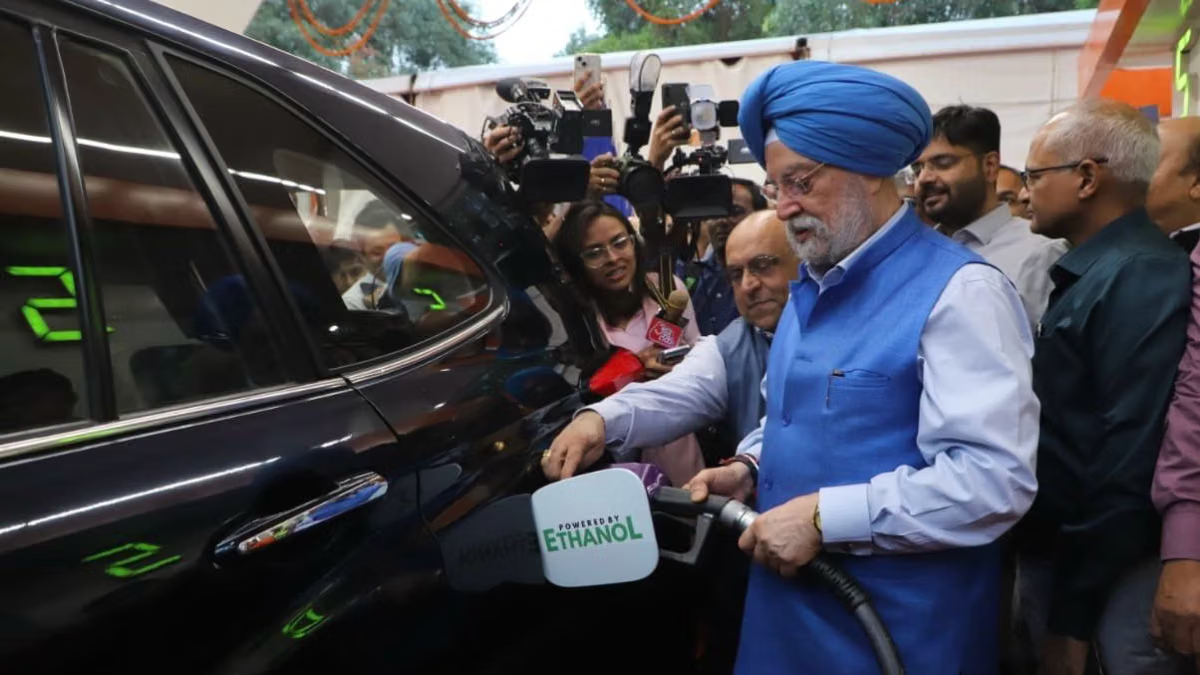
Historically, India has borne the economic burden of a substantial crude oil import bill, which reached an astonishing $137 billion in recent cycles. At present, the country is transitioning towards domestically produced biofuels, viewing this shift not only as an environmentally responsible initiative but also as a vital survival strategy. A central element of this energy transition is the Ethanol Blended Petrol (EBP) programme.The momentum of this shift is undeniable. As of February 2026, industry data reveal that during the Ethanol Supply Year (ESY) 2025 to 2026, India successfully blended over 353 crore litres of ethanol. This progress has maintained a national average of 20 per cent blending of petrol across the country. This milestone is the payoff of a decade spent aligning policy with infrastructure. However, as the industry scales, it has run head-first into a narrative that is as loud as it is scientifically hollow. The first is the claim that every single litre of ethanol consumes 10,000 litres of water.Unmasking the statistical sleight of handThe argument that ethanol production consumes “10,000 litres of water per litre of fuel” is rooted in a fundamental misunderstanding of how water footprints are calculated. That often-cited figure refers to virtual water — the cumulative rainwater and irrigation used during the agricultural cultivation of the crop over its entire lifecycle. It is an agricultural accounting metric, not a measure of industrial water consumption.The reality inside a modern Indian ethanol distillery is dramatically different. Today’s high-efficiency distilleries, operating under stringent environmental norms and zero-liquid-discharge frameworks, typically consume only about 3–4 litres of process water for producing one litre of ethanol. The contrast between these numbers is not a minor technicality; it represents the critical distinction between the biological water requirement of a crop and the actual industrial water used during ethanol conversion.Equally important is the nature of the feedstock being utilised. A significant share of India’s grain-based ethanol production relies on damaged food grains, broken rice, surplus maize, and other stocks that are unsuitable for human consumption. If these grains are not redirected towards ethanol production, they often remain underutilised or deteriorate in storage, effectively wasting the agricultural resources already invested in cultivating them.By converting such surplus or non-food-grade grains into clean fuel, the ethanol industry is not creating an additional water burden on the system. Rather, it is extracting economic and environmental value from agricultural output that has already consumed water at the farm level. In this sense, grain-based ethanol production represents a pragmatic waste-to-wealth approach that enhances resource efficiency, strengthens energy security, and supports circular economy principles.The double standard of virtual waterThe current debate around ethanol and water usage also reveals a striking double standard in how the concept of virtual water is selectively applied. India is among the world’s largest exporters of rice, and every kilogram of rice exported effectively carries with it an estimated virtual water footprint of nearly 4,000 litres. Yet this enormous outflow of embedded agricultural water seldom attracts the same level of public criticism or alarmist commentary directed at the ethanol sector.Similarly, for decades, food grains have been diverted towards industrial applications such as starch manufacturing, brewing, and other processing industries without significant debate over their cumulative water footprint. The underlying agricultural water consumption associated with these sectors was rarely framed as a national resource crisis.In contrast, ethanol production is increasingly being singled out and held solely responsible for a much broader and longstanding structural challenge related to agricultural water use, cropping patterns, and irrigation practices. These issues predate India’s biofuel programme by many decades and cannot be simplistically attributed to ethanol alone.For the public discourse to remain credible and constructive, it must be grounded in context, scientific accuracy, and a complete understanding of the data. Isolated or decontextualised figures may generate sensational narratives, but they do little to advance meaningful policy solutions. India’s ethanol programme is fundamentally aimed at enhancing energy security, reducing fossil fuel imports, supporting farmers, and accelerating the transition towards cleaner fuels. Any evaluation of the sector must therefore consider both its resource footprint and its wider national benefits in a balanced and evidence-based manner.The dividends of energy self-relianceThe EBP programme is not just a climate project because it functions as an economic powerhouse. The results recorded from 2014 to 2015 through February 2016 paint a picture of undeniable success.Expeditious payments exceeding ₹1,50,925 crore have flowed back to the farming community. This has turned traditional food providers into vital stakeholders in the energy value chain, often referred to as Urjadatas. Additionally, the initiative has saved India over ₹170,560 crore in foreign exchange, acting as a critical cushion against global oil market volatility.From an atmospheric standpoint, the programme has facilitated a net CO₂ reduction of approximately 869 lakh metric tonnes. It has also successfully substituted over 289 million metric tonnes of crude oil. These are tangible, recorded wins for the national economy and the environment alike.The arrival of the net-zero distilleryBeyond the blending statistics, the industry is undergoing a digital overhaul. The modern distillery is no longer just a utility but has evolved into a high-tech ecosystem. AI and IoT sensors are enabling facilities to precisely control water usage and steam flow. Extensive use of a Zero Liquid Discharge (ZLD) system for treating and recycling process water within the plant is reducing dependence on natural sources for fresh water.Even the byproducts such as Distillers Dried Grains with Solubles (DDGS) are high-protein animal feeds. It replaces fodder that would otherwise require its own significant water footprint to grow.A forward-looking perspectiveThe narrative that ethanol is a water villain is a misinterpretation of industrial mechanics. As India targets higher blending percentages and welcomes the era of flex-fuel vehicles, the conversation must evolve.The ethanol programme is a masterstroke of national resource optimisation. It cleans the air, shores up the agrarian economy, and shields the nation from foreign energy dependence. It is a system built on the bedrock of self-reliance. Its legacy should be defined by the tangible prosperity it brings to India’s soil, not by the myths that seek to obscure it.The author is Vice President, All India Distillers’ Association (AIDA)Published on May 16, 2026
The 10,000-litre myth: Understanding the true water footprint of ethanol in India
Explore the truth behind ethanol's water footprint in India, debunking myths and highlighting its economic and environmental benefits.
1,018 words~5 min read