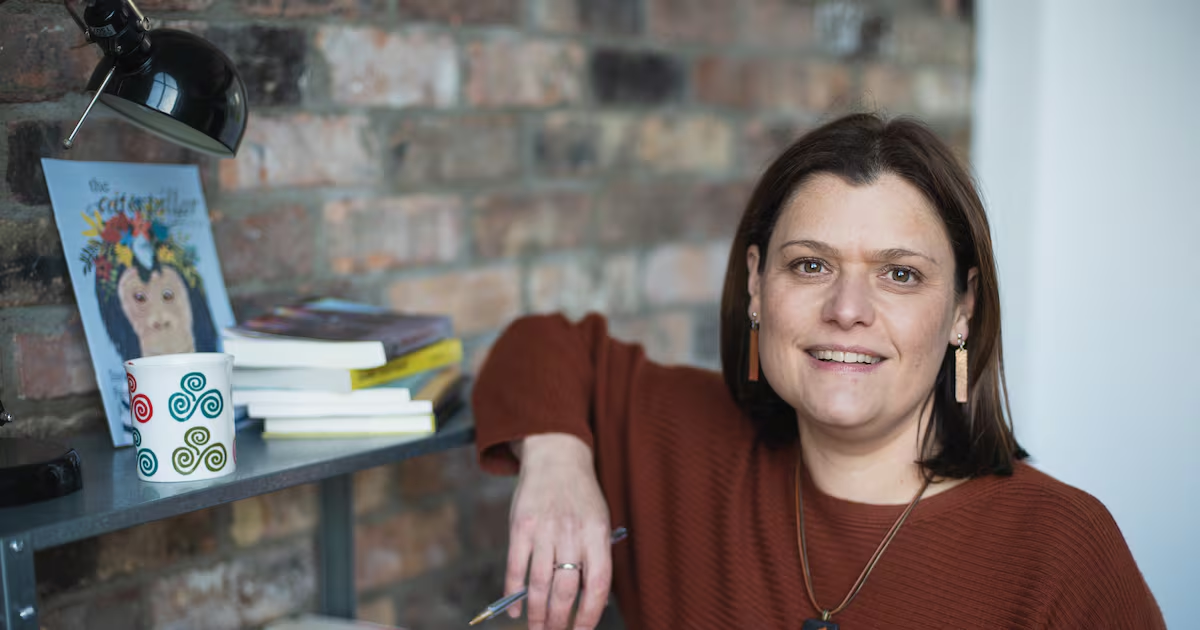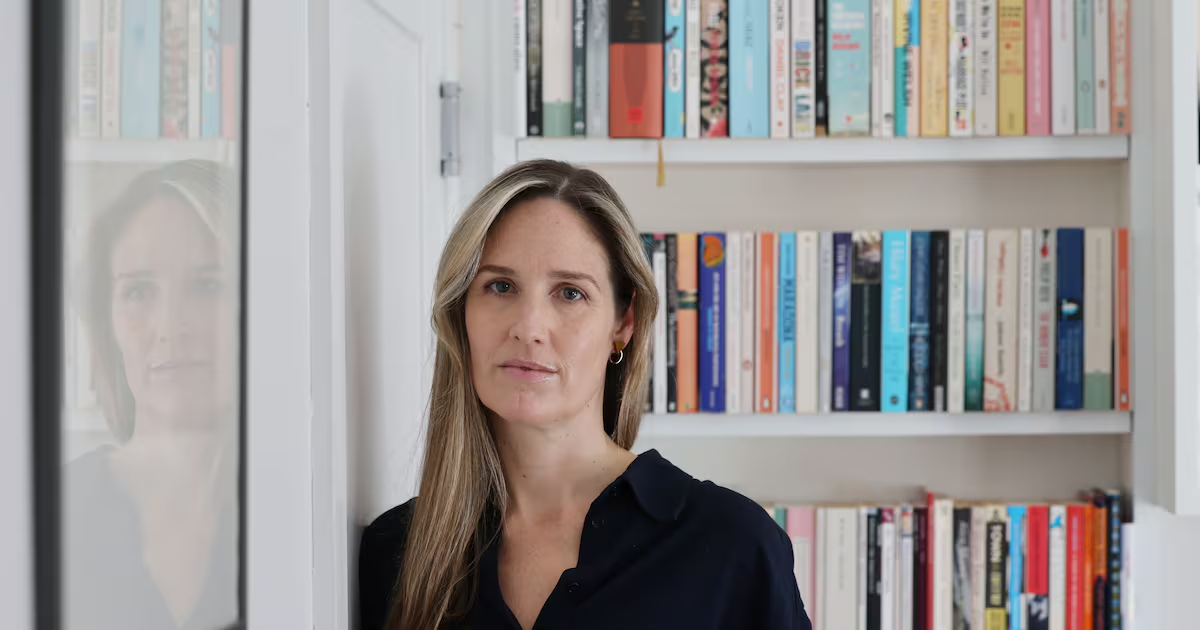
Sarah Gilmartin is on a roll. Her year-long residency at DCU finished last December. Last week Dublin Unesco City of Literature announced that she has been selected for this autumn’s International Writing Program residency at the University of Iowa, making her the first successful Irish applicant since Sara Baume, in 2015. And next week she launches her third novel, Little Vanities, building on the success of her debut, Dinner Party, from 2021, and Service, from 2023.Little Vanities is about relationships and friendships, two secretly struggling couples circling 40, made up of a triangle of Trinity College Dublin friends – struggling actor Ben; physio Stevie, his wife; and best friend Dylan, a retired Leinster rugby player – and Dylan’s wife, Rachel, a working-class girl who took her shot but still feels an outsider in their company.It’s a midlife-crisis novel, full of sharp wit and sharper wisdom, whose characters’ plight the writer captures in an early description of Dylan and Rachel’s only child, Leah, “entitled, lonely and, at four years of age, already preoccupied with the greatest of all human quests, the hunt for more and better love”.The novel began for Gilmartin with a triangle, where geometry meets psychology. “Triangles have an inbuilt sense of loss and inequality,” she says, two versus one, “a great source of tension.” The initial idea was a friendship between three men, but at some point Stevie became a woman, choosing between the jock and the bohemian.During the pandemic Gilmartin was reading a lot of fiction about miserable American marriages, Richard Yates, Jeffrey Eugenides’s The Marriage Plot. “I knew I was on to something. I was thinking a lot about desire. Even before relationships and infidelity, desire is a great driver, what a character wants. We all want things as human beings. There was this basic tension or suspense. Will this happen? Will they ruin their lives? And the other type of suspense; if they do it, what will happen? I was probably more interested in that.”Pain also emerged as a key part of the novel, be it physical, emotional, existential or psychological. Gilmartin had suffered from long Covid and wanted to explore that.“What happens when you are sick, young but have no energy to do anything, the burden that puts on a relatively young person and marriage, I do that through Dylan and Rachel, but it is a postpandemic novel; it quickly moves on from that. Dylan had got over an old injury and had a middling career, but the return of chronic pain got in on him. Does he cope with it in a boring, adult way or does he go looking for distraction, which is what he does?“Pain can be funny as well, if we are looking at absurdity of what we go through in life but survive. I wanted to write a book about how people cause themselves pain but in a way that balanced comedy and tragedy. I think this is my funniest book.”Sarah Gilmartin Gilmartin’s four characters are taking stock of where they have got to in life, whether they are happy. “Dylan and Stevie fall for a simple narrative – ‘If I had only done something different 20 years ago’ – the road not taken. How fragile things are, how easy it is to break things. People’s actions have consequences.“I think this is a theme I’ve been interested in across the three books now, the reach of the past, legacy.”Around the time Gilmartin was writing Dinner Party, she read The Body Keeps the Score, by Bessel van der Kolk; its message about trauma’s effect on the body left a really big impression on her.“Sometimes past pain that hasn’t been dealt with can have a physical effect: Kate’s anorexia in Dinner Party; the line in Service between sexual assault and how Hannah is living later in life. For the male characters in Little Vanities, it’s very strongly linked to failed ambition. Envy as well: Ben on the rise and Dylan dropping gives a new momentum.”What Gilmartin’s novels also have in common is the way people interact, to help or damage each other, the first focusing on family, the second on the workplace, the third on friends. “It sounds so generic to say my books look at people in relationships and how they interact, as so do all books.”She quotes Eudora Welty: “Morality as seen through different relationships is the whole heart of fiction, and the serious writer never lived that dealt with anything else.”The title comes from Flaubert’s Madame Bovary, and the lament of Emma’s mother-in-law that “in her life’s isolation she had centred on her son’s head all her shattered, broken little vanities”. “When I realised this was a story of betrayal, I read or reread a lot of infidelity classics such as Madame Bovary, Anna Karenina, Effi Briest and a lot of 20th-century US fiction: Richard Yates, Cheever, Jeffrey Eugenides, Edith Wharton; also Anne Tyler’s fiction, which is a staple.”The writers Gilmartin frequently returns to and thinks she has a learned a lot from are McGahern, Keegan, Maeve Brennan, Anne Enright.[ The Game, a short story by Sarah GilmartinOpens in new window ]Ben gets a big break in an Abbey production of Harold Pinter’s Betrayal, whose plot is all too on the nose for the others watching in the audience.“I love Pinter’s play. I didn’t know Ben was going to be an actor. I knew he was a creative, with an art-monster temperament. Once I hit on acting, thought about mirroring Betrayal’s structure [in which time spools backwards] but realised for my story to be organic I couldn’t impose a structure on it.” Elizabeth Jane Howard’s novel The Long View also shows a marriage in reverse, from divorce to first meeting, “but for this book I wanted the past to keep on interfering. The past is written in the present tense, more alive; the present is written in the past tense. “I didn’t realise until quite far into it that, apart from the final section, the present timeline all take places over the course of a day. I’m trying to get across a sense of time being dragged out in the present.”Does the triangular relationship make Rachel a bit of a spare wheel?“Rachel may be my favourite character. Not to begin with, as I found her a bit of a party-pooper, quite sharp, but she’s the outsider, she’s got a better perspective. It’s important she wasn’t the stooge, she has agency. I maybe took that unconsciously from Anna Karenina. Quite early on everyone can see Anna and Vronsky are going to have an affair; it’s a slow-motion car crash.” Sarah Gilmartin at her writing desk How and where does Gilmartin write? “I had a great and highly unusual office last year as part of the residency in DCU, a converted cell in All Hallows, the old seminary. Now I work in our den at home [near Portobello], on a narrow, uncluttered wooden desk from Ikea, facing a wall, with a print by Felim Egan in a corner just beyond my eye line. I find it hard to write anywhere messy or distracting. Even with very little on the desk, I waste time straightening things.”When not teaching, she works office hours at home: fiction first, while she is still fresh and dreamy. In that liminal space “before daily banal concerns encroach, before emails and social media, it flows a bit better. I don’t move on till it’s right on a line level. Structural stuff can be sorted later.“I want to make sure my fiction is moving forward in a linear way. Fiction is a temporal art; you can only get away with a certain amount of moving about in time. After that I can get lost as a writer, a good indicator that readers will get lost too. “It’s one of the hardest things to manage: linear, spatial time, the real world, and psychological time, measured more by the intensity of a thought or moment – usually when your character is with other people but thinking back to another time. Both are happening at the same time, but how to show that without it seeming chaotic? “Starting out, I found it really difficult but didn’t know that’s what I was struggling with. Over the course of three novels I have more clarity.” ‘I can be funny in a novel whereas my stories tend to be a lot more melancholic’— Sarah GilmartinGilmartin studied English and German at Trinity College Dublin, where she tried her hand at acting, including a role as an Ogham stone (at least she wasn’t wooden), but her first attempt at writing was for a class in San Diego, a thinly disguised description of her grandmother’s slide into dementia, describing her flamboyant bedroom, a lot of satin, gold lipsticks. It got her on a master’s course in creative writing at University College Dublin taught by Éilís Ní Dhuibhne and James Ryan. She loved it and used it as a springboard to switch from business to arts journalism. She reviewed mostly debut fiction for The Irish Times for several years. “I learned an awful lot reviewing: not just ‘don’t confuse the reader’ but also structure, time, voice and style. The latter is almost impossible to teach, but having an idea of all the variety is quite freeing. The more I wrote myself, the less I wanted to review. Initially I thought it was more social, seeing writers, and seeing how much went into it, but then I read John McGahern say writers should observe but they shouldn’t judge. That was more it.”She wrote Dinner Party first as a short story but couldn’t get it published. “I was disillusioned with it and thought, Maybe I don’t have it.” A friend persuaded her to go to a two-day course with Claire Keegan, who told her she could see something in her story. Another workshop with Keegan gave her the confidence to apply for the MFA in creative writing at UCD led by Enright.Dinner Party was going to be the title story in a collection, then it was going to be a novel of interconnected stories before it became “a plain old novel” when Gilmartin realised it was Kate’s story and she was also struggling with the structure of too many points of view. “Now it’s the bit I love most.” But the discarded bits became backstory and a stand-alone short story in The Dublin Review. “I do believe there is no such thing as wasted writing.”“Anne Enright said a short story should have some element of change in it, not necessarily an epiphany, but with Dinner Party nothing has changed: the character was the same as at the beginning. For me to understand why required a much bigger, broader story than a short story could contain.“One difference I notice between my stories and novels is I can be funny in a novel whereas my stories tend to be a lot more melancholic. Maybe there is more licence in a novel to riff, to experiment, to go into a voice.”I joke that a scene near the end where Rachel gathers the others on a sofa to confront them with home truths reminds me of Poirot or Miss Marple. I had earlier alluded to Paul Howard, when Dylan reminisced about a stalker who had his name and Total Ride on her jersey: “She never missed a match, in fairness.” “Along with your Rock” – Ross O’Carroll-Kelly – comparison, you’re really nailing the literary tone,” Gilmartin says. “A short story, because of its length, doesn’t go into character so much. There isn’t time for development. It deals with a fleeting moment in a person’s life, the thing that’s almost caught, even briefly understood, then gone again. Like everything going still for an intense moment before the revelation, if you could call it that, is swallowed up by the usual madness of life. “Maeve Brennan really captures the emotion of this. Mary Lavin too. I’m reading An Arrow in Flight, Colm Tóibín’s new selection of her work, and what she does within the relatively short space of time of her stories is remarkable.”[ Colm Tóibín on the writer Mary Lavin: She removed the props by which we might read her women easilyOpens in new window ]Most writers face a lull after the launches and festival invitations fall off, but Gilmartin has her 12-week residency starting – previously enjoyed by John Banville and Sebastian Barry – in August to look forward to. Trump pulled its funding last year, but a philanthropist stepped in to save it.“I’m hoping to progress my next novel, which is in such an early stage I don’t want to unsettle my thoughts by talking about it. But, briefly, two male perspectives in dialectic opposition, and the first book to be set outside Dublin, with a rural-Limerick backdrop. “Cross-cultural exchange is a big part of it, too: 20 writers from different countries. I think it’s such an important programme in this current strange, turbulent time where global politics is marked by a distinct lack of empathy and foresight, where those in charge are either rampaging or reacting to the rampage. “Literature is the opposite of that. It’s about slowing down, observing, contemplating; an act of empathy, of imagination, that places us, without borders or passports, in the mind of another, that reminds us, in a grossly individualistic time, of our shared humanity.”Little Vanities is published by One on Friday, May 22nd
Sarah Gilmartin: ‘Even before relationships and infidelity, desire is a great driver’
The fiction reviewer turned writer on her new novel, Little Vanities, writing early and often, and novels versus short stories
2,238 words~10 min read