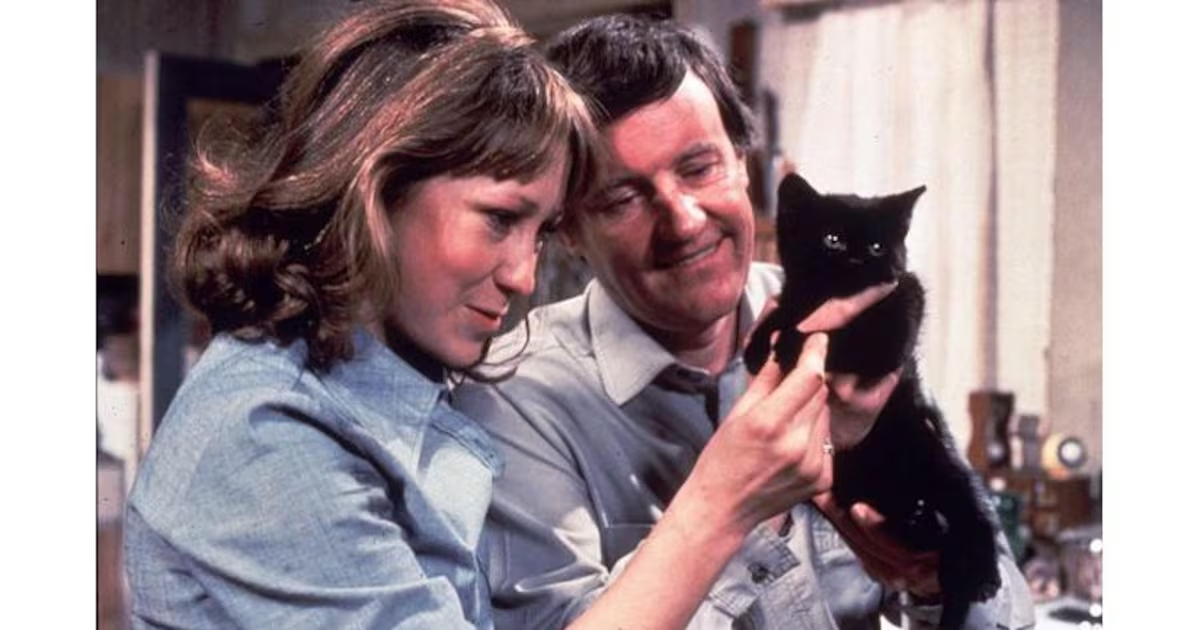
The Powerful Primate: How Homo Sapiens Came to Dominate the Planet Author: Roland Ennos ISBN-13: 978-1836431305 Publisher: Oneworld Guideline Price: £18.99Humanity’s best chance of survival is to model itself on Ireland just before the Great Famine. This is the startling conclusion of Roland Ennos’s The Powerful Primate, which calls for homo sapiens to abandon industrial food production and embrace low-energy alternatives.“Irish peasants, banished from the best farmland by their English colonists, had to scrape a living from tiny plots of unproductive bog,” the University of Hull biology professor notes. “Nevertheless, by cultivating a few rows of lazybeds and by keeping the odd cow, 8.5 million people sustained themselves in good health.”Whether or not Ennos’s vision appeals, it does at least flow logically from his sweeping and provocative study of human development. Drawing on recent academic research into how our bodies work, it begins by challenging the popular notion that we conquered all other animals with brain over brawn. Instead, the author argues, it was flexible muscles and grippy joints that ultimately made hairless apes “the bullies of the natural world”.According to Ennos’s earnest, learned narrative, there is a direct link between discovering we could throw rocks and putting men on the moon. His sequence of game-changing human creations includes metallurgy, gunpowder, weaving, electricity and computing, all explained here in clear but unexciting detail. There are granular accounts of how Dutch peat and British coal fuelled the industrial revolution, along with tributes to pioneers such as the Irish engineer Harry Ferguson (immortalised by the Massey Ferguson tractor).All this makes The Powerful Primate read like a Whig version of history, steadily moving from primitive barbarism to technological affluence. Then its final chapter takes an ominous turn, warning our “slavery to machines” and “plunder of the earth’s resources” risks sending that process into reverse. Channelling the 1970s BBC sitcom The Good Life, Ennos advocates self-sufficient gardening as a way back to happiness by “marry[ing] our physical and mental skills”. Intensively researched and cogently written, this is yet another addition to the “great unifying theory” genre that has spawned so many recent bestsellers. Unlike Jared Diamond or Yuval Noah Hariri, however, Ennos focuses on dry exposition rather than illustrative stories and exaggerates the originality of his thesis. As an academic reference work, The Powerful Primate has considerable strength – but as a green manifesto it’s closer to the pygmy marmoset than King Kong.Andrew Lynch is a freelance reviewer
The Powerful Primate by Roland Ennos: A startling conclusion about pre-Famine Ireland
Channelling the 1970s BBC sitcom The Good Life, Ennos advocates self-sufficient gardening as a way back to happiness
404 words~2 min read