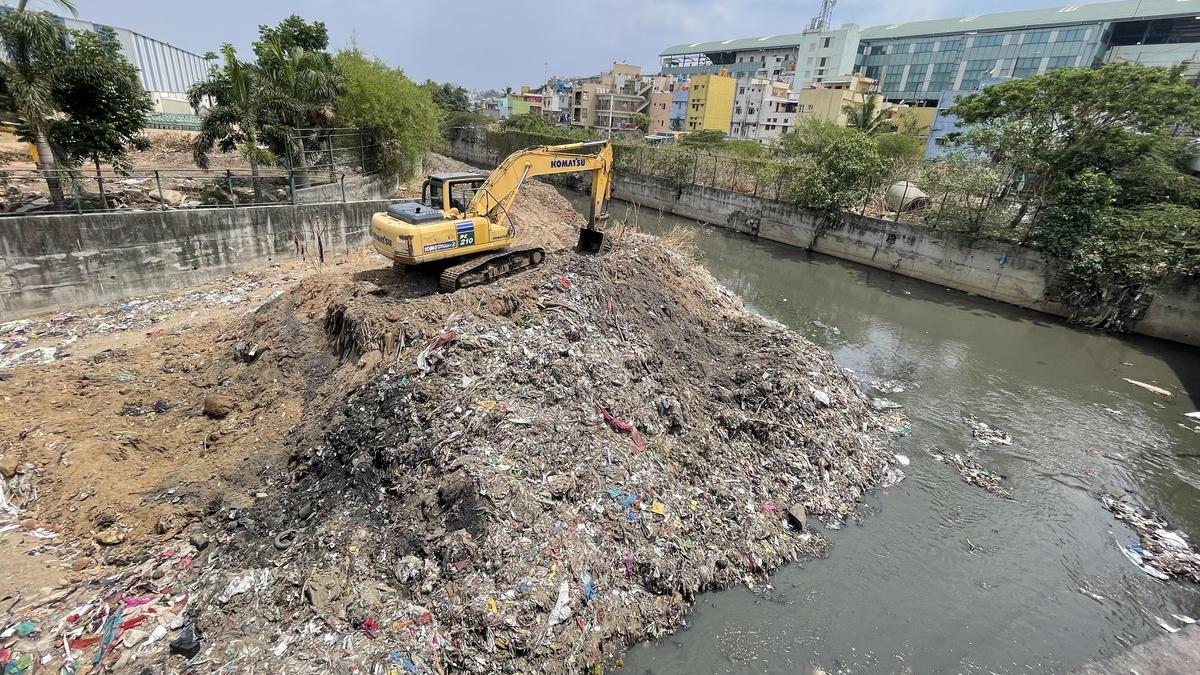
The initiative is aimed at bringing citizens together to collectively observe and document the physical conditions of the SWDs that feed into the stretch of the river between Kengeri Metro Station and Kengeri Bus Terminal Metro Station.
| Photo Credit: K. MURALI KUMAR
A guided citizen audit of the storm-water drains (SWDs) of the Vrishabhavati River will be coordinated by Paani Earth Foundation as part of the ‘Building a resilient Bengaluru’ initiative by Mod Foundation on 17 May. The initiative is aimed at bringing citizens together to collectively observe and document the physical conditions of the SWDs that feed into the stretch of the river between Kengeri Metro Station and Kengeri Bus Terminal Metro Station. The audit data will be fed into an open public dashboard.Building citizen connectThe ‘Building a Resilient Bengaluru’ is a public awareness and action campaign to document and improve the city’s storm-water systems. Madhuri Mandava, co-founder of Paani.Earth, emphasises on the importance of such citizen-led engagements, saying that the biggest hurdle to reimagining rivers or to revive them is the citizen disconnect. “We met a 73-year-old man who remembers swimming in Vrishabhavati till he was 10,” she said.But the perception about the river has been changing as generations pass. A tributary of the Arkavathi that eventually flows into the Cauvery, the river today is heavily polluted by sewage and industrial waste and is often derisively referred to as “Kengeri Mori” or the Kengeri sewer.Shifting perceptions“We organise ‘By the River’ every second Sunday near the Vrishabhavati, where people gather to sing, make art, do activities and simply acknowledge that the river still exists. Once, an elderly couple walked up to us and, on seeing what we were doing, they grew emotional and joined us. While many youngsters who were around didn’t care much and dismissed it as a ‘mori’,” Ms. Mandava remembered.“This is the same disconnect we see for every tributary to Cauvery- whether it is Lakshmanatheertha or Hemavathi. Everybody looks at these streams as channels that carry their wastewater away, but not as freshwater ecosystems. If Bengaluru starts an initiative like this to reconnect with the rivers, it will lead the way.”Potential feedback on existing mechanismsDuring the audit, participants will look at parameters and visual indicators such as the presence of retaining walls and their height, sewage inlets into the stream, solid waste, the colour of the water, the smell, buffer zones, the nature of the spaces next to the streams and so on. All the data will be fed into a public dashboard built by MOD Foundation, and a data jam will later be held with the collected data. What comes out of the data jam could also act as feedback on the existing mechanisms, Ms. Mandava noted.Since it’s done spatially, it is also a data set that the GBA can use. This way, the public becomes the eyes for the government, she said. Published - May 16, 2026 12:38 am IST