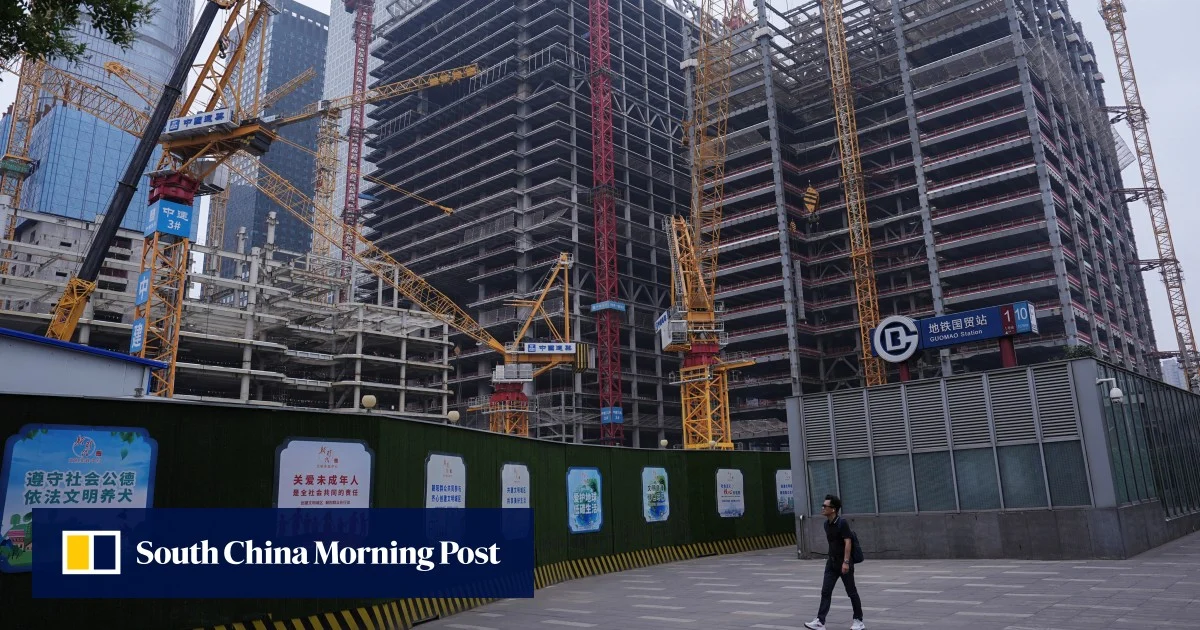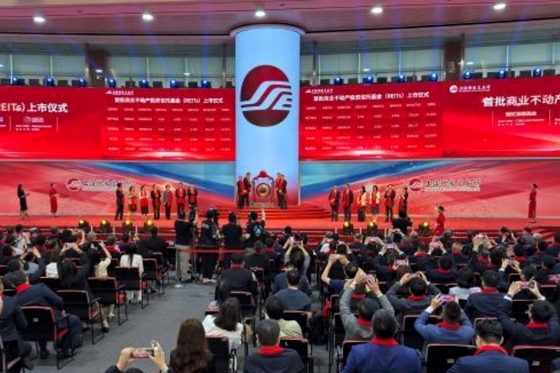
1. China's REIT market, previously limited to infrastructure like toll roads and industrial parks [para. 1], expanded on Dec. 31 when the CSRC included commercial real estate such as luxury malls, offices, and hotels [para. 2], aiming to unlock asset value and aid property sector financing [para. 2].2. Market response was swift: 12 commercial REIT applications filed on Shanghai and Shenzhen exchanges for 41.7 billion yuan ($6 billion), surpassing the 22 public REITs issued all of 2025 [para. 3], led by Poly Developments, Jinjiang International, and Shanghai Land [para. 3].3. Since 2020 launch, 78 public REITs raised 201.75 billion yuan, mostly infrastructure [para. 4]; new policy enables rental income sharing from commercial assets amid liquidity needs, though office demand lags due to vacancies [para. 4].4. REITs provide dividends without property management, originating in U.S. 1960s [para. 6]; China started 2020 with infrastructure focus to curb residential speculation [para. 7], attracting institutions for stable yields but retail under 5% [para. 8].5. New REITs target shopping centers, offices, hotels, mixed-use [para. 9]; largest: CICC VIPshop (7.47 billion yuan), Guotai Haitong Sasseur (5.06 billion yuan) [para. 9]; assets in Shanghai, Guangzhou, Shenzhen by Poly, Jin Jiang, CapitaLand; first standalone offices/hotels, high-end retail like Hefei Intime Centre (Louis Vuitton, Gucci) [para. 10].6. Approvals streamlined: commercial REITs bypass NDRC, done in 6 months vs. 1-2 years [para. 11]; yields require 150 basis points over 10-year bond [para. 11].7. Malls outperform offices/industrial parks [para. 13]; late 2025 Bridge5 Asia data: consumption REITs +30% NAV premium, industrial +5.9%, highways at discount [para. 14].8. Wu Xiaojun (Bridge5 Asia) favors consumer infrastructure for rising rents vs. falling office/industrial [para. 15]; malls resilient via traffic/brand upgrades, unlike cost-sensitive offices [para. 16].9. High-end retail robust, mid-range saturated ("involution"), community malls steady [para. 17]; offices risky with high vacancies [para. 18]; hotels prefer budget/mid-range over luxury due costs and 800 yuan/day travel caps [para. 19].10. Developers hesitate: REITs transfer equity/control via SPV, assets off-balance-sheet, decisions supervised [para. 21][para. 22][para. 23]; suits asset-light pivots or deleveraging [para. 24].11. Complex structure (fund + ABS + holders) vs. U.S. corporate model causes governance issues, expertise gaps, high costs [para. 26][para. 27].12. Taxes hinder: VAT, land taxes, CIT; Ni Min (Deloitte) calls for tax-neutral evolution [para. 28][para. 29]; CSRC pledges coordination and REIT legislation [para. 30].(Word count: 498)AI generated, for reference only
In Depth: China REITs Enter New Era With Asset Expansion
Offices, hotels and high-end malls enter the public real estate investment trust market, but high vacancies, governance complexity and tax hurdles cloud the outlook
386 words~2 min read