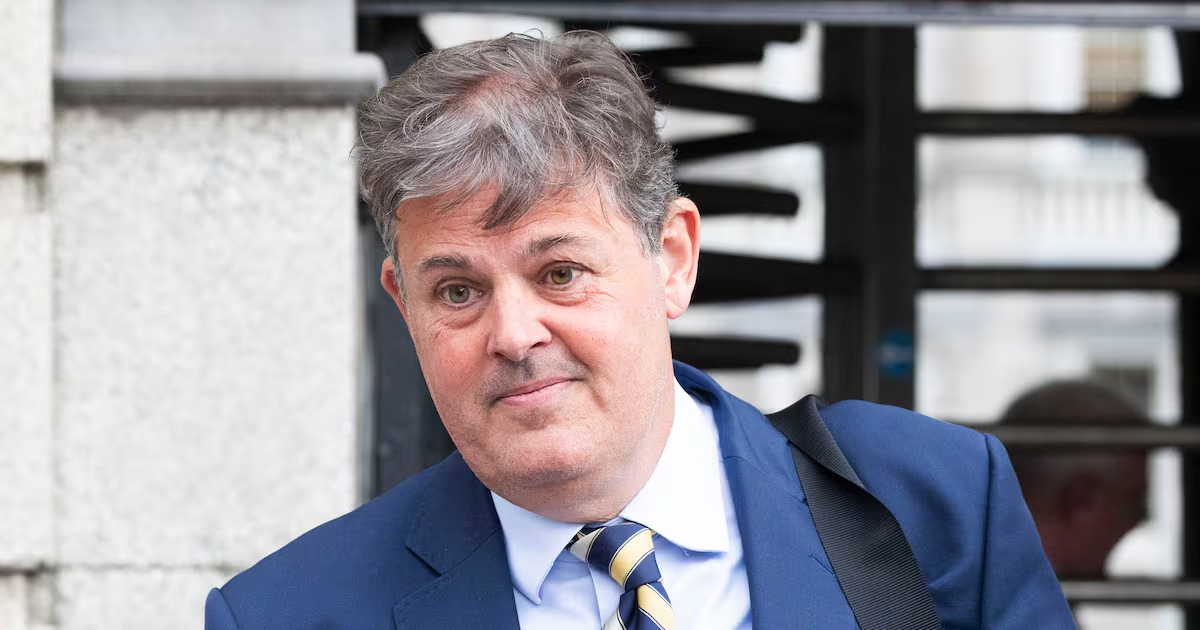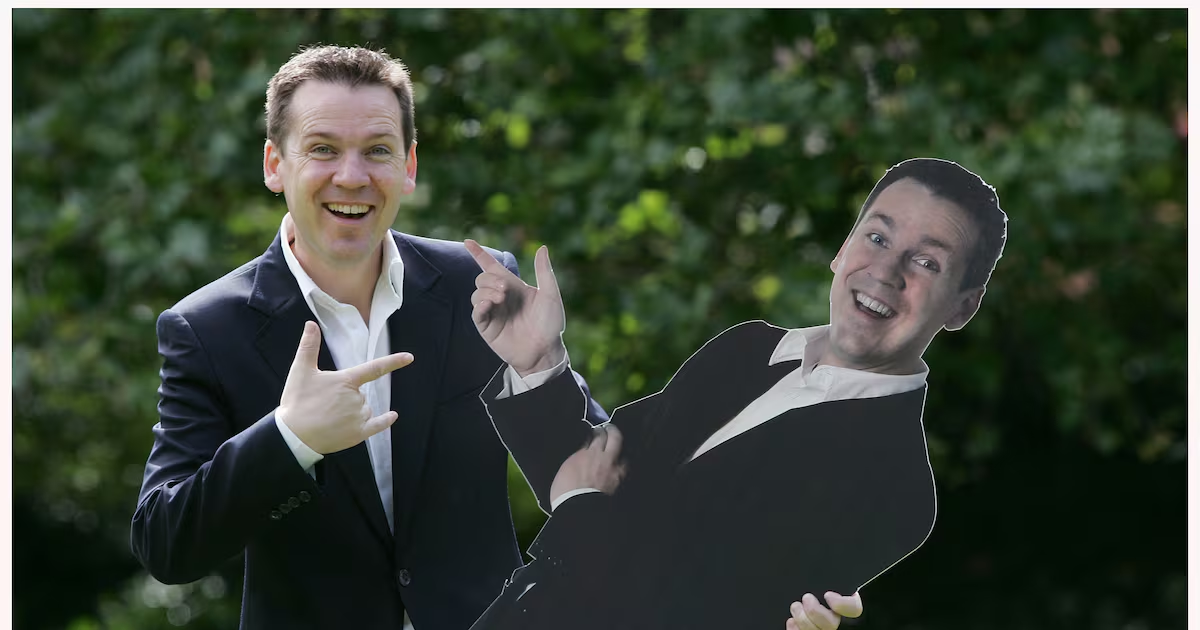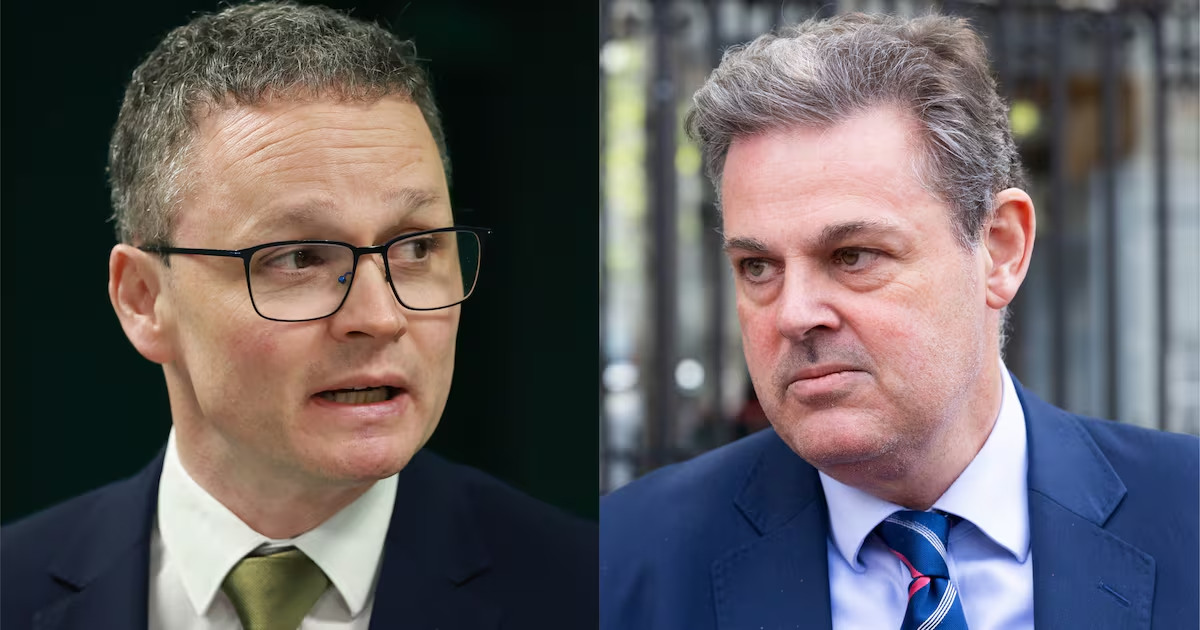
RTÉ’s Derek Mooney was paid enough to feature among the 10 highest-paid presenters every year between 2020 and 2025, according to new figures from the broadcaster.Mooney had not been included in the annually published list as he was deemed to be a “producer” as per the terms of his contract.On Thursday, RTÉ published its 2025 figures and included Mooney for the first time since 2014, saying it had reconsidered what constitutes a “presenter”.It also republished revised figures for 2024 to allow for a year-on-year comparison.Mooney featured eighth in 2024 and seventh in 2025, earning €197,151 and €202,264 respectively.After calls to publish his earnings back to 2020, RTÉ published the figures which confirmed he would have featured in the yearly lists if the same criteria had applied at the time.He earned €195,079 in 2020, €187,854 in 2021, €188,885 in 2022, and €192,592 in 2023 – all of which would have placed him ninth on the list.Taoiseach Micheál Martin said the latest issues to arise at RTÉ are “difficult to comprehend” but that the right decision was taken to correct the matter.Speaking in advance of the Fianna Fáil ardfheis in Dublin, Martin said he welcomed the “transparency that was in evidence in terms of the clarification that RTÉ brought forward this morning”, adding that he had listened to RTÉ director general Kevin Bakhurst‘s interview on Morning Ireland. He said it was important for RTÉ to retain the public’s confidence, adding it was “difficult to comprehend what transpired, but nonetheless I think the right decision was taken to correct that”.He said Government supports public service broadcasting and “will do everything we can to support media in general, because we have many challenges out there in the world”.He said there has to be “full accountability” and the “highest standards possible” but “we need to be very, very careful in terms of our democracy really because I think the kind of forces that are out there right now are more challenging than anyone ever had to deal with in any previous generation”.Meanwhile Minister for Culture Patrick O’Donovan is due to meet chairman Terence O’Rourke and other officials from the State broadcaster next Tuesday to discuss payments made to a number of presenters.The State broadcaster is embroiled in further controversy after it emerged RTÉ paid almost €100,000 in total to Claire Byrne and Ray D’Arcy after they left their roles at Radio 1 last year. Byrne topped the highest-paid presenters list in 2025 on €280,000, while D’Arcy was in fifth place on €219,992.Mooney presents the one-hour wildlife show Mooney Goes Wild at 10pm on Mondays on RTÉ Radio 1.RTÉ broadcaster Derek Mooney Speaking on Friday morning, Bakhurst said Mooney is best known as a presenter but the “majority of his work is as an executive producer”.On Friday afternoon, O’Donovan said RTÉ had questions to answer, particularly after being granted State funding worth €725 million over three years in 2024.“Here we are yet again, Groundhog Day, explaining something that, to be quite honest about, I thought after giving the company three quarters of a billion euro, that we had moved on from that, and that we had moved to a position where there was full disclosure, and we get this information yesterday,” O’Donovan told RTÉ Radio’s News at One.The Minister said he became aware of the situation on Thursday afternoon when Prime Time contacted his department seeking a comment. The Minister said he “immediately sought” to speak with O’Rourke and the pair held a virtual meeting on Thursday night. Regarding Mooney being designated as a producer by RTÉ from 2020 to 2024, O’Donovan said: “A very logical question that I asked the chairman last night is, how could Derek Mooney have been regarded as anything other than a presenter? [ RTÉ confirms Derek Mooney’s pay was incorrectly listed in public recordsOpens in new window ]“He was a presenter, he is a presenter, he is obviously a presenter. It’s like a duck – if it walks and quacks like a duck, it’s a duck.”RTÉ was engulfed in a spate of controversies in 2023 including the revelation there had been undisclosed payments to former Late Late Show presenter Ryan Tubridy among other issues.There have been falls in the number of €160 licence fees sold since, though sales had already been dropping prior to 2023 as well. In January, The Irish Times reported the number of television licence sales has decreased for the sixth year in a row.Last year saw 768,657 licences bought overall, a 2.98 per cent decrease on 2024.The latest data published by the Department of Culture, Communications and Sport indicates the fall in sales is continuing.There were 240,791 TV licences sold from January to April this year, down almost 6 per cent on the 255,576 TV licences sold in the first four months of 2025.RTÉ’s 2024 annual report said the €174.3 million it received from the TV licence that year was down €4 million compared to 2023.Byrne and D’Arcy both left RTÉ in October 2025, later moving to Newstalk and starting a podcast respectively. Claire Byrne and Ray D'Arcy. Photographs: Conor McCabe/Newstalk & Alan Betson Byrne ceased providing services to RTÉ on October 31st but her company Derrough Media Limited was paid €47,000 for the last two months of the year.D’Arcy ceased providing services on October 9th but his company Whatnext Productions Limited was paid €50,000 after that date.Speaking on Morning Ireland on Friday, Bakhurst defended the decision to pay both presenters after they stopped working at the broadcaster, saying it was “totally the right decision”. He said presenters, “although they’re are paid a lot of money, they also have contracts”.He said: “People have notice periods, and you have to abide by that ... If we hadn’t, by the way, and we got into a legal fight, it would have cost us a shedload more money than it did.”Bakhurst said Byrne had offered to stay until the end of her contract but RTÉ asked her to leave early so it could launch the new Radio 1 schedule. He said both presenters “were available to work until [the end of their contracts], but we took a decision, we wanted to launch the new schedule”.Speaking on her Newstalk programme on Friday, Byrne said she resigned from RTÉ last summer and her contract ran until the end of 2025.“I made it clear, I was happy to stay on and work there until the end of my contract,” she said.“But RTÉ came to me and told me that they wanted me to finish up at the end of October. That was their right and their decision. So that’s how that happened, from my perspective.”When it was announced last October that D’Arcy was leaving the State broadcaster, the presenter said he was “blindsided” – something disputed by RTÉ’s director of audio Patricia Monahan.The Irish Times has contacted D’Arcy and Mooney for comment. During the Morning Ireland interview, Bakhurst defended both the decision to classify Mooney as a producer six years ago and the decision this week to reclassify him. Bakhurst said no one on RTÉ’s current leadership team was involved in the decision to reclassify Mooney in 2020. He said RTÉ recently sought independent legal advice about the matter and was told the decision was “a perfectly rational decision to take at the time”.Bakhurst said “someone in finance” at RTÉ raised the question in recent weeks as to whether Mooney was “correctly classified”. After reviewing the situation, Bakhurst said the current executive team made the decision to reclassify Mooney as a presenter, as part of “efforts to be transparent and as thorough as possible”.During the interview, Sarah McInerney said the maximum salary for a producer on the RTÉ pay scale in 2021 was €90,000, meaning the majority of Mooney’s salary “must have still been coming from his presenting role”.[ Sarah McInerney: When I told my manager I was pregnant he said, ‘can’t be helped I suppose’Opens in new window ]In response, Bakhurst said Mooney’s roles at the broadcaster “changed over the years” and “when people’s roles change, quite often their salaries change with them”.In 2020, RTÉ implemented a 15 per cent pay reduction for its highest-earning presenters as part of a restructuring plan. McInerney asked if the decision to reclassify Mooney as a producer was a “side deal” to avoid cutting his salary.Bakhurst said that was “a very unfair gloss to put on [Mooney]”, adding: “I don’t think he got a pay cut but he was on the staff salary he was on, and he was on an executive producer role already by that stage.”Bakhurst said Mooney was informed of RTÉ’s decision to reclassify him as a presenter but he “played no role in this”.“We told him this was happening, and he agreed that that was our decision, but he’s played no role in this at all. You know, he’s just carrying on with his work.” - Additional reporting PA
Derek Mooney among RTÉ’s 10 highest-paid presenters since 2020
Broadcaster paid almost €100,000 to Claire Byrne and Ray D’Arcy after both left roles in Radio 1 last year
1,478 words~7 min read