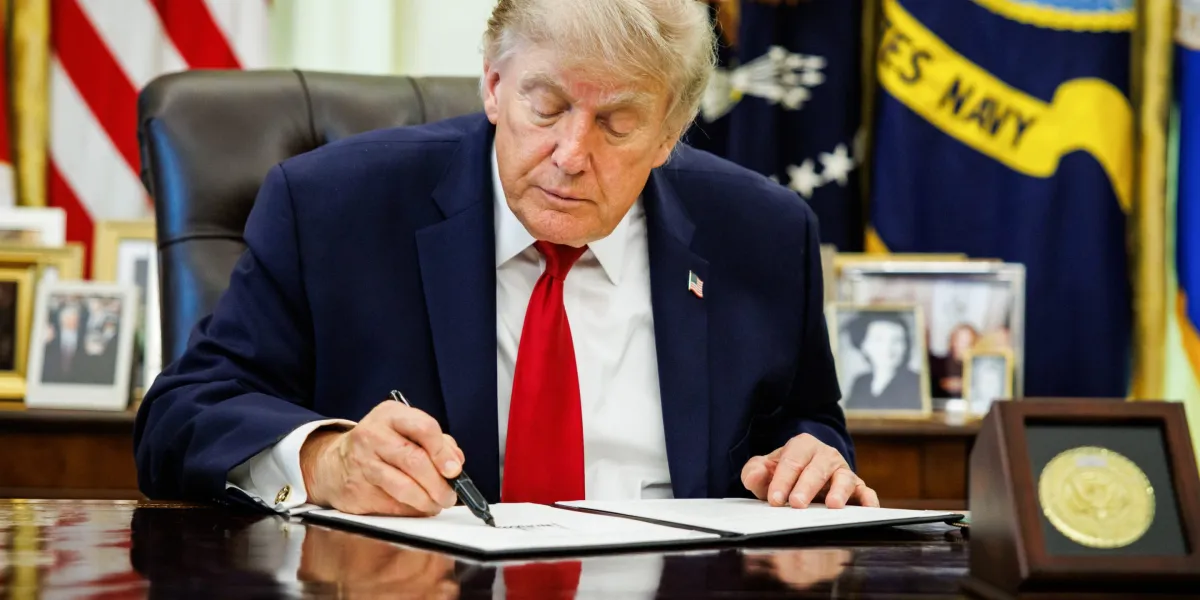
President Trump made big news this week by revealing how much income he’s personally made in his second term. The total number is $2.2 billion in 2025, according to White House disclosures, with roughly $1.4 billion of it coming from crypto assets. The unusual thing, several top economists, legal scholars and corporate governance experts told Fortune, is that this fits into a decades-old corner of economics: “big player theory.”
“I think we’re in a new era,” Steve Hanke, the so-called “Money Doctor” told Fortune. The Johns Hopkins economist, a veteran advisor on monetary policy to several administrations (including the Trump White House), told Fortune that when he saw the big income disclosure, he immediately flashed onto “the economics of big players.”
An expert in “dollarization” who has advised Asian, Eastern European, and South American governments, Hanke has spent decades studying market manipulation in developing countries and now sees the same dynamics playing out in Washington. A big player, in his formulation, is someone—a central bank head, a finance minister, or a president—big enough to independently move supply, demand, and market expectations.
Three characteristics define the phenomenon, according to both Hanke and Roger Koppl, the Syracuse University professor who originated the theory decades ago: the actor is big enough to shift markets, is not disciplined by profit and loss the way ordinary firms are, and operates by discretion rather than any knowable rule. A big player “introduces personality into markets,” Koppl said, and in so doing, “corrodes our ability to form reasonable expectations of the future.”