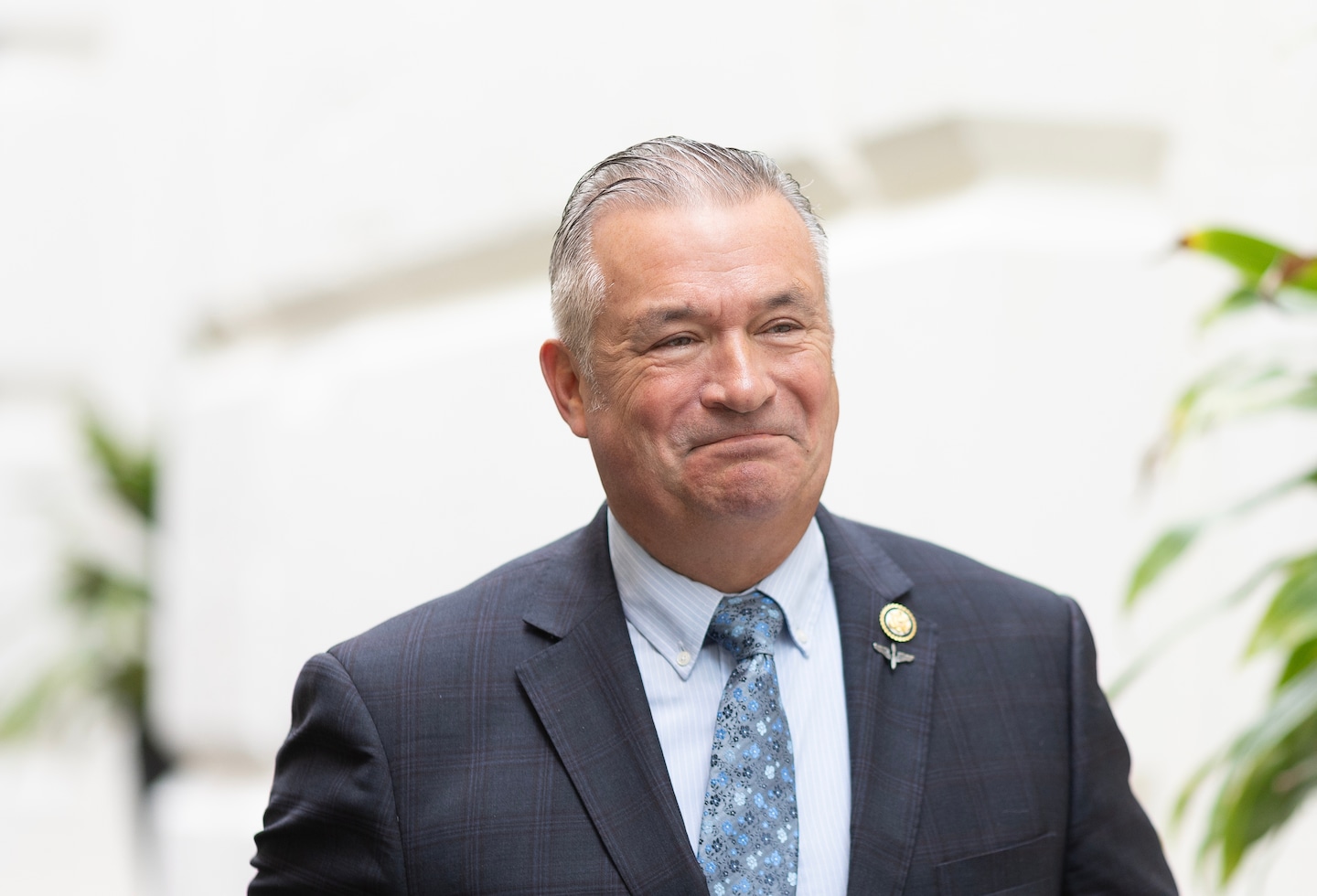
Don Bacon is going home to Omaha. His departure illustrates a conundrum inside a paradox: Those you wish would leave Congress linger. And those you wish would stay depart because of traits that make them worthy legislators: seriousness and spines.Bacon, a Republican, is leaving without rancor, but with stories that suggest why he thinks 10 years in the House of Representatives are enough for him. Herewith two stories:He grew up on a farm in Kankakee County, Illinois. Inspired by Ronald Reagan’s reinvigoration of the military, Bacon, upon graduating from Northern Illinois University in 1984, commissioned in the Air Force. He retired, after almost 30 years, as a brigadier general. Having come to Congress from a serious job — intelligence; electronic warfare — he has finite patience for childishness, such as the Army base “renaming reversions” debacle.Bacon recalls that his great-great-great-grandfather John lived near Thomas Jefferson’s Monticello. John’s uncle helped maintain it while Jefferson was away being president. John moved to Illinois and in 1861 enlisted in the Union Army. So, in 2020 it seemed like familial piety for Bacon to be a one of two prime movers of legislation to remove from Army bases (Forts Bragg, Hill, Pickett, Hood, Benning and others) the names of Confederate soldiers who did their damnedest to dismember the nation.The legislation, which included a stipulation that no base would ever again have a Confederate’s name, inspired a provision in the 2021 defense authorization bill that became law over President Donald Trump’s veto. In 2025, however, the second Trump administration, practicing what it evidently considers sophisticated trickery, restored the names. Sort of. Fort Bragg, which briefly was Fort Liberty, is now renamed back to Fort Bragg. Not, however, for Confederate Gen. Braxton Bragg, but for Pfc. Roland L. Bragg, who won a Silver Star in World War II. Fort Pickett, which briefly became Fort Barfoot, is again Fort Pickett. This time, however, the name (we are supposed to believe) honors not the Virginian who led Pickett’s Charge at Gettysburg, but Vernon W. Pickett, a lieutenant who in World War II won a Distinguished Service Cross.This sophomoric trickery — the cleverness of the dim-witted — by the commander in chief is intended to mock the law. This is what now passes for fulfilling the president’s constitutional duty to “take care that the laws be faithfully executed.”In the making of laws, Bacon has occasionally made himself a nuisance to people who deserve to be tormented. As he did in February.The Republican-controlled House was doing its job as it miserably understands this: tugging its forelock and doing the president’s bidding. The president’s confidence in his arguments for his tariffs can be gauged by his eagerness to squelch debate about them. The House Republican leadership was determined to pass a gag rule to prevent a debate on ending the “emergency” that supposedly justifies the tariffs. The GOP leadership could not afford to lose even three Republicans. Bacon was one of three recalcitrant. The White House tried to buy Bacon’s compliance by promising tariff and other special benefits for three businesses in his district. Bacon thought the legality of this was dubious, and its unseemliness obvious.During hours of pressure, a member of his party’s leadership said, “Don, look me in the eye before you vote ‘no.’” Bacon said: “I did before the vote.” The gag rule having failed, the next day the ungagged House rebuked Trump for his tariffs against Canada. Bacon, a Reaganite who supported Nikki Haley in the 2020 Republican nomination contest, believes Republicans will revert to better thinking and manners: “Losing makes people change. If [Trump] starts losing, people will change.”A stocky slab of patriotism, Bacon has competed in nine elections (including primaries) in 10 years, raising $6 million to $7 million every two years. He has said, “I just felt ground down.” Congressional pay ($174,000) has not increased for 17 years, during which that sum has lost more than a third of its purchasing power. (Adjusted for inflation, today it would be $274,437.) The congressional life can be (this is the title of a 1954 book by the radio-era comedian Fred Allen) a “treadmill to oblivion.” So far, nearly 60 members are leaving the House — for retirement, the private sector or to seek other political offices — after the November elections. In two Native American languages, “Nebraska” means “flat water.” In 2018, the state’s tourism office, with dry, no-nonsense Midwestern drollery, adopted this slogan: “Honestly, it’s not for everyone.” It is for Bacon. As he steps off the treadmill, Congress will miss him more than he misses it.
Opinion | Serious. Has a spine. No wonder he’s leaving Congress.
Rep. Don Bacon (R-Nebraska) isn't seeking reelection. That’s a loss for the country.
762 words~3 min read