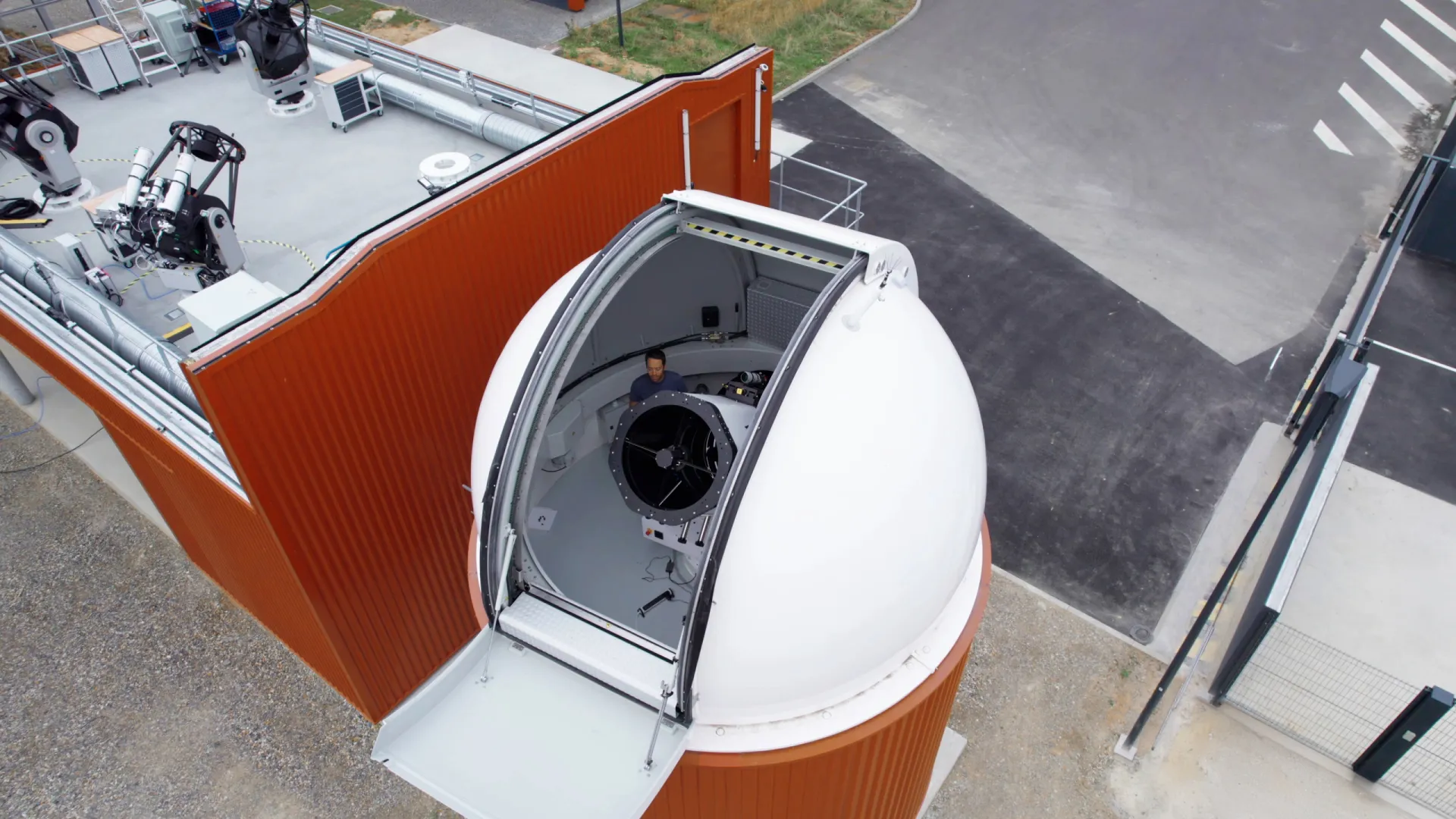
An optical ground station. Credit: Cailabs
With the proliferation of Earth observation satellites in orbit, the increasing sophistication of sensors and surging demand for imagery and geospatial intelligence across a growing number of sectors, it is no surprise that more data is now collected than ever before. But what is perhaps surprising is that the main obstacle to the smooth operation and development of this system lies not in space, but on the ground. Indeed, Earth observation data is taking so long to be received, processed and distributed that it is degrading, losing its value and, in some cases, becoming unusable.
In certain fields, the speed at which data can be sent and received is vital. One obvious example is Intelligence, Surveillance, and Reconnaissance (ISR) and wider high-resolution Earth observation. In these and many other areas, the quality of the data is bound up with its timeliness. You might have crystal-clear images of an incoming storm, but they’re not much use to the relevant agencies or emergency response units if they come a day late. The same holds for defense and security operations, where decisions depend on current, not historical or near-historical, information.