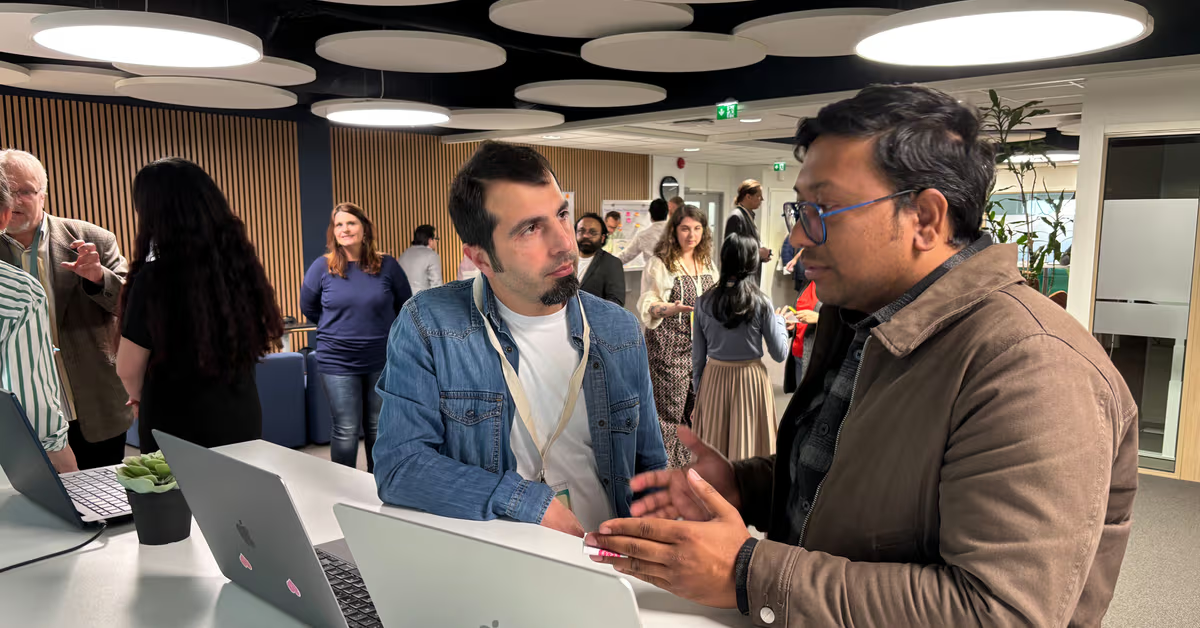
Evgenia Shepeneva, a BIM and engineering specialist, was unemployed for nearly two years — making her one of a record high number of highly-educated people who have found themselves out of work in Finland in recent years."It was frustrating, very frustrating," she says. "Especially when you tailor your CV and motivation letter and spend a lot of hours applying for a job and then, you barely even get the automated reply."With her future looking ever more uncertain, and her confidence in her own skills at a low ebb, Shepeneva recalls that she began to question whether she would ever get a job.Then she saw an advertisement for Kasvuhuoneilmiö, a pilot project funded by the City of Tampere and run by a team of entrepreneurs that aims to help highly-educated, long-term unemployed people get back into the workforce. She decided to apply.Kasvuhuoneilmiö is a word play on the Finnish term for 'greenhouse effect' and promises a "co-evolutive innovation programme that connects real world challenges and diverse, talented people who are eager to solve complex problems".The programme is unpaid, but participation is free of charge.For Evgenia Shepeneva, it was exactly what she needed."Firstly, I was busy with something again. I knew that I could be a part of a project again. I had forgotten this feeling over the past two years," she explains. "I think these kinds of programmes help you to build your self-confidence again. You can see yourself from different angles because you try different roles."Evgenia Shepeneva was a participant in the Kasvuhuoneilmiö programme during the month of April. Image: Ronan Browne / YleGreenhousing talentKasvuhuoneilmiö is run over the course of 4-5 weeks, with between 20 and 30 participants per period. The pilot project kicked off at the end of last year, and the current cohort are the fourth grouping to participate.The programme offers a two-track approach to finding work and rebuilding a jobseeker's confidence — one track focuses on innovation, as the groups solve real-world challenges set by local companies, and the second on professional development, which includes mentoring, peer support and networking opportunities."We want to give them the opportunity to shine, because there are amazing talents, amazing people here with lots of skills and experience and knowledge," explains Kimmo Hokkanen, one of the programme's coordinators.The programme is open to applications from Finns or foreigners, with Hokkanen noting that the main objective is to help people find employment — especially those who face obstacles such as a lack of Finnish language skills or "maybe even just having the wrong name".Another participant, chemical engineer Enrique Rojas, says the programme has opened up doors for him that had previously remained firmly shut."When you are unemployed, basically you're alone at home searching for a job and, and that's really hard," he says. "They [the programme coordinators] help you to connect with some companies and to increase your networking, and it's really important here in Finland to have a network because you need to be recommended by someone else to get in front of the employers."The importance of moving from a place where jobseekers felt very alone in their job search, to suddenly being surrounded by a community, was an advantage of the programme cited by many of the participants interviewed by Yle News.According to Kimmo Hokkanen, this is an important objective of the Kasvuhuoneilmiö initiative."I wanted to start this programme not just to help people find jobs, but also to build or grow a sort of ecosystem, to 'greenhouse' people who have experienced a certain way of collaborating together," Hokkanen says.Kimmo Hokkanen is the co-founder and one of the coordinators of the Kasvuhuoneilmiö programme. Image: Ronan Browne / YleProtecting participantsEach iteration of the programme begins with a kick-off event, where real companies present real challenges to the participants.They then form groups based on the challenge they find most engaging, and work together to come up with solutions and present their ideas to the companies at the end of the programme.Although the programme is free, participation is unpaid — which raises questions about whether the participants are expected to work for free.Antti Martikainen of Startup Nation Finland, a non-profit working in the Finnish startup space and one of the organisations behind Kasvuhuoneilmiö, says this issue was given careful consideration when the programme's layout was being developed.For example, the ideas and concepts developed by the participants during the programme remain their intellectual property — unless the company which set the challenge decides to develop the ideas further and provides the team with appropriate compensation.This prevents the participants from being exposed to any kind of exploitation, Martikainen notes."It's our responsibility as organisers to prevent this kind of behaviour [exploitation]," he says. "If the company wants to use any of this work, they can negotiate the terms, and we support the teams in the negotiations if that was to happen."The programme includes a number of networking events. Image: Ronan Browne / YleThinking differentlyWith Finland's unemployment rate currently the worst in the EU, the country's employment services have been struggling to keep up with the growing demand — as one employment specialist is responsible for an average of around 200 jobseekers in some areas.Many jobseekers have expressed dissatisfaction and disappointment with the services at their proposal as well as frustration at the lack of alternative options.Jeremias Nieminen of the research institute Labore therefore welcomes the development of innovative programmes such as Kasvuhuoneilmiö as a means of stimulating Finland's sluggish jobs market."I think the point is that we want the regions to try different things, and to preferably also study the effects of these projects and then try to improve the services so that they would fit the local needs," he says.The need for Finland to try different approaches was also championed by Sami Hero, CEO of Ellie Technologies, one of the companies that set a challenge for the Kasvuhuoneilmiö participants."Finland needs more positivity and risk taking," Hero says. "There's this concept, the hedgehog defence, the Finns are experts on that. Nobody spends money, or takes any risks, in case something bad might happen tomorrow."Bearing fruitBut is Kasvuhuoneilmiö getting results? Are the participants finding jobs as a result of the programme?According to figures provided by the programme's organisers to Yle News, 67 percent of participants from the two pilots run last year, in September and again in November, have landed some form of employment contract since attending the programme.Although securing those roles cannot be directly and unequivocally attributed to each individual's participation in the programme, Evgenia Shepeneva notes that the experience helps give jobseekers renewed belief in their employment prospects.
"I had forgotten this feeling" — Tampere pilot project offers green shoots of hope amid unemployment gloom
An innovative employment programme in Tampere is helping highly-educated, long-term unemployed people get back on their feet.
1,092 words~5 min read