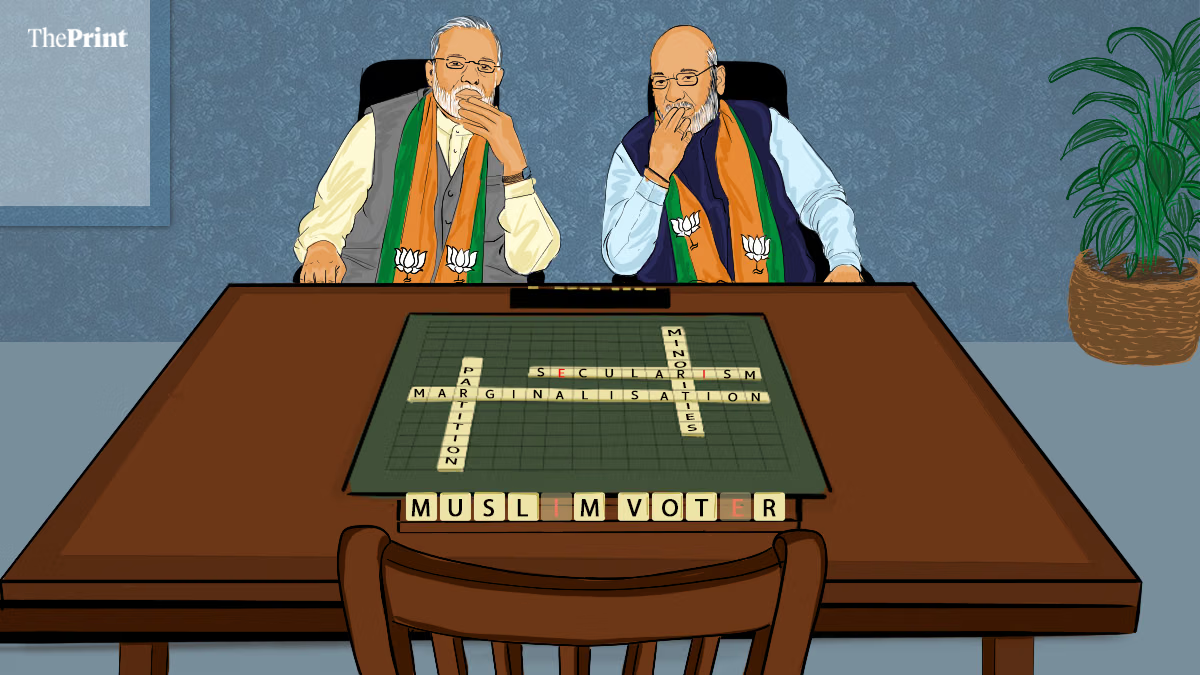
For the liberals, however, the new grammar of politics has spelled a tragic story. It was they, and not the Muslims, who actually benefited from the vote bank politics. It’s the liberals, and not the Muslims, who lost power as the elementary arithmetic of democracy put paid to the hallowed calculus of secularism. As the dialectics of the Muslim vote bank created its inevitable antithesis, the liberals lost both their bark and their bite. After every election, when they lapse into mandatory mourning at the diminishing number of Muslims elected, they actually mourn their own fate. They grieve the loss of their own relevance when they condole the Muslims for the irrelevance of their vote bank.The Ashrāf obsession with power
After every election, Muslims display a peculiar obsession with tallying the numbers of their co-religionists elected. They do the same, year after year, when the UPSC announces the results of the civil services examination. This strange fascination with counting the number of MPs, MLAs, IAS and IPS officers, etc, is not without reason. The Muslim political discourse, rooted as it is in the power theology of Islam, has been shaped by the descendants of the old ruling class—the elite Ashrāf class. Their gaze has remained fixed on the seats of power. As the economy grows, education spreads, and society becomes prosperous, the number of Muslim doctors, engineers, lawyers, accountants, academics, journalists, and entrepreneurs has also grown exponentially. Yet these professions, no matter how important, are not considered significant indices of the community’s growth. The reason: these are not the sovereign domain of the state. Muslims want power, not prosperity.It may be asked what one measures when one counts the number of Muslims elected. Does one measure the depth of Indian secularism, or the relative strength of two religions at war? Is it about the willingness of Hindus to vote for Muslims, or the ability of Muslims to attract Hindu votes? What is at stake — the secularism of Hindu voters or of the Muslim candidates? In the first-past-the-post system, if the people of one religion vote for candidates from a rival religion, it’s nothing short of a civilisational miracle. And this has routinely happened in India as Hindus have regularly voted for Muslim candidates. Indeed, most of the Muslims in the national parliament or the state legislatures have been elected from Hindu-majority constituencies. Former governor Arif Mohammed Khan takes pride in highlighting how he has been repeatedly returned to parliament by an overwhelmingly Hindu electorate. One may contrast this with the behaviour of the Muslim electorate: constituencies with a Muslim majority seldom return a non-Muslim candidate. In fact, in most cases, they elect hardline Muslims. If they want the Hindu majority to elect Muslims, shouldn’t they, then, be setting an example by electing Hindus from Muslim-majority constituencies?