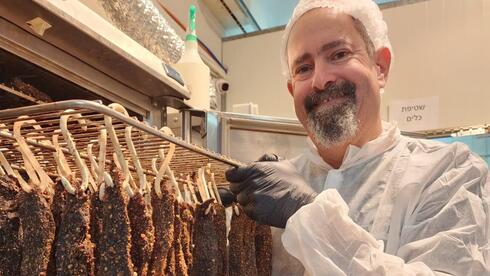
Gadi Blau once made Ikea’s Swedish meatballs kosher, while at home, he made South African-style sausages; that hobby became dried meat business he now runs with his wife, as they work to get Israelis hooked on beef jerkyTiki Golan|Israelis do not need a special reason to eat meat. It is a fixture on plates year-round, whether grilled in the backyard or at the park, on restaurant menus or in pots simmering in home kitchens. Steaks, skewers and shawarma are familiar territory. But one category has remained on the margins: dried meat.Around the world, products such as biltong and beef jerky are everyday, legitimate and common snacks. In Israel, however, dried meat is still seen as something foreign, with an unusual texture.5 View gallery Gadi Blau and his dried meat(Photo: PR)That has begun to change in recent years. During the long months of war, soldiers in the field were provided packages of dry, protein-rich meat strips that do not require refrigeration and do not spoil. Soldiers accustomed mainly to canned meat, kabanos and tuna discovered a very different, accessible and reliable source of protein. The dried meat packages started catching on, and canned meat’s standing began to weaken. Before long, beef jerky and biltong made their way to butcher shops and delis across the country.“It all started because I’m South African, and one of my childhood snacks was biltong and dried sausage,” says Gadi Blau, 52, the entrepreneur behind Gadi’s, a brand of dried meat snacks sold in small bags that do not require refrigeration.Together with his wife, Merav, 51, he runs the production of their dried meat delicacies: beef jerky, biltong and dried sausages. Gadi immigrated to Israel at age 3 and grew up on biltong and dried sausages. When he became a chef, he began trying to recreate at home the flavors he remembered from childhood.“As a child, when we would travel abroad to visit family, we would bring it back in our suitcases,” Gadi says. “We waited so eagerly for it to arrive, and by the next day, it was already gone. Dried meat was hard to find in Israel, and only a few people made it at home. Since I couldn’t find it here, I decided to make it myself. I adjusted the seasoning until I recreated the flavor I remembered from childhood.”“Our dried meat really took off during the war,” he says. “Before that, we mainly sold to South Africans and Americans who knew the product from their countries of origin. During the war, many of our products reached combat zones because they can be kept in a vest pocket, do not require refrigeration and provide a high-protein serving. "We donated to military units we connected with directly, and at the same time various nonprofits bought from us and distributed the products to soldiers at staging areas or before they entered the field. After soldiers had grown accustomed to canned meat, our beef jerky was met with enthusiasm; they loved it, and when they came home from reserve duty, they started looking for where they could buy it.”5 View gallery Family business(Photo: PR)The couple’s first breakthrough came during the COVID-19 pandemic, when buying groups and home deliveries flourished. Only after the pandemic did they decide to open their own factory in Kfar Saba. Today, two years after the factory was established, their products are sold at hundreds of locations, including delis and supermarket chains across Israel, distributed by Agat-d.Why did you think Israelis would like this? The texture is tough for their palate.
From Ikea meatballs to beef jerky, the Israeli chef bringing dried meat to the mainstream
Gadi Blau once made Ikea’s Swedish meatballs kosher, while at home, he made South African-style sausages; that hobby became dried meat business he now runs with his wife, as they work to get Israelis hooked on beef jerky
1,680 words~8 min read