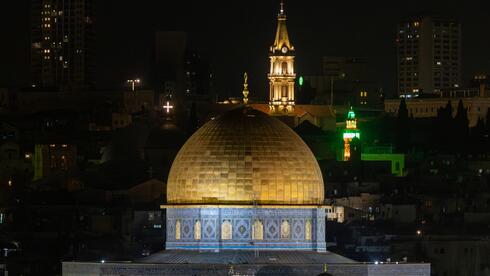
For 59th Jerusalem Day, the capital’s illuminated churches, monuments and public buildings offer a free nighttime tour through history, architecture and light, revealing a side of the city that looks strikingly different after darkIlluminating significant buildings is a powerful form of visual design, using light to “sculpt” their unique features and bring out details that remain visible even after dark. That is true around the world, and even more so in Jerusalem, where buildings from different periods, some hundreds or even thousands of years old, stand side by side.Advanced lighting techniques in Israel and abroad are used to emphasize architectural lines, materials, details and ornamentation that can be swallowed up by daylight. Smart lighting can transform a building into an impressive nighttime work of art, adding another layer to its appearance during the day. 16 View gallery The Dome of the Rock and Monastery of Saint Saviour(Photo: Dor Pazuelo)This is not merely functional illumination, but lighting that gives a building “soul,” creating a play of light and shadow that intensifies its physical presence in the urban landscape.From both a tourism and architectural perspective, illuminated buildings become major attractions, drawing visitors after sunset and extending the hours of activity at key sites. Cities around the world have embraced this idea long ago, and Jerusalem has followed suit: more than 20 buildings across the city have been illuminated through the work of the Jerusalem Development Authority, the Jerusalem Municipality, the Tourism Ministry, and the Ministry of Jerusalem Affairs and Jewish Tradition.16 View gallery Every empire wanted a foothold in Jerusalem: The Holy Trinity Cathedral(Photo: Dor Pazuelo)16 View gallery The Holy Trinity Cathedral was built at the initiative of the Russian Empire(Photo: Dor Pazuelo)About 10 more buildings are expected to be illuminated later, creating additional magnets for evening tours after nightfall.For the 59th Jerusalem Day, the capital is inviting visitors to take a journey among buildings that are far more than stone and plaster. The buildings, of course, are illuminated year-round. Here are several that are worth visiting tonight as well. Given that Jerusalem has been one of Israel’s quieter destinations over the past year, and since October 7 in particular, the city is well worth visiting year-round, not only around Jerusalem Day. Better still, these are free public-space attractions, with no opening hours or admission fees to consider.At the heart of the Russian Compound (known in Hebrew as the “Moskoviya,” a distortion of the word Moscow, as Jerusalem tour guide Roi Damari explains), stands the Holy Trinity Cathedral, built in 1872 at the initiative of the Russian Empire.16 View gallery The YMCA, with motifs reminiscent of the Empire State Building(Photo: Dor Pazuelo)The structure, designed in a neo-Byzantine style with Russian influences, stands out for its pale Jerusalem stone and the green dome above its pointed towers. The interior is impressive, but even viewed from the outside after dark, it is a striking sight.One of the city’s best-known buildings is the YMCA on King David Street, built in 1933 for the Young Men’s Christian Association. Architect Arthur Loomis Harmon, who also designed the Empire State Building, and whose influence is clearly visible in some of the YMCA’s features, created a complex inspired by the three major monotheistic faiths associated with Jerusalem: Judaism, Christianity and Islam.16 View gallery A center for culture, recreation, education and tourism: The Jerusalem Internatioanl YMCA(Photo: Dor Pazuelo)16 View gallery Another Russian legacy: The Church of Mary Magdalene(Photo: Dor Pazuelo)One of the building’s crowning features is a 40-meter bell tower that does not merely tell the time, but also “plays” music through the work of a veteran bell ringer. He is now preparing to retire and is training the next generation in the unusual profession.Another defining feature of the Jerusalem International YMCA, though less immediately apparent visually, is its ethos of brotherhood and tolerance. It allows people of all religions and communities to take part in cultural events, including concerts and performances, sports activities, with an indoor pool and courts, and leisure events, including its well-known bustling Christmas market. It also hosts educational programming, camps and vacations, with lodging in the hostel floors of the building.This is one of Jerusalem’s most beautiful and spectacular buildings, immediately recognizable by its gleaming golden domes. The church was built in 1888 at the initiative of Czar Alexander III and his mother, Maria, in memory of Maria Alexandrovna, the wife of former Czar Alexander II, who died that year.16 View gallery The Church of Mary Magdalene is also illuminated by laser beams from the “High Light JLM” audiovisual show
The capital in lights: Jerusalem Day landmarks to see
For 59th Jerusalem Day, the capital’s illuminated churches, monuments and public buildings offer a free nighttime tour through history, architecture and light, revealing a side of the city that looks strikingly different after dark
2,178 words~10 min read