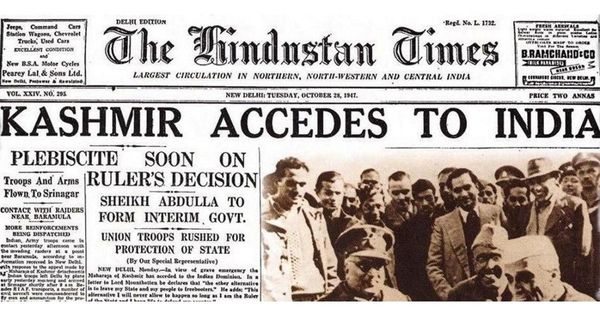
Pakistan’s accusation that Mountbatten and the British government conspired to ensure that Kashmir went to India rests on the assumption that the British had strategic interests in Asia that they would need to safeguard even after leaving India, and that, in their considered judgment, India would be a much more reliable and effective guardian of these interests than Pakistan.
In his book, Kashmir: A Disputed Legacy, Alastair Lamb identified the strategic purpose to be the monitoring of Soviet activities in Central Asia with a view to checking Soviet expansion in a southerly direction. For this, keeping tabs on Sinkiang was essential, and that could be done only from the northernmost parts of Kashmir – ie, Gilgit and Hunza. Lamb based his conclusion that the British had conspired with India over Kashmir almost entirely on Mountbatten’s decision to retrocede Gilgit and Hunza to the Maharaja of Kashmir in 1947, instead of transferring the 60-year lease of the area signed with Maharaja Hari Singh to Pakistan, which, he believes, would have been in accordance with the principles of Partition laid down in the India Independence Act.
Pakistan first made this accusation before the UN Security Council in January 1948, when it was defending itself against India’s charge of aggression in Kashmir. The charge had no substance even then, for, as is shown later, British interests – and the role Britain played in the Kashmir dispute – were the exact opposite of the one Pakistan accused it of playing.