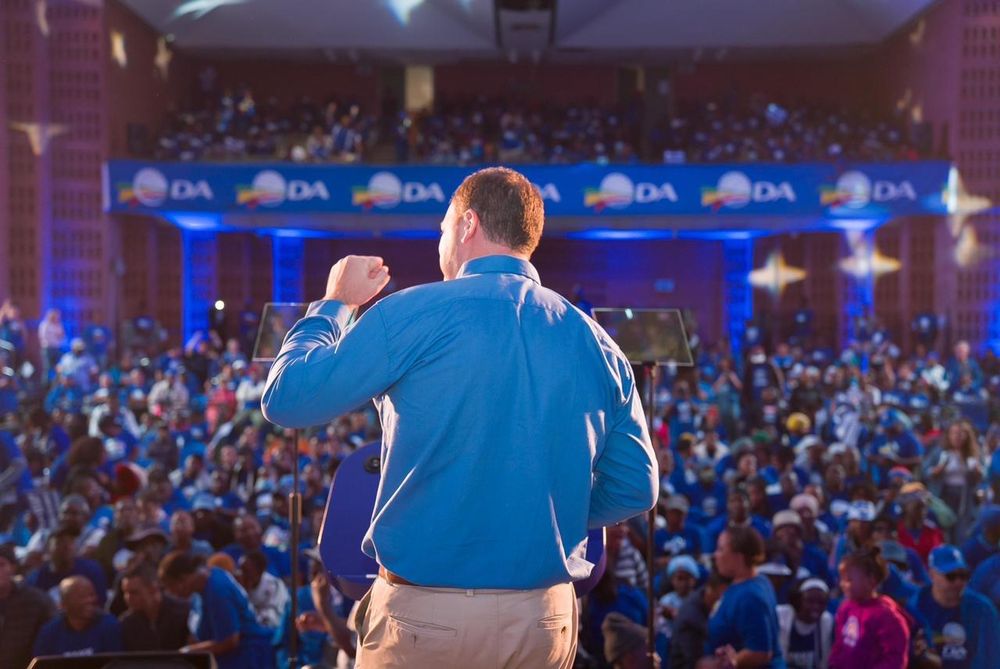
Newly elected DA federal leader Geordin Hill-Lewis made some striking remarks in his acceptance speech on April 12. “The question”, he first asked, “is whether the DA can lead the country. Whether we can become the largest party in national government.” The new leader’s answer was a “resounding Yes. Yes we can.” He continued by setting out the “mission you have assigned to me: to grow the DA into the largest party in South Africa and to lead a new national government”. Reactions to the federal leader’s mission statement focused on the first element, with many commentators rightly observing that winning the biggest vote share will be a huge task. Equally taxing, though, will be the second challenge with which Hill-Lewis conflates the first: converting largest party status into the ultimate prize of leading national government. After all, it is quite common in democracies for the largest party to find itself excluded from the governing coalition. Ideologically it may sit at one end of a spectrum, allowing centrist and smaller parties to form an alternative “anyone but them” blocking coalition. Smaller parties may also prefer to coalesce, because doing so avoids the condescension and disadvantage that befall a “junior partner”. Moreover, if the largest party rejects patronage politics, smaller resource-seeking parties that need to feed their impoverished activists and voters may simply decide to eat together. Meanwhile, we do not have a process for selecting a formateur, the person initially tasked with trying to form a government. This role is likely to fall by default to the president elected within 14 days of the election outcome, and there is every chance he or she will not be the leader of the largest party, especially if the largest party is the DA. The formateur, as President Cyril Ramaphosa has shown, gets to shape the initial proposal, the portfolio distribution and the policy compromises that are on the table. This agenda-setting power matters because the first credible offer usually anchors subsequent negotiations. A DA leader could perhaps assemble a “removal van” coalition forged primarily to eject the governing party, rather than united around other shared commitments. The “moonshot pact”, the minefield of exploding egos through which John Steenhuisen picked his way, serves as a reminder of how dangerous such an enterprise can be. Hill-Lewis’ speech suggests he has been tasked personally by his party with “leading a new national government”. However, he will be confronted with the most dismal question any ambitious but pinkish SA politician must ask: can a white man like me really become president? A DA leader could perhaps assemble a “removal van” coalition forged primarily to eject the governing party, rather than united around other shared commitments. Of course, around the world party leaders quite often decide not to seek the premiership themselves and designate someone from their party who is more acceptable to potential coalition partners. The most striking modern example is India in 2004. When a Congress Party-led coalition came to power, its chair, Sonia Gandhi, unexpectedly relinquished the prime ministership to Manmohan Singh. The official narrative centred on Gandhi’s “inner voice”, but the reality was more complex. Her Italian birth had become controversial, and there were legal challenges being prepared against her eligibility. Singh was chosen precisely because he was a technocrat who could hold a fractious coalition together. He was respected, non-threatening to coalition partners, and lacking any independent power base. The DA leader might likewise select a coalition-compatible presidential nominee while exercising real power himself behind the scenes. This Putinesque manoeuvre is also something an ailing ANC is quite likely to attempt. Finally, of course, there could always be an agreement among two equally matched parties, the DA and the ANC, to back a president from a mutually acceptable third party, such as the IFP. President Velenkosini Hlabisa, anyone? • Butler teaches public policy at the University of Cape Town.
ANTHONY BUTLER | DA faces coalition challenge despite largest party hopes
Parties could back third-party candidate for president if it comes down to power play
647 words~3 min read