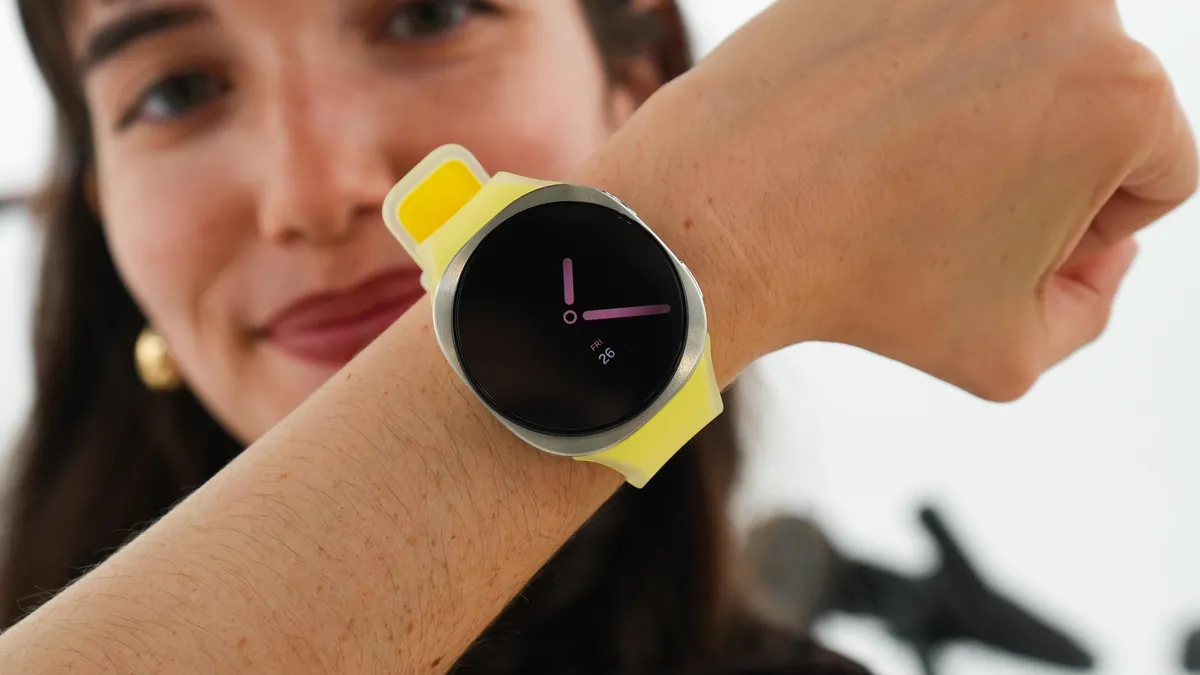
Uganda's Jacob Kiplimo crosses the finish line at the Lisbon Half Marathon on March 8. He set a world record of 57 minutes 20 seconds wearing a Galaxy Watch8 as part of Samsung's Team Galaxy athlete roster. (Samsung Electronics) Samsung Electronics on Thursday walked reporters through how the Galaxy Watch and Samsung Health support runners with training and recovery, framing the platform as its long-term play in Korea's booming running market.The demand signals at home are strong. Running rates among Koreans aged 10 and over climbed to 7.7 percent in 2025 from 4.8 percent the year before, a roughly 60 percent jump, according to the Ministry of Culture, Sports and Tourism's annual sports survey of 9,000 respondents. Smartwatch usage among Korean adults reached 33 percent in 2024 and 2025, up from 12 percent in 2020, a Gallup Korea survey found.Samsung Health has roughly 77 million monthly active users and 46 million weekly active users worldwide, with running the most-logged workout category, said Choi Joon-il, vice president of the Mobile eXperience Division's Digital Health Team."Korea's share runs even higher than the global average," he added.What Samsung emphasized as its differentiator was not any single feature but the integration. "We don't look at running on its own," Choi said. "Running sits inside comprehensive health management, alongside sleep, nutrition and even mental health and cardiac signals." Choi Joon-il (left), who heads strategy for Samsung Electronics' Digital Health Team, and former national marathoner Kwon Eun-joo take questions at a Galaxy Watch running briefing Thursday in Seoul. (Samsung Electronics) Kwon Eun-joo, a former national marathoner who helped develop Samsung's Running Coach program, walks reporters through the service at a media briefing Thursday in Seoul. (Samsung Electronics) The clearest expression of that pitch is Running Coach, launched in 2025. A 12-minute test assigns users a fitness level from 1-10, benchmarked against distances from 5 kilometers to a full marathon, then matches them to one of roughly 160 training programs covering long runs, tempo runs, intervals and hills.Former national marathoner Kwon Eun-joo, who held the Korean women's marathon record for 21 years, helped develop the program with researchers at Dongguk University. She said the team anchored the design in heart-rate-based pacing rather than time targets, with real-time voice guidance to prevent over-pacing.Kwon, who recently completed the London Marathon as part of her bid to finish all seven World Marathon Majors, said she now uses the watch mainly for recovery signals."After London, my sleep score came back at 53, and my heart rate hit 190 right out of the gate on a 7K run the next morning," she said. "The watch told me to pull back. That's the kind of guidance ordinary runners need most."The competitive backdrop is unforgiving. While global smartwatch shipments grew 4 percent year-on-year in 2025, Samsung's fell 12 percent, and its market share slipped to 7 percent from 9 percent, with Apple, Huawei and Xiaomi all gaining ground, according to Counterpoint Research. The $200 to $400 segment, where Galaxy Watch competes, surged 48 percent as buyers traded up for health features.
Samsung doubles down on running as wearable race tightens
Samsung Electronics on Thursday walked reporters through how the Galaxy Watch and Samsung Health support runners with training and recovery, framing the platfor
508 words~2 min read