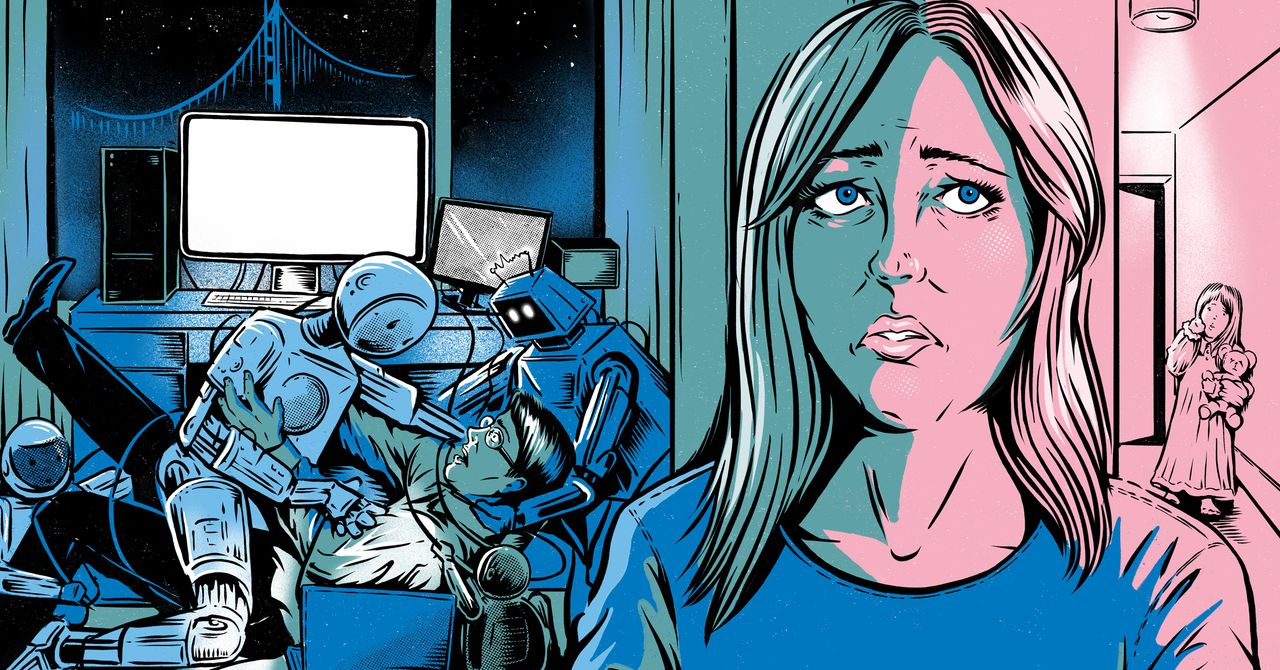
IF I HAD to listen to another minute of my husband talking about Claude Code, I might have actually died. It was 11 pm in Berkeley, California, where I was home alone with our 10-month-old daughter, and 2 am in Cambridge, Massachusetts, where he was visiting for his newish job in AI. “JUST LOOK AT THIS!” he shouted. The FaceTime camera zoomed toward a laptop sitting on a hotel bed. “SEE?!”
See what, I thought. I wanted to shower. I still had to take the dog out.
“ARE YOU LOOKING?” he shouted again. I wasn’t. I was looking at our real baby. But that’s the thing. There are two babies in this household now: the small human one and the large language model. Both demand constant attention. Both keep us up at 2 am.
Is this a Sophie’s choice kind of situation? Please. I’d kill the AI baby in an instant.
THERE’S A STRANGE and under-discussed side effect of the AI boom: what it’s doing to family dynamics. By which I mean: how it’s potentially destroying family dynamics. I’m sure this applies to all kinds of families, gay or straight, rich or poor, with any AI-pilled members. The technology is coming, has come, for us all. But for the purposes of this story, I mostly spoke to white-collar heteros in the Bay Area, because that’s where a certain psychological crisis seems most acute. Often it goes like this: He works in AI, and she does everything and anything else. Other times, it’s bleaker: He desperately wants to work in AI—or feels he must work in AI—and she wants him to do literally anything else.