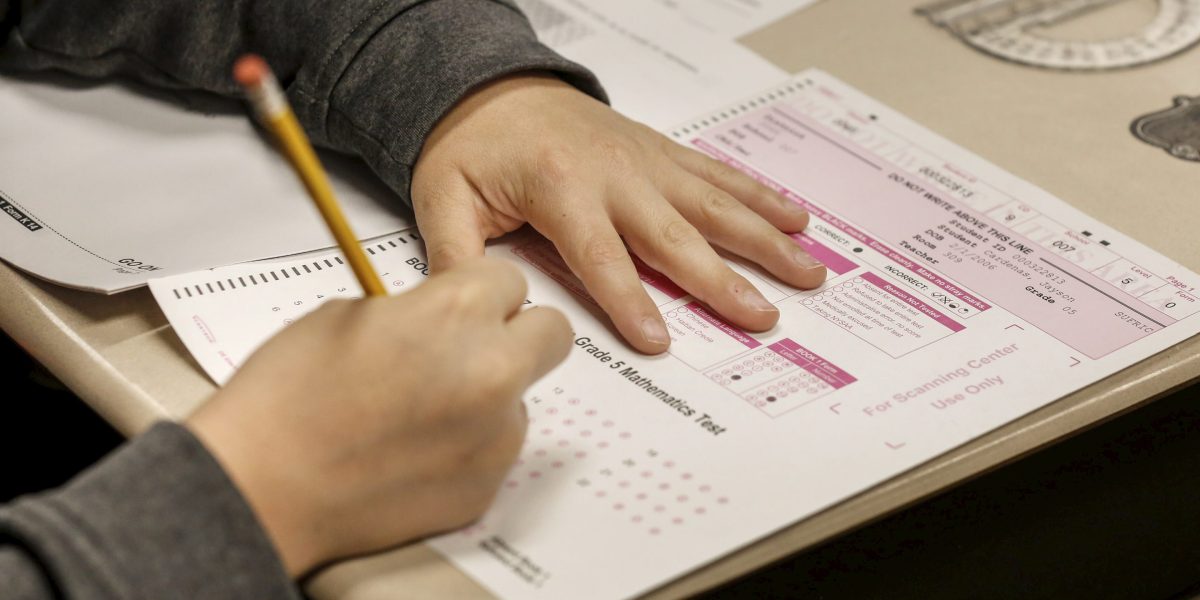
How much does that stick tell us?gettyEveryone agrees that more student achievement is a good thing, and that teacher effectiveness is highly desirable. But not everyone can define those terms. That’s a problem.The Education Consumers Foundation published a Tennessee teacher prep report card showing that “the state's programs are turning out more ineffective new teachers than effective ones.”A new study adds to the literature that argues that school phone bans have no effects on academic achievement. The results overall are complicated, but because phone bans don’t increase student achievement, they are being reported as “close to zero impact.”Growth mindset had a moment several years ago, until research showed that it generally had no positive effect on student achievement.But what does that actually mean? In practice, it is all about scores on a single standardized test of reading and math. When researchers write about studies, they sometimes use, at least, some version of the phrase “student achievement as measured by test results.” Journalists, lawmakers, and people sitting at the local diner more commonly just say "student achievement.’Sometimes the test results may be framed as “days or months of learning," a phrase that simply means a certain amount of test score change. Some states still use “value added” numbers (VAM or VAAS), a widely debunked process that runs test score numbers through a formula that is supposed to compare actual test results to hypothetical test results from a parallel neutral universe.MORE FOR YOUIt’s still just scores on a single standardized reading and math test. How might many parents define high student achievement? Are students familiar with classic works of literature? Are they able to read, reflect on, and interpret full-length works? Do they have appreciation of music and art? Can they explain and discuss major historical events? Do they know and understand fundamentals of several science disciplines? Are they able to execute and interpret experiments? Can they balance a checkbook and change a flat tire? Do they maintain good social, emotional and physical health? Do they have command of “soft skills” related to communication and cooperation? Are they able to hold a conversation about complex issues? Do they have a basic understanding of how American government works? None of those questions are answered by state testing. There is some use for the data coming from the annual ritual of testing math and reading. But to call those results a measure of student achievement or teacher effectiveness is misleading at best. A new survey from EdChoice shows that when it comes to knowing if a student has had a successful year, only 17% of teachers say that standardized test scores are important. Narrowing the definition of student success means narrowing the mission of schools. Multiple studies have found that the high stakes testing that emerged from the push for Common Core resulted in a narrowing of the curriculum-- if it’s not on the test, many districts decided, then it was not a priority.The high stakes attached to the state tests has been somewhat reduced. Proposals like “The Widget Effect” tried to promote the idea of firing or promoting teachers based on their students’ test scores, and that has largely not happened.But even if the official high stakes are reduced, the notion that test scores on the state standardized test are a full measure of student achievement has taken hold in public discussion of education policy. The Alpha School claim that students can be successfully taught in just two hours on computer seems incredible, but if the measure of student success is standardized test scores on math and reading, then two hours a day should be plenty of time for schooling.Research and reporting that treat standardized math and reading scores as the full measure of student achievement do a great disservice to students, teachers, and anyone else who cares about the quality of education in this country. We are using measuring the depth of a body of water with a ruler and declaring that we know the quality of the water, the width of the basin, and the variety of fish in the lake. If we must talk about those test results, let’s stop dressing them up as something larger and more important than they truly are.
Beware Studies Of “Student Achievement”
If we must talk about those test results, let’s stop dressing them up as something larger and more important than they truly are.
703 words~3 min read