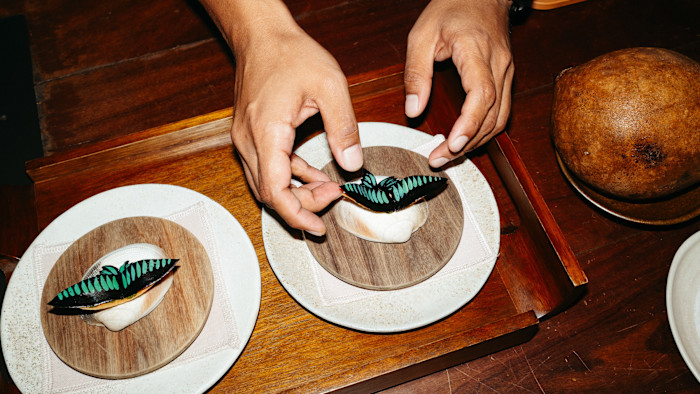
At two-Michelin-starred Dewakan in Kuala Lumpur, the tasting menu features a canapé modelled on the Rajah Brooke’s birdwing, a butterfly native to Malaysia. Making it starts with fruit from the belinjau tree. The team manually extracts the kernels, removes the skins and pounds them into a paste, which is pressed and baked into a cracker. The wings are made separately using keranji, a wild forest fruit with a brittle shell and a tamarind-like pulp that is just as labour-intensive to process. To finish, a savoury paste of chayote leaf shoots is spread on the cracker, preserved keranji pieces are added and the wings are draped on top. “It’s a highly manual process that takes several days to complete,” says chef Darren Teoh.
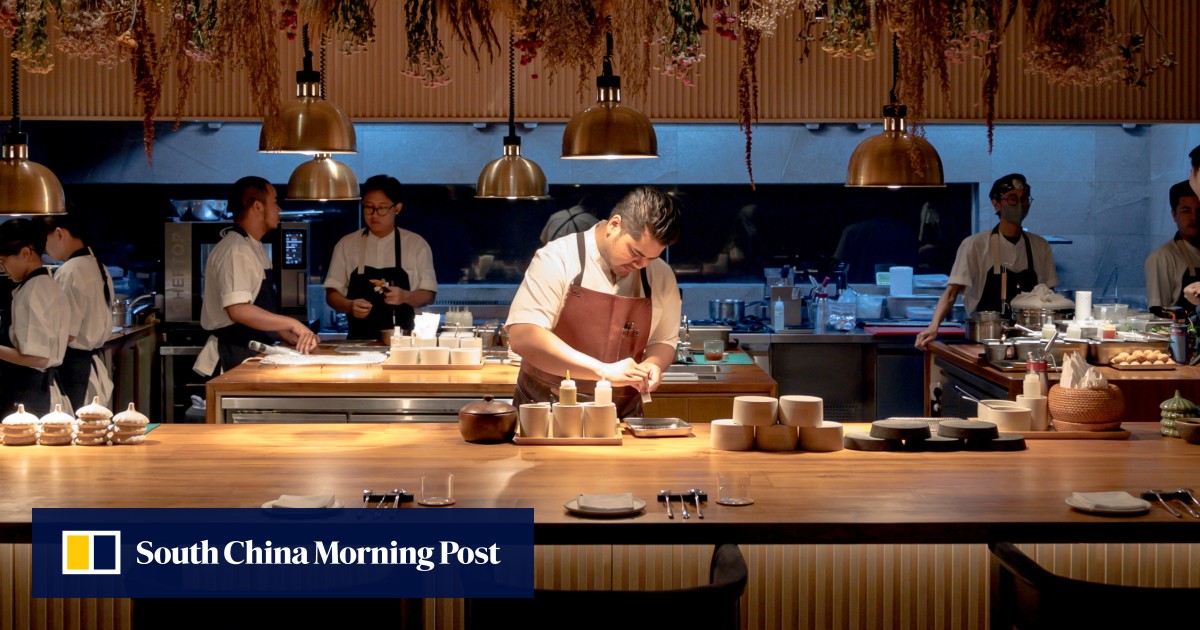
Dewakan’s head chef Darren Teoh (right) is assisted by Hong Keh Lin in the restaurant © Paulius Staniunas
It’s tempting to wonder how anything as brief and bitesized as a canapé could be worth the effort. But in fine dining, that’s often the point. “The effort is an exercise in focus: distilling flavour, technique and balance into a single bite,” says Teoh. “The fact that a dish disappears in seconds is precisely what makes it meaningful.”
At Zén in Singapore and FZN in Dubai, Björn Frantzén’s Råraka canapé requires turning Agria potatoes into thin, even strings, wrapping them around steel tubes, frying, dehydrating and frying them again before filling them with whipped crème fraîche and topping with vendace roe. “In two bites it’s gone,” says Frantzén, “but in the kitchen, it has deflated generations of young chefs.”