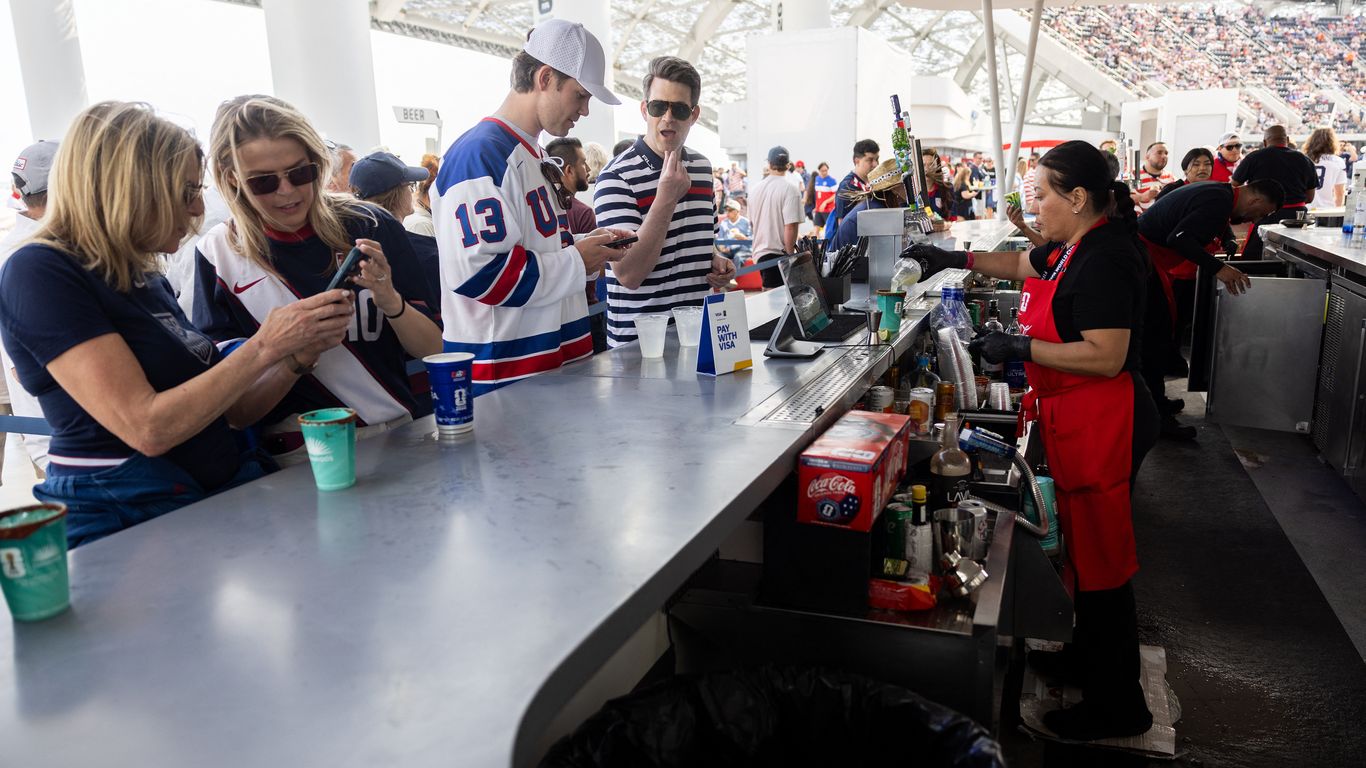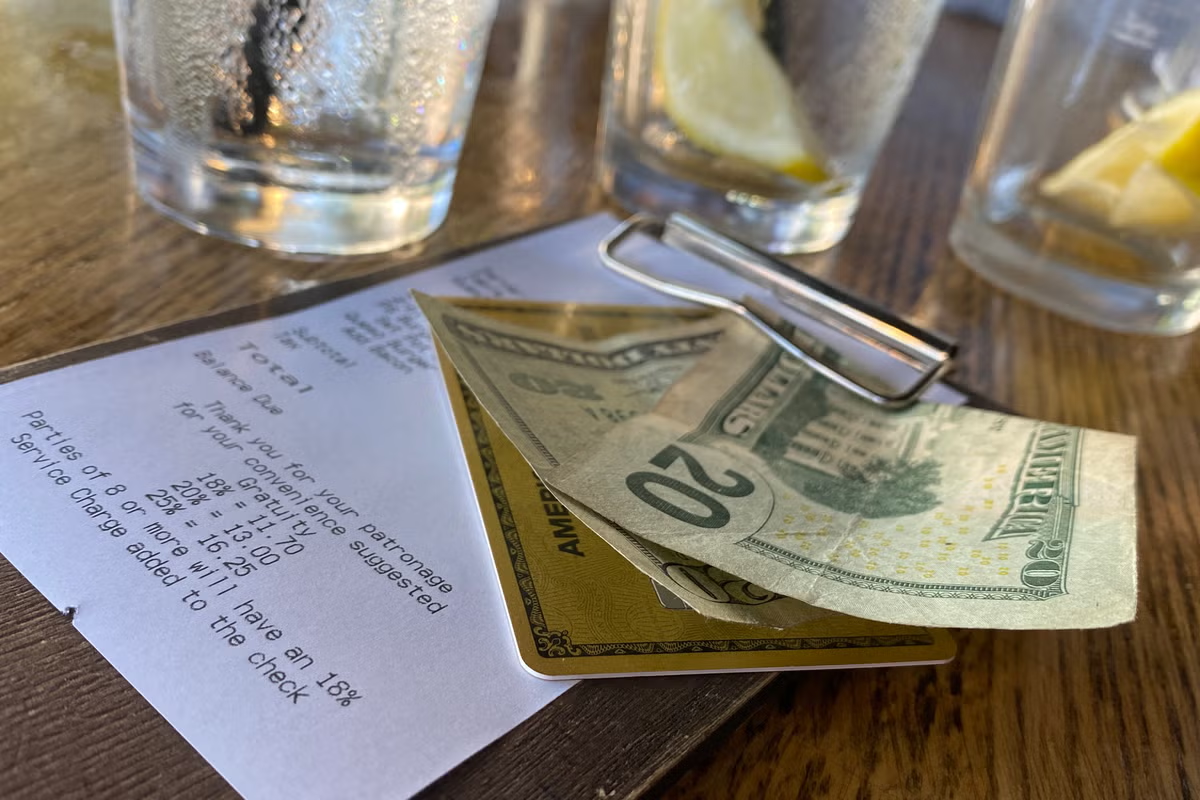
The "no tax on tips" deduction would be lost if restaurants add in a mandatory service charge during the World Cup.gettyIn just over a month, more than one million additional international tourists are expected to visit the U.S. for the 2026 FIFA World Cup. The tournament is expected to generate nearly $6 billion in direct visitor spending in the U.S., but a twist may result in an unintended side effect: more taxes on U.S. tipped workers. An effort to force foreign tourists to tip may mean that servers who were slated to benefit from “no tax on tips”—a temporary tax deduction Republicans passed last year to fulfill a campaign pledge by President Donald Trump—will find more of their total compensation is taxable. That’s because, according to IRS regulations, the only tips that qualify for the up-to-$25,000 tips income tax deduction are those paid voluntarily, not as part of a mandatory service charge.The FIFA tournament, hosted by the U.S., Canada, and Mexico, is scheduled to kick off on June 11, 2026, and will wrap at MetLife Stadium in East Rutherford, New Jersey, on July 19, 2026. The average visitor is expected to stay 12 days and spend approximately $400/day (high spenders, including corporate sponsors, and those who pay for pricy VIP packages, will likely spend upwards of $1500/day).That’s a lot of extra income flowing into the U.S. hospitality sector. But one group is worried about potentially missing out on revenue—restaurants. That’s because the tipping culture in the U.S. is very different from the tipping culture in most other countries. To combat this, U.S. restaurants are considering tacking on a mandatory 20% service charge.How Tipping Works in Most Countries In most developed countries, tipping is not the primary compensation for service workers. Instead, wages tend to be higher and tips—if they exist—are supplemental or symbolic.In much of Western Europe, tipping practices are modest and informal. Countries such as France, Germany, Italy, and Spain typically include a service charge in menu prices or bills, either explicitly or implicitly through higher wages. As a result, tipping is not mandatory and is often limited to rounding up the bill or adding a small percentage for good service. Workers are paid at or above the minimum wage without relying on tips.In the United Kingdom and Ireland, tipping is more common, especially in restaurants, where a 10–12.5% service charge is often added automatically. If a service charge is included, additional tipping is not expected. While tips can subsidize wages, wages are still primarily how service employees are paid.In parts of Latin America and the Middle East, tipping is usually included as a service charge. Additional tipping is optional and typically modest. Workers often rely on a fixed wage as opposed to discretionary tips. In Canada, tipping is customary—typically 15–20%—and historically, some provinces allowed a lower minimum wage for tipped workers. However, many provinces like Ontario and British Columbia have moved to eliminate the tipped minimum wage supplement, requiring employers to pay the full minimum wage regardless of tips. In Australia and New Zealand, tipping is minimal and not expected. Service workers receive relatively high hourly wages under national wage standards, and restaurant prices reflect those costs.In East Asia, tipping practices vary widely but are often discouraged. In Japan and South Korea, for example, tipping is generally not customary and may even be refused. As a result, workers are paid a base wage that does not rely on tips.How Tipping Works in the U.S.In contrast, most servers in the U.S. depend on tips for compensation since base pay may be less than the required minimum wage.Under federal law, which applies in all states unless a state imposes stricter requirements, employers may pay tipped workers a cash wage of $2.13 per hour. However, the federal minimum wage is $7.25 per hour. If the total of the employee’s cash wages and tips does not meet the minimum wage, the employer must make up the difference. This obligation is mandatory, not discretionary. The state treatment of tipped workers varies widely.A number of states, including several in the South, follow the federal rules. In these jurisdictions, employers may pay the minimum cash wage of $2.13 per hour and rely on tips to bring the employee up to the minimum wage threshold. That includes states like Texas, Georgia, North Carolina, and Tennessee. Some states require employers to pay the full state minimum wage, regardless of tips. In these jurisdictions, tips are treated strictly as gratuities belonging to the employee and cannot be used to offset the employer’s wage obligation. States such as California, Washington, Oregon, Alaska, Nevada, Minnesota, and Montana follow this approach. The remaining states have a hybrid approach. In these states, employers may still count tips toward meeting minimum wage requirements, but both the required minimum wage is higher than under federal law. For example, an employer might be required to pay a wage in the range of $6 to $14 per hour, with tips making up the difference to a state minimum wage that could fall between $12 and $17 per hour. States that use this approach include New York, New Jersey, Florida, Illinois, Arizona, and Colorado. How Wages Are Taxed, GenerallyTips have always been considered taxable income. And, for federal income tax purposes, the split—what’s paid as a wage by the employer and what an employee receives as tips—doesn’t change what gets taxed. The IRS taxes the employee’s total earnings, both wages paid by the employer and tips received from customers.Here’s how that works. Employees are required to report their tips to their employer. Specifically, if an employee receives $20 or more in tips in a given month, they must report those tips, typically using IRS Form 4070 or an employer-provided reporting method. Once tips are reported, the employer must treat them as wages for withholding purposes. This means withholding federal income tax, as well as Social Security and Medicare taxes (known as FICA taxes), from the combined total of wages and reported tips. The employer must also pay its matching share of FICA taxes. At year-end, the employer includes both the employee’s wages and reported tips on the employee’s Form W-2. In larger food and beverage establishments—generally those with more than 10 employees and a customary tipping environment—additional rules apply. These businesses must ensure that total reported tips equal at least 8% of the establishment’s gross receipts, unless a lower rate is approved. If total reported tips fall below that threshold, the employer must allocate additional tip income among employees. These “allocated tips” are reported on the employee’s Form W-2 and are not subject to employer-level withholding. Instead, the employee is responsible for reporting and paying tax on those amounts when filing their individual return.If an employee fails to report all of their tips to their employer, they are still legally required to report the full amount of tips they received on their individual income tax return. But, it could cost them—Social Security and Medicare taxes (FICA taxes) would not have been withheld from those amounts, to the employee must calculate and pay the uncollected FICA taxes using Form 4137. How Wages Are Taxed Under the One Big Beautiful Bill Act (OBBBA)As a result of OBBBA, which President Trump signed into law on July 4, 2025, tipped workers can deduct up to $25,000 in qualified tips from their taxable income. The so-called “no tax on tips” provision is a temporary deduction effective from 2025 through 2028. That includes 2026—the year of the World Cup.Qualified tips are considered payments earned in a recognized tipped occupation, paid voluntarily by customers, and given in cash or its equivalent.To qualify, the tips must be voluntary. That means that mandatory service charges, often added automatically to restaurant bills, do not qualify. Ditto for automatic gratuities or any “tip” or charge which the customer has no discretion to modify or disregard—those are not qualified tips. This treatment was confirmed earlier this year under the IRS final regulations.What Restaurant Owners Are ProposingSince tipping norms outside of the U.S. are very different, visitors to the U.S. during the World Cup may not be less inclined to leave a significant tip. Some restaurants are proposing an extra 20% service charge to make up the difference. The fee would apply to all customers.While a mandatory service fee may make regular customers grumble—especially since many may expect the charges to become routine, à la those “temporary” credit card fees that have now made their way onto checks—it creates a bigger problem for tipped workers. Under the IRS final regulations, those service fees would not be considered qualified tips for purposes of the tipping deduction. The result? Those tips are all 100% taxable to the employee. It may also cause headaches when it comes to recordkeeping. Some restaurants have proposed tacking on a fee just for the 39 days the World Cup is in the U.S. If that happens, it could create two tiers of tips in the same reporting year for employees who would normally receive only voluntary tips, making sorting out reporting more confusing.Other Solutions ExistAs someone who loves to travel, I must admit that I find this solution—the mandatory service fee as a way to sidestep cultural norms—a little lazy. Outside of the U.S., especially in the UK and parts of Europe, it’s common to see tipping or service charge policies clearly printed on menus. You might read “A discretionary 12.5% service charge will be added to your bill” or “All prices include service, no additional gratuity required” printed on a menu to educate you about existing tipping policies. It’s great for U.S. tourists who travel abroad, and it should be easy enough to do the same in the U.S. for tourists coming to the country.It could look something like this: In the U.S., restaurant servers rely on tips as part of their income. Gratuity is not included; guests typically leave 18–22% for good service. It’s easy enough for the restaurants to do the math, too. Like you, I’ve seen this work on printed receipts where suggested tips are already calculated, spelling out clearly what a 18%, 20% or 22% tip might look like.The result? Tourists would understand what’s expected of them. Even better? Tipped workers would get their full tips—and they won’t lose the benefit of the tax deduction.ForbesIRS Issues New ‘No Tax On Tips’ Rules—Here’s Who QualifiesBy Kelly Phillips ErbForbesWarning: New IRS Instructions Limit ‘No Tax On Tips’ Deduction For Gig WorkersBy Kelly Phillips Erb
World Cup Tipping Practices Could Undercut ‘No Tax On Tips’ Break
An influx of World Cup tourists from countries with different tipping cultures has restaurants eyeing mandatory service charges. But workers could lose the tips deduction.
1,740 words~8 min read