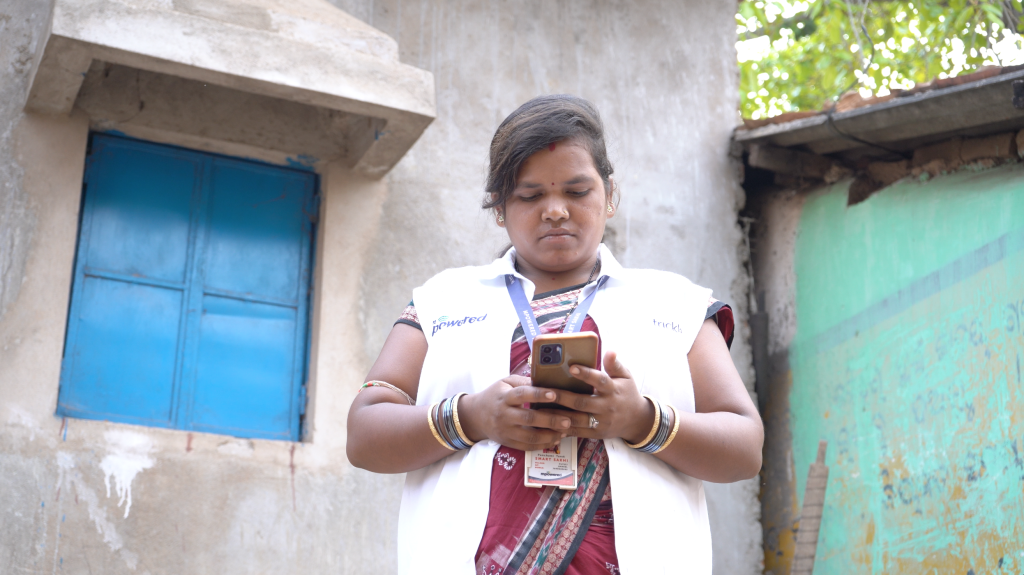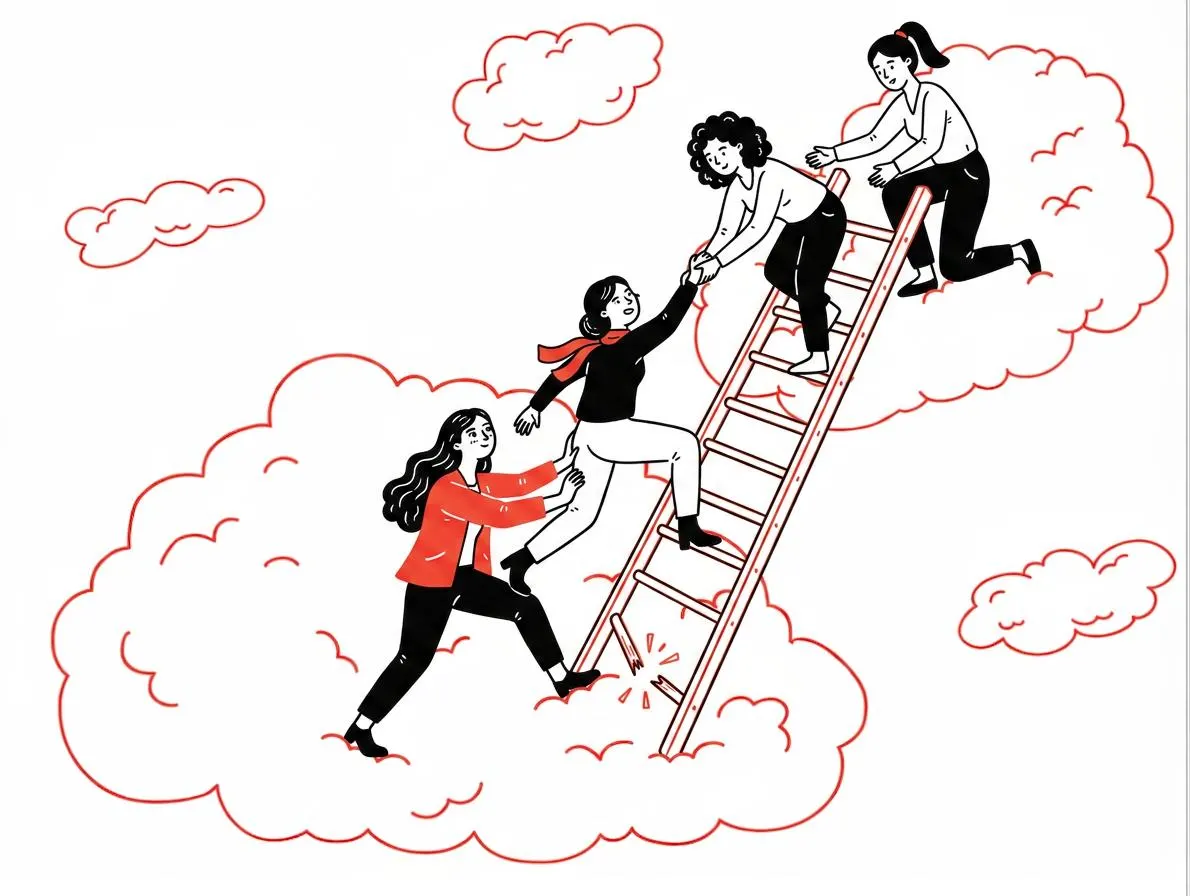
When women with access choose to extend it, the Exposure Gap closes one hand at a time.Image generated with Nano Banana 2 / Google GeminiEvery few months, a new report lands confirming what most of us already know: The AI revolution is leaving women behind. The numbers are clear. The analysis follows. And somehow the conclusion keeps landing in the same place. On women themselves. Are they hesitant? Underskilled? Too stretched to keep up?That framing flattens women into a single story. It fails to address those already inside the system, already in the pipeline, already at the table. It says nothing about the woman managing a household and a career with no institutional support. The caregiver who doesn’t have a manager pushing her in a new direction. The woman two jobs away from where she wants to be, figuring it out alone. These women aren’t a footnote in the conversation about women in the workplace and AI. They’re the majority of it.As a mother, as a technology executive who spent years working toward this seat in industries where experimenting with AI wasn't exactly welcomed, I don't see a women problem. The signal hiding in plain sightThe McKinsey and LeanIn Women in the Workplace 2025 report, now in its eleventh year, has a finding buried inside that should be driving much more urgency than it is. The report is a joint effort between McKinsey, whose senior partners Kweilin Ellingrud and Lareina Yee literally wrote the book on the broken rung this year, and LeanIn, the organization Sheryl Sandberg founded in 2013. Between them, they've spent decades tracking this issue. Yes, the broken rung persists. Only 93 women are promoted to manager for every 100 men. That gap compounds year over year.But here's the part people are sleeping on: only 21% of entry-level women say their managers encourage them to use AI tools. For men at the same level, it's 33%.That's not a perception gap. It's a system failure. The same data shows that when employees are encouraged to use AI, they're more than 50% more likely to actually do so. This isn't about capability. It's about whether someone with credibility looks at you and says, This is for you, too. For most early-career women, that signal never comes. And when it doesn't, the broken rung doesn't just hold. It gets harder to see. This is what the Exposure Gap looks like in numbers.MORE FOR YOUWhat I see on my own teamAt Forbes, AI adoption is not a technology initiative. It's a leadership mandate, one I've driven deliberately across every function, every level, every role. Engineers are shipping faster. Product managers are moving from insight to decision without losing a week. Designers are pressure-testing ideas before committing a single pixel. And beyond team productivity, we're rethinking how readers actually experience Forbes: how we find them, engage them, keep them. AI is not a back-office efficiency play for us. It is core to what Forbes becomes next.The women on my team are not reluctant. They are not slow. They are often among the sharpest early adopters on the floor. The difference isn't gender. It's that I am modeling this from the top, and my leadership team across genders is doing the same. That's the variable.We talk endlessly about the "boys’ club" at the top of the AI and technology industry. AI thought leader, investor and co-founder and CEO of Affectiva Rana el Kaliouby said it plainly at SXSW: if women are left out of founding, funding and building AI companies, "we're going to look back five years from now and we're going to have widened the economic gap like crazy." She's right. But the solution can't live only at the founding and funding levels, inside startups and venture portfolios. It has to live inside established companies, where most people actually work, in the daily practice of who gets encouraged to experiment and who gets handed access first.The motherhood multiplierThere's another layer here that rarely gets said plainly. Founder of Girls Who Code and Moms First Reshma Saujani put it directly at TIME's 2026 Women of the Year Leadership Forum: "The biggest thing in women’s leadership that’s been left out is motherhood." In the AI conversation specifically, it’s almost absent.I didn't get here by waiting for someone to hand me the opportunity. I got here by working for it and asking for it, repeatedly, in rooms where asking felt presumptuous, in jobs where the culture didn't reward people who put their hand up. I pushed myself to earn my master's degree and paid for it myself. I learned on my own time—not in a funded training program or during a sponsored innovation sprint. In the hours after my kids fell asleep at night, with my husband was covering the home front and no broader village backing us up, I was working in roles where AI experimentation wasn't part of the culture and definitely wasn't part of my job description.I'm not telling that story as a blueprint. The system should not demand what it required of me. But waiting for the system to change is its own kind of risk. The tools available today make this easier than it used to be. Not easy. Easier. That distinction matters.The broken rung hits hardest at exactly the moment when many women are navigating early parenthood. And it isn't only mothers — it's anyone carrying an invisible second shift. The woman caring for an aging parent. The one holding together a household on a single income. The one for whom "just go learn this" competes with everything else life requires. The first promotion window, the critical skill-building years, the moment you most need someone to put your name forward: all of it lands during the season when cognitive load is highest and slack time is lowest. Now layer AI adoption on top of that.Used well, AI can actually reduce that load. It can give time back. It can level the field for a working mother staring down a 6 a.m. inbox, for a caregiver stealing thirty minutes between responsibilities, for any woman who has had to do more with less just to stay in the game. But only if someone actually hands it to her and means it.The gap no one is namingHere's how the conversation about women and AI usually goes. Either women need to move faster, adopt earlier or lean in harder. Or the industry needs more women and non-binary people building and funding AI. Both are true. I believe both. But neither one explains what I see every day.Neither of those arguments lives inside a company. Neither shows up on a team. Neither is in the room on a Tuesday afternoon when someone decides who gets pulled into the new initiative and who doesn't. Who gets told their instincts are worth trusting. Who gets access first. That's where this actually gets decided. Not in venture portfolios or policy papers, but by leaders making small decisions every single day.What we don't have enough of are women and non-binary leaders who are visibly, credibly doing this work and bringing their teams with them. Not as a program. Not as a stated value. As a flat expectation.That is the gap I keep coming back to. Not reluctance. Not pipeline. The absence of modeling at the level where it actually changes outcomes.I call it the Exposure Gap. Who gets access early determines who leads later. Full stop. Right now, in AI, women are losing that race before they even know it's started.If you're in the trenches, start with the deltaI want to speak directly to the women and anyone who has ever felt like this revolution wasn't being built with them in mind. Not just the ones with a manager and a title. The ones between jobs. The ones re-entering after time away. The caregivers. The ones who've never had a sponsor and don't expect one. I've been that person. Here's what I learned, mostly after my kids were in bed, the house was quiet and I had 30 minutes.The most important shift I made: I stopped waiting to be included and started asking. Directly. Specifically. Before I felt ready. That sounds simple, but it isn't. It means naming what you want before you're sure you deserve it, volunteering for things you haven't done yet, sitting with the discomfort of being the one who asked. In the age of AI, the same principle applies. Don't wait to be included in the rollout. Ask.From there, focus on the delta. The gap between the role you have and the role you want. That gap is your AI curriculum. Use these tools to close it. If no one is closing the Exposure Gap for you, this is how you start closing it yourself. If you want to move into strategy, use AI to compress research and reclaim thinking time for the work that gets you noticed. If you want to lead, use it to show up sharper in the moments that count. If you want a broader scope, use it to understand parts of the business you don't touch today.Start small. Automate one thing this week. Find someone else experimenting and learn together. And if the only window you have is after the kids are asleep, I know exactly what that costs. Those hours are often the only time in the day that belongs to you—and your partner. Spending them on one more screen is not nothing.I'm not writing this from a place of having figured it out. I'm a mother, learning in the margins, building this inside a company that's been around for over a century and is still working out what comes next. We do not have a village. We never did. There was no perfect window, no moment where it all clicked into place. There was just a decision, over and over again, to keep going. These tools can move you faster than I moved. That's the only reason I'm saying any of this.The broken rung has always punished women for arriving late to the rooms where decisions are made. Don't arrive late to this one. And if the door isn't open, knock.If you lead people: encouragement is the interventionIf you manage people, this is where the change actually happens.Don't just use these tools. Be visible about it. Talk about what you're trying, what worked and what didn't. Make experimentation feel normal rather than risky. Push access broadly, not just to engineers, not just to the people who raise their hand, and be explicit that AI fluency is a professional expectation, not a side project.Sponsor a woman or non-binary person on your team for AI-forward work. Put their name forward for the pilots, the working groups or early access. McKinsey's data is clear: employees with sponsors are nearly twice as likely to be promoted. Pair that with active encouragement around AI, and you are directly closing the Exposure Gap on your team. Not through a program. Through a decision you can make this week.The broken rung has always been about what happens before the glass ceiling. AI is building a new version of it right now, and some people can see it and others can't. Which side your team lands on has less to do with ability than we'd like to admit, and far more to do with who's already standing there and what they choose to pass down.This cannot stop at the office door. The women who need this most are not always the ones with a manager willing to advocate or a company with a budget to invest. They are caregivers. They are re-entrants. They are women building careers without a village, in circumstances where nobody is handing anything down. The promise of AI is that it could reach all of them. That it could be the village so many of us never had. We are not there yet. But the Exposure Gap is solvable. The decisions we make right now, within our organizations and beyond, will determine whether we ever close it.
AI And The Gender Gap: The New Broken Rung Most Women Don’t Know Exists
Most women aren't falling behind in AI because they're hesitant. They're falling behind because no one handed them access. Here's how to close the Exposure Gap.
2,006 words~9 min read