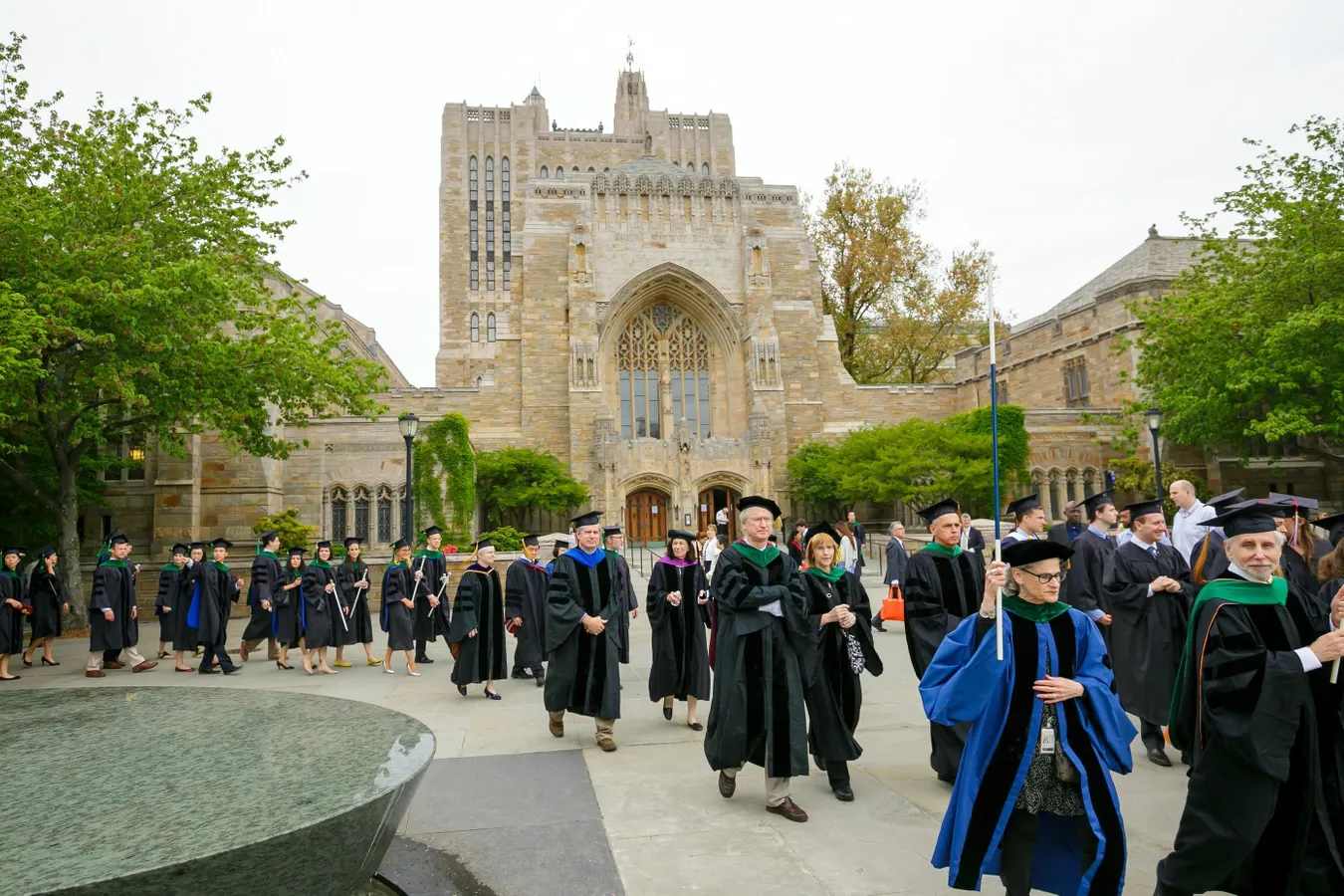
A Yale University faculty committee has recommended several major changes in policies and procedures as a means of regaining the public's trust in higher education.gettyA long-awaited report by a Yale University committee makes 20 recommendations for how the Connecticut university can help set an example for regaining public trust in the value and purpose of higher education.The committee, composed of 10 faculty members, was commissioned by Yale President Maurie McInnis a year ago, when she charged the commission with examining “the problem of declining trust in higher education.”Co-chaired by Julia Adams, the Margaret H. Marshall Professor of Sociology, and Beverly Gage, the John Lewis Gaddis Professor of History, the group pointed to three “immediate factors” responsible for the erosion of trust at Yale and other colleges: The soaring price of higher education, along with doubts about whether college degrees are worth the money;The college admissions system — specifically, questions of who gets in and why; and Concerns about what is said and taught at a university, touching on matters of free speech, political bias, and self-censorship.It also identified a broader challenge contributing to declining trust: “widespread uncertainty about the fundamental purpose and mission of higher education,” claiming that a “diffusion of purpose” has undermined the public’s confidence in America’s colleges and universities. "Trust is earned by doing what you say you’re going to do — and, ideally, doing it well,” the committee wrote.In releasing the well-documented, 58-page report, McInnis indicated that she supported its findings and wanted to see many of its recommendations implemented. “In its report, the committee calls on Yale to reflect on and take responsibility for our role in the erosion of public trust. I accept this judgment fully,” McInnis wrote in a campus-wide email on Wednesday. MORE FOR YOU“This decline did not come out of nowhere, nor did it happen overnight. And we were certainly more than mere bystanders. We must acknowledge how we have fallen short," she added. "That means welcoming as comprehensive a panorama of perspectives as possible—even, and especially, those that may be critical—and facing such criticism with humility and curiosity.”Here are summaries of several committee recommendations likely to capture public attention.A Clarified MissionThe committee recommended that Yale revise its mission statement. In place of the current language, which emphasizes the lofty ideals of "improving the world today,” educating “aspiring leaders worldwide,” and fostering “an ethical, interdependent, and diverse community,” the committee proposed a return to basics that would be consistent with the current Faculty Handbook: “Yale University’s mission is to create, disseminate, and preserve knowledge through research and teaching.” “At a moment when higher education is being buffeted from all sides, it is imperative to understand what we are here for and what universities do best. That requires clarity, not diffusion, of purpose,” according to the committee.Reformed undergraduate admissionsThe committee made several suggestions for how to revise Yale’s “holistic” undergraduate admissions process, which “however adeptly designed and applied, is subjective and hard to explain.” The goal should be a process that is conducted “with as much fairness and respect for the aspirations of young people as it can muster," adding that “it should only use criteria for admission that it is willing to describe publicly and defend openly. The top priority in admissions decisions should be academic achievement."The committee wrote that the current process “disproportionately benefits wealthy applicants,” and it recommended that Yale reduce its practice of giving admission preferences to applicants such as varsity athletes, legacies, and children of faculty, staff, and donors, claiming that such advantages “distort the admissions process by reducing the number of slots available to high-achieving applicants who do not fit into one of the favored categories.”In a matter sure to stir debate, the committee also called for establishing and making public a minimum standard of academic achievement to guide admission decisions. It suggested that such a standard could be set by requiring a minimum score on the SAT or a Yale-specific entrance exam that "would ensure that no student is admitted without the requisite academic preparation and ability.”Financial Aid SimplificationLike many elite schools, Yale discounts its high sticker cost of education by offering generous financial aid. This “high tuition-high aid” model results in a situation where published tuition prices bear little relation to what many students actually pay. This approach has lowered the expense of college for many low-income and middle-class students. For example, beginning with the upcoming academic year, Yale students from families with incomes under $200,000 will qualify for free tuition, and those under $100,000 will have tuition, housing, and food costs fully covered.Nonetheless, the committee concluded that the current financial aid system is “complicated, unpredictable, secretive, and highly variable,” and that “the process of applying for aid is laborious, frustrating, and unpredictable.” It called for Yale to “do everything possible to make the financial aid system more comprehensible, predictable, and fair,” and urged that “Yale provide a more accessible and reliable indication of the actual price that an undergraduate student will pay at the moment of enrollment and over the course of a four-year degree.”The committee further found that the cost of education was still too expensive, leading to the recommendation that, over time, Yale substantially raise the income limit on its "no tuition" guarantee for undergraduate students, and that charges for families earning above the limit be increased “gradually rather than sharply.”It also recommended that Yale increase its financial support for graduate and professional students.A Re-centered ClassroomThe committee found that “over the years, a constellation of pressures has steadily eroded the centrality of academic work in campus life.” It then offered several commendations aimed at making “the classroom experience more rigorous and rewarding, with the goal of cultivating sustained attention, intellectual curiosity, and disciplined habits of mind.” Included in those recommendations were:A device-free policy in classrooms — no phones, laptops, or tablets. While exceptions could be made for “compelling pedagogical, research, or practical reasons” the intent is “to restore respect for the living classroom experience as a place of active interchange and focused learning.”A policy to reduce grade inflation. The committee wrote that “decades of inflation and compression have rendered the college grading system almost meaningless.” It suggested establishing a “college-wide standard,” such as a 3.0 mean grade-point-average, to improve the meaning and comparability of grading. It also called for the registrar compute course percentiles or a similar metric that would be included on transcripts to reflect the context for each grade. These rankings would show where a student stands relative to the rest of the class, “so that an A-minus at the top of a demanding course is recognized as a distinction, not penalized by comparison with grades inflated elsewhere.”The report offered several other recommendations on issues such as protecting free speech and academic freedom; cultivating rigorous, open dialogue across the university; addressing problems of ideological conformity at the institution; streamlining its bureaucracy; prioritizing investments in core academic functions; making its teaching and research more available to the public; and improving its processes of shared governance.Did Yale get it right? How well will its analysis and suggestions translate to other institutions, particularly those with fewer financial resources? Will it follow through and make the changes urged by the committee? Those are open questions. Opinions about the academy’s need and capacity for reform remain deeply divided.As the committee went about its work, studying the relevant higher education literature, considering public opinion data, and interviewing a wide range of stakeholders, it said it encountered a wide range of perspectives. "At one extreme were those who scoffed at the possibility that the university was capable of genuine self-scrutiny. At the other were those who saw no need for change at all. Most fell somewhere in between, frustrated by aspects of the status quo but genuinely eager to improve higher education.”
Yale To Consider Changes To Mission, Admissions, Financial Aid And Grading
A Yale University report makes 20 recommendations to regain public trust in higher education.
1,296 words~6 min read