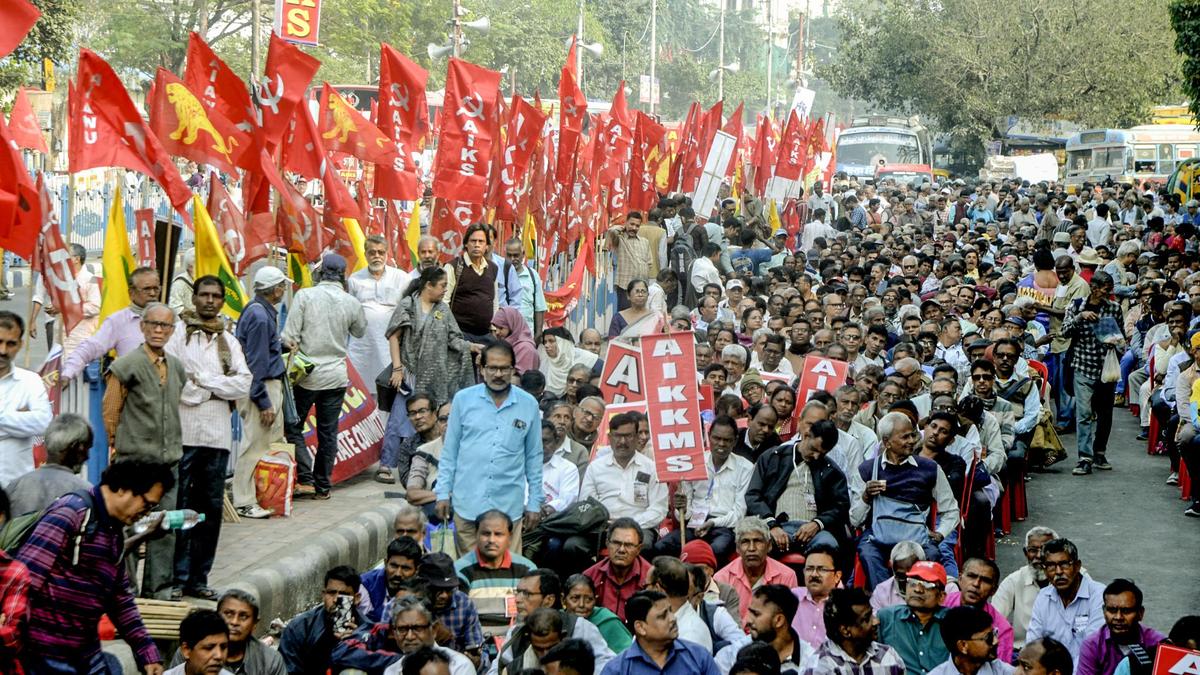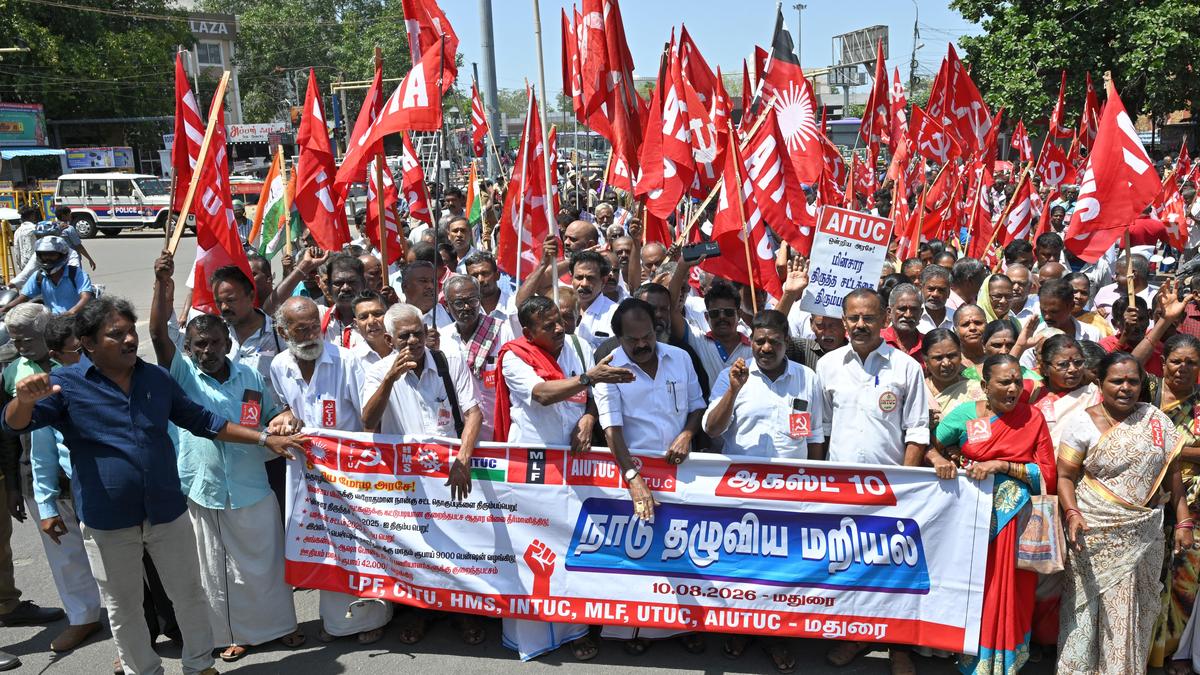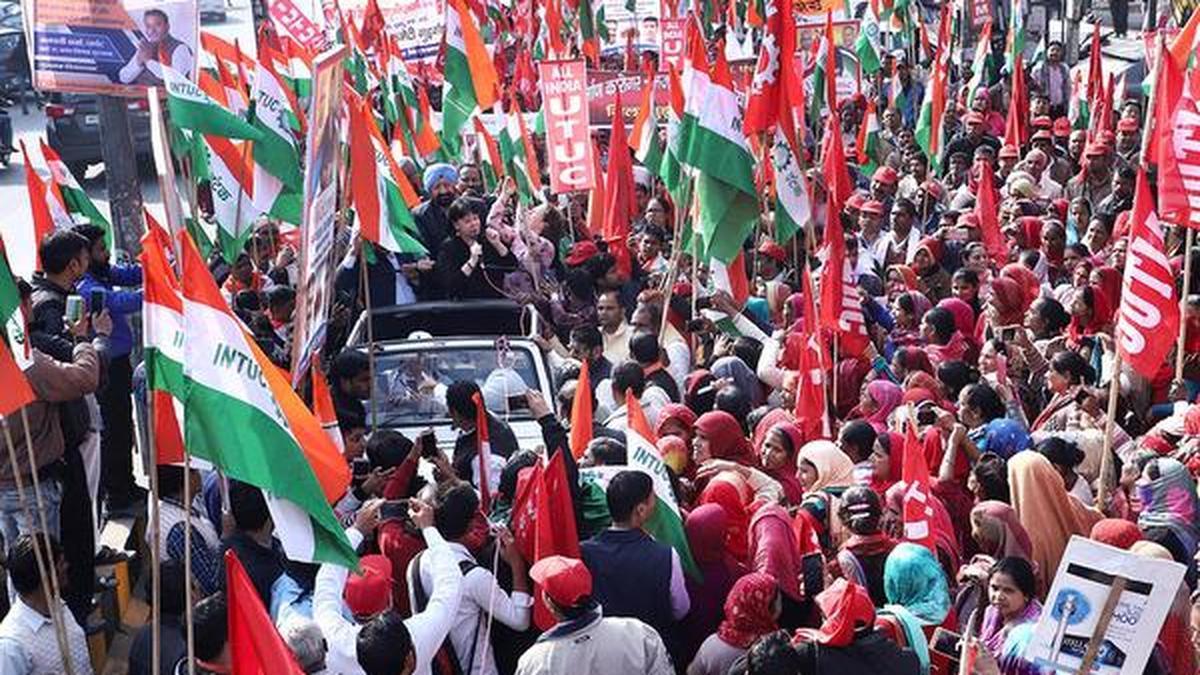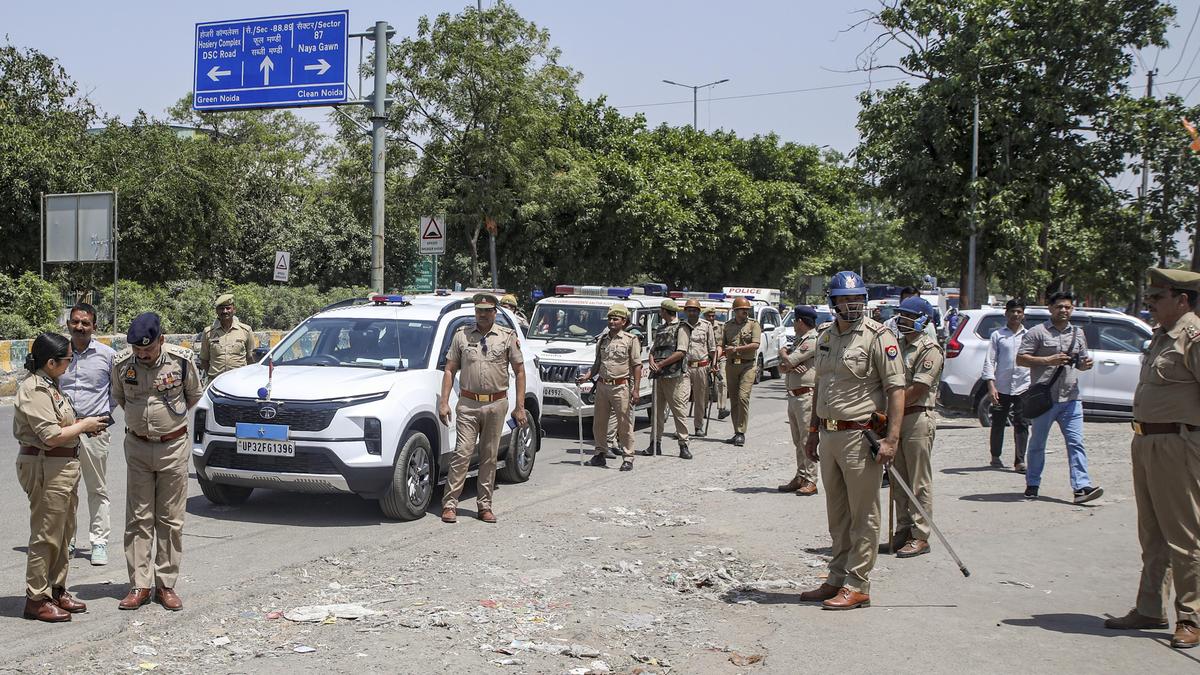
Condemning the police action against protesting workers in Uttar Pradesh and Haryana, Opposition parties and Central Trade Unions (CTUs) blamed the unrest in industrial belts on the Union government’s “unilateral” announcement on the implementation of the four Labour Codes. They demanded the Centre ensure fair wages and allowances for workers.The Bharatiya Mazdoor Sangh (BMS), the trade union affiliated to the Rashtriya Swayamsevak Sangh (RSS), tasked the Union government with balanced and firm action.What had happened on the roads of Noida on Monday (April 13, 2026) was the final cry from the country’s workers, the Leader of the Opposition in the Lok Sabha Rahul Gandhi said.“A worker in Noida earns a monthly salary of ₹12,000; rent costs ₹4,000-₹7,000. By the time he gets a ₹300 annual raise, the landlord hikes the rent by ₹500 a year,” Mr. Gandhi said, adding that people probably shelled out ₹5,000 for a cylinder just to light the stove at home in the midst of the cooking fuel crisis.The Narendra Modi government, in a hasty move, without consultation, had implemented the four Labour Codes from November 2025, extending work hours to 12 hours a day, the Congress leader said.Widespread exploitation of contractual labour was taking place across multiple States, former MP and head of the Unorganised Workers and Employees Congress Udit Raj said, linking the recent worker protests to low wages and the implementation of the new Labour Codes. Labour unrest reported from Noida, Manesar, Faridabad, and Bhiwandi reflected systemic issues, including monthly wages ranging between ₹11,000 and ₹12,000 for contract workers, which was “unsustainable”, Mr. Raj said, addressing a press conference.The Polit Bureau of the Communist Party of India-Marxist (CPI-M) condemned the “brutal repression” unleashed on agitating factory workers by the Bharatiya Janata Party (BJP)-ruled State governments of Haryana and Uttar Pradesh. “Over the past two-and-a-half months, workers across several parts of the country, especially in north India, have spontaneously risen in protest against inhuman working and living conditions, stagnant wages, denial of basic labour rights, and the callous, pro-management attitude of Labour Departments. The workers’ upsurge in the National Capital Region is the latest expression of this growing discontent,” the CPI(M) said.All India Trade Union Congress general secretary Amarjeet Kaur said minimum wages had not been revised in many States for the past 10 years despite price rises in basic essentials. “In most of the industrial hubs, contract workers are migrant workers living in precarious conditions, devoid of basic amenities,” Ms. Kaur said.The Labour Codes had pushed the labour force to slavery, increased working hours, “literally ending the right to strike”, made fix-term employment a norm, with no job security, thresholds raised, thrown protected workers also out of labour law protections, with unionisation a difficult process while de-registration and de-recognition were very easy, she said.The Centre of Indian Trade Unions (CITU), whose district leaders are under house arrest in Noida, said the so-called wage increase was a sham, remaining far below survival levels. “Workers in Uttar Pradesh and Haryana are paid significantly less than in Delhi despite identical living costs. In the face of soaring inflation, the demand for a minimum wage of ₹26,000 per month is not merely a demand but a necessity,” they said. “This explosion is the outcome of years of wage stagnation, non-revision of minimum wages since 2014 in Uttar Pradesh, rising inflation, and systematic suppression of trade union activity in the NCR industrial belt. Workers are now breaking that imposed silence and asserting their rights,” the CITU added.The BMS said the recent incidents of labour unrest in the industrial belts were a matter of serious concern. “These developments must be viewed with responsibility, balance, and a commitment to long-term industrial harmony,” the BMS said, adding that the current unrest reflected the genuine concerns of workers. “Issues such as wage disparities within similar industrial clusters, rising cost of living, excessive contractualisation, and lack of effective grievance redressal mechanisms have contributed to dissatisfaction. When these concerns are ignored or delayed, they inevitably manifest in unrest,” the BMS said.“The government must act with balance and firmness. While strict action should be taken against those indulging in violence or instigation, equal seriousness must be shown in addressing violations by industries, including non-compliance with labour laws and denial of rightful benefits. The government must also strengthen tripartite mechanisms to resolve disputes before they reach flashpoints,” the BMS added.The All India Central Council of Trade Unions (AICCTU) said the surge in workers’ protests across the country had underscored the long-pending demands of trade unions, including wage increases, social security coverage for all workers, and most importantly, rollback of the anti-worker Labour Codes, the implementation of which would lead to complete abrogation of labour rights.“The Modi-led BJP government had promised a better life for workers in the wake of the implementation of the Labour Codes. On the contrary, the protests from Panipat to Manesar and Noida have clearly shown that workers across sectors disapprove of the 12-hour workday, which is one of the major anti-worker changes the Labour Codes aim to bring about across the country,” the AICCTU’s statement said.
Trade unions, Opposition blame Labour Codes for unrest; condemn police action against workers
Trade unions and Opposition criticize Labour Codes for worker unrest, demanding fair wages and condemning police actions against protests.
844 words~4 min read