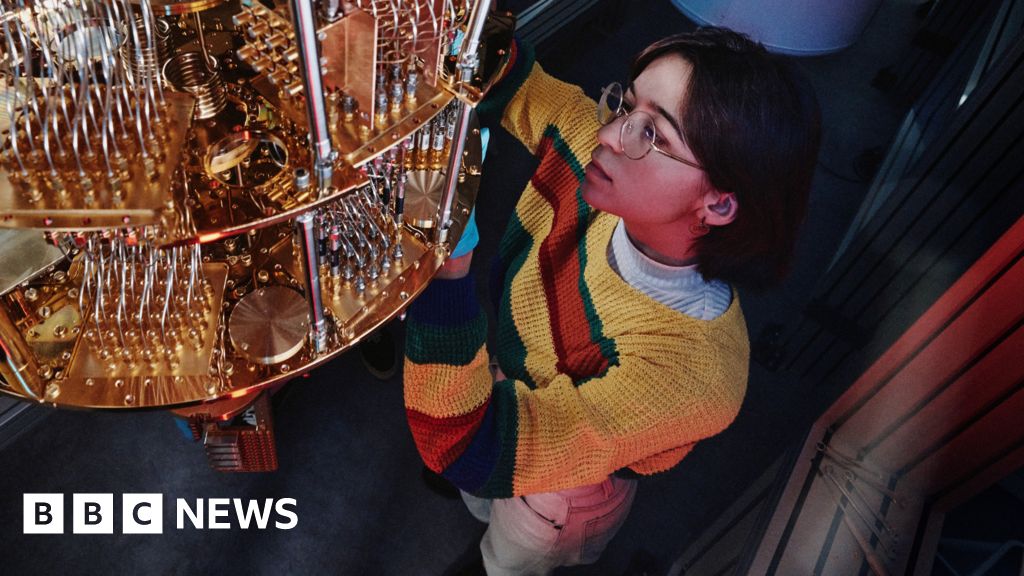
In a lab on the western edge of Paris, where the River Seine flows wide and trams slide past glass-fronted buildings and blossoming cherry trees, a technician called Rémi makes some adjustments with a spanner.
The machine, a cascade of gold and silver-coloured cylinders descending through a cloud of wires, is a cryostat, a device that cools so much it slows activity even at the molecular level.
Minus 273 degrees Celsius in the cylinder at the bottom. A temperature at which even the tiniest particles are still. Isolation from the outside world is complete.
In this cylinder is placed a small case, again of gold and silver colour, in which is inserted a chip.
This chip is another, tinier box inside of which takes place the phenomenon discovered by Albert Einstein and other physicists that seems to defy the mechanics of the world we live in: the quantum leap, when particles change energy levels in ways that are predictable, reproducible and apparently impossible.