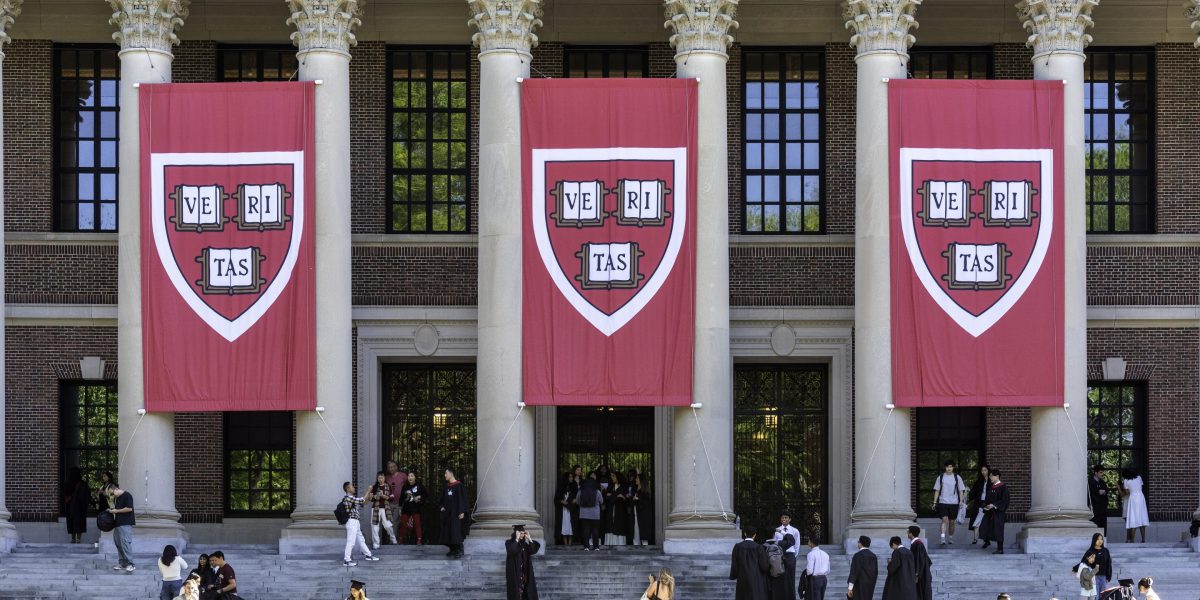
Harvard will conduct a pilot where it partners with other Ivy League institutions to offer instruction in less commonly taught foreign languages.gettyHarvard University plans to join three of its Ivy League peers and participate in the Shared Course Initiative, a long-standing collaborative effort in which select universities partner to offer less commonly taught foreign languages through teleconferencing. The original partnership involved Yale University, Columbia University, and Cornell University, which were awarded a two-year, $1.2 million grant by the Andrew W. Mellon Foundation in 2012 to develop a pilot program allowing them to share classes in languages that were rarely offered at their individual campuses because only a handful of students were typically enrolled, making the courses too expensive to sustain through traditional means like tutorials. Now, Harvard is set to pilot its participation in the program. According to reporting by The Harvard Crimson, the university’s Faculty of Arts and Sciences Faculty Council unanimously approved a proposal this week for a two-year pilot program with Columbia beginning this fall that would see Harvard offer and also receive at least one foreign language course during the pilot period.Depending on the results of that pilot, Harvard would enter a five-year agreement to participate fully in the initiative with the other three universities starting in 2028.With foreign language courses and majors under increasing financial strain across the nation, the Small Course Initiative provides a means for universities to teach foreign languages in a more affordable way, thereby maintaining their ability to offer a diverse array of language instruction.According to the Spring 2026 catalog posted on the SCI website, more than 20 languages are available for sharing, including both introductory and advanced offerings in languages such as Bengali, Bosnian/Croatian/Serbian, Czech, Dutch, Finnish, Nepali, Punjabi, Swedish, Ukrainian and Zulu.MORE FOR YOUThe SCI permits up to 12 students across the participating schools to enroll in a course. Students earn academic credits at their home institutions even when the course is offered by an instructor at a different school. A detailed handbook describing the program’s policies, technology, calendar, and faculty obligations is available online.Although, according to the Crimson, some Harvard faculty expressed concerns about whether the initiative would set a precedent that could pave the way for the university to cut back on more of its course offerings, Vice Provost for International Affairs Mark C. Elliott said that the intent was to complement existing courses at Harvard rather than to replace them.“Courses in the Shared Course Initiative cannot take the place of Harvard language instruction that’s already here, so this is not going to remove anybody from their current position,” he said. “The exchange is limited only to less commonly taught languages or very less commonly taught languages.”Of course, academic consortia are nothing new. Several such alliances exist across the nation that provide students with expanded academic opportunities and an enriched curriculum through course sharing and cross-registration agreements with other schools. They have been particularly popular at small private colleges that find it difficult to scale the breadth of course offerings typically found at large universities. A leading example is the course-sharing approach developed by the Lower Cost Models for Independent Colleges Consortium and Rize Education, In higher education’s current world, where institutions even as wealthy as Harvard are finding it necessary to trim their sails, look for more initiatives designed to share instructional resources across multiple campuses.
Harvard Set To Join Ivy League Peers In Sharing Small Language Courses
Harvard plans to join three Ivy League peers in the Shared Course Initiative, a collaboration where universities partner to offer less commonly taught foreign languages.
560 words~3 min read