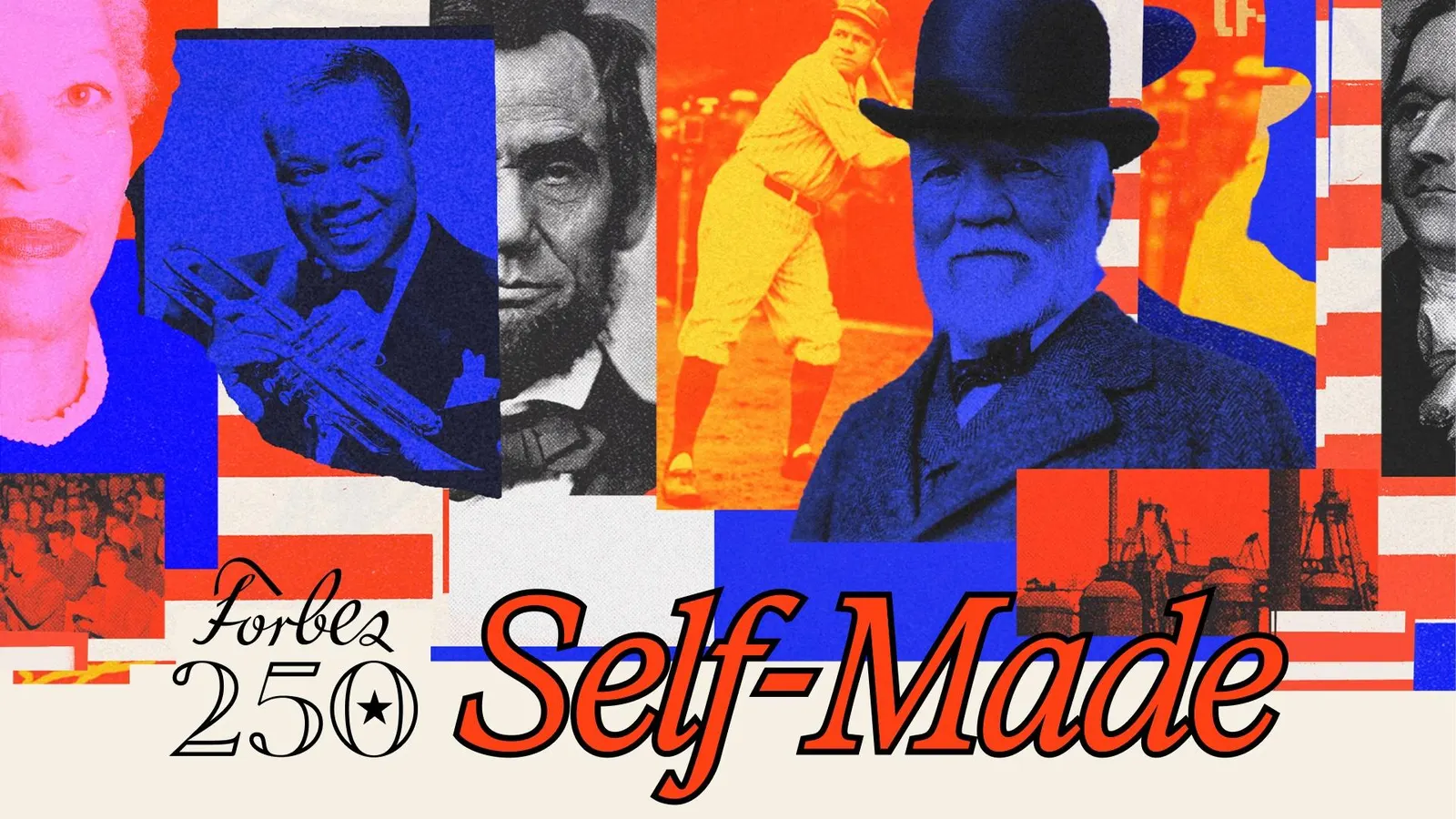
Edited By Alex Knapp and Michael Noer, Forbes StaffReported by Jessica JacolbeAbraham Lincoln once wrote to a young man who asked him for advice to “always bear in mind that your own resolution to succeed is more important than any other one thing.” That sentiment is at the heart of an American principle that Honest Abe himself embodied: that unlike in the Old World, in the United States, anyone can rise to the top. So in honor of the nation’s 250th anniversary, we present to you the 250 Greatest Historic Self-Made Americans–men and women who rose from slavery, poverty, abuse to achieve fame, fortune and impact. (Our ranking of the 250 Greatest Living Self-Made Americans is available here.) To identify these hustlers and strivers, we dug into Forbes’ century-plus-old archives, looking for classic tales of entrepreneurial capitalists. Then we queried Gemini and ChatGPT for ideas. We also polled the historical societies of all 50 states, because although we emphasized notable businessmen and industrialists, we also included influential scientists, artists and athletes.Next, we ran those names past the experts: Louis Hyman, a professor of political economy in history at Johns Hopkins University and Abbylin Sellers, professor of public policy at Pepperdine University. Forbes editors determined the final ranking.The Greatest Historic Self-Made Americans#1-50#1. Abraham Lincoln (1809-1865)Before he saved the Union, the 16th president of the United States grew up in abject poverty. He was largely self-educated and had a variety of jobs ranging from store clerk to wrestler to rail splitter (cutting logs for fences) before he taught himself the law and became an attorney. After a stint in the House of Representatives, his 1858 failed run for the Senate vs. Stephen Douglas propelled him to national prominence. He won the presidency in 1860 in a heated four-way race with less than 40% of the popular vote.#2. Andrew Carnegie (1835-1919)The steel magnate’s family borrowed money to immigrate to the U.S. from Scotland after the Industrial Revolution rendered his father’s weaving business obsolete. Upon arrival in Pittsburgh, at age 13, he began working in a cotton mill, educating himself thanks to a local benefactor who opened his private library to neighborhood children. He used savvy investments (railroads, bridges) and sold bonds to build up his capital before founding the Carnegie Steel Company in 1892. He financed more than 2,500 public libraries around the world. The first was built in his birthplace of Dunfermline, Scotland.#3. John Jacob Astor (1763-1848)America’s first multimillionaire was the son of a struggling German butcher who emigrated to London and New York. Astor started working as a butcher in his brother’s shop before becoming a leading force in the American fur trade, using the proceeds to build a real estate empire in New York City.#4. Alexander Hamilton (1755-1804)The ten-dollar Founding Father was born out of wedlock on Nevis, in the Leeward Islands, and was effectively orphaned and left penniless when his mother died when he was 13. He became a clerk in an import-export firm on Saint Croix before moving to New York in 1772. After attending King’s College (now Columbia University), he rose through the ranks during the Revolution, becoming Washington’s right-hand man. He later was a key figure in the adoption of the Constitution and the prime architect of America’s financial system.#5. Frederick Douglass (1818-1895)Born into slavery in Maryland in 1818, the abolitionist leader honed his business skills early, managing to earn wages even before escaping to New York City and freedom in 1838. His autobiography became a bestseller, and in the 1840s he launched a successful newspaper, The North Star. After the Civil War, Douglass became an adviser to presidents and was appointed U.S. Marshal.martin schoeller#6. H. Ross Perot (1930-2019)The salesman who famously met his annual IBM quota in less than a month grew up during the Great Depression in Texas, delivering newspapers on horseback. In 1962, he launched Electronic Data Systems, which he sold to GM for $2.5 billion. He subsequently founded Perot Systems, which he sold to Dell for $3.9 billion in 2009. In between he made two third-party runs for the White House, garnering nearly 20% of the vote in 1992.#7. Milton Hershey (1857-1945)Born into Pennsylvania’s German-speaking Mennonite community, Hershey’s first home was a hardscrabble farm near Harrisburg. He dropped out in fourth grade to become a printer’s apprentice. On the road to candy dominance, he suffered several bankruptcies before selling his Lancaster Caramel Company, which gave him the seed cash for his milk chocolate empire.#8. Thurgood Marshall (1908-1993)Born in segregated Baltimore, Marshall was rejected by the University of Maryland due to his race and earned his law degree at Howard University. He then became a legendary litigator, winning landmark rulings such as Brown v. Board of Education before becoming the first Black Supreme Court justice in 1967.#9. Maggie Lena Walker (1864-1919)Walker’s father was murdered when she was young, leaving only her formerly enslaved mother to care for her. She took command of a Virginia-based mutual aid society that was on the brink of financial ruin and turned it into a thriving conglomerate. She was the first Black woman to charter and operate a bank, which provided loans that helped build the Black middle class in Richmond, Virginia.#10. Bernard Marcus (1929-2024)The cofounder of The Home Depot was raised on the fourth floor of a walk-up tenement in Newark, New Jersey. Unable to afford medical school, he earned a pharmacy degree instead but ended up working as an executive at a regional hardware chain, from which he and Arthur Blank were fired. The pair started The Home Depot in 1979, growing it into a multibillion-dollar concern.fotosearch/getty images#11. Levi Strauss (1829-1902)The blue jean pioneer grew up in a poor German village before his widowed mother brought him to America.#12. Andrew Jackson (1767-1845)Orphaned at 14, the seventh president used his legal practice–and land speculation–to amass a fortune.#13. Romana Acosta Bañuelos (1925-2018)Deported as a child to Mexico despite being a U.S. citizen, she came back to California as an adult, where she founded a multimillion-dollar tortilla business, served as chair of Pan-American National Bank and became the Treasurer of the United States in 1971.#14. David Murdock (1923-2025)A high school dropout, he bought a small restaurant after serving in World War II and eventually parlayed its success into fruit and veggies giant Dole.#15. Peter Peterson (1926-2018)The cofounder of private equity giant Blackstone spent his childhood working at his parents’ small diner in Kearney, Nebraska.#16. Elvis Presley (1935-1977)Before he was the King of Rock and Roll, Elvis was born into a two-room shotgun house in Tupelo, Mississippi, where his family relied on neighbors and government food assistance to survive.#17. Rocco Commisso (1949-2026)The founder of cable TV giant Mediacom worked as an accordion player in movie theaters as a kid to help support his family.hulton archive/getty images#18. Elizabeth Arden (1881-1966)The child of tenant farmers, the cosmetics mogul supported herself as a nurse’s assistant before moving to New York in 1908 and opening her first salon.#19. Benjamin Franklin (1706-1790)The Founding Father ran away from his Boston home as a youth, moving to Philadelphia where he became America’s first media tycoon.#20. Mark Twain (1835-1910)The Huckleberry Finn author’s father died when Twain was 11, leaving his family in dire financial straits.bettmann archive/getty images#21. Jesse Owens (1913-1980)Owens picked cotton as a child with his sharecropping family before earning Olympic gold at the 1936 Berlin games.#22. Samuel Goldwyn (1879-1974)The Hollywood studio pioneer grew up in poverty in Warsaw before arriving in America, where his first job was sweeping factory floors.#23. Frances Allen (1932-2020)Allen grew up on a dairy farm that lacked electricity and taught high-school math before pioneering optimization techniques that underpin modern computer programming.The Ring Magazine/Getty Images#24. George Foreman (1949-2025)The heavyweight champion recalled childhood meals where he and his siblings would share a single hamburger.#25. Cornelius Vanderbilt (1794-1877)“Commodore” Vanderbilt quit school at age 11 to work on his father’s ferry, which gave him a taste for life on the water, leading him to build a steamship (then railroad) empire.#26. Barney Ford (1822-1902)After escaping slavery, Ford built–and lost–multiple fortunes in the Old West, along the way helping to ensure Black suffrage in Colorado.#27. William Fox (1879-1952)The founder of what became 20th Century Studios worked in a garment factory as a child.#28. A.G. Gaston (1892-1996)Born in a log cabin in Alabama during Jim Crow, Gaston was a coal miner before building the Booker T. Washington Insurance Company, a financial powerhouse that served the Black community.#29. John H. Johnson (1918-2005)The founder of Ebony and Jet magazine launched his company by borrowing against his mother’s furniture.#30. William Lear (1902-1978)The creator of the Learjet and inventor of the 8-track audio tape was raised by a single mother in a Chicago tenement.#31. John D. Rockefeller (1839-1937)America’s first billionaire was the son of a con artist and bigamist who left his family in financial ruin.#32. Richard DeVos (1926-2018)During the Great Depression, the Amway cofounder’s family of five was forced to move into his grandparents’ attic.addison n scurlock/getty images#33. Madam C.J. Walker (1867-1919)Her cosmetics business made her one of the first Black women to become a millionaire, but she started as an orphaned domestic servant and laundress.#34. John Marshall (1755-1835)The self-educated Supreme Court justice was born in a log cabin in Virginia and endured winter at Valley Forge.#35. Dwight Eisenhower (1890-1969)Unable to afford college due to his father’s business failure, Ike earned a seat at West Point and became the general who won World War II and became president.david corio/getty images#36. James Brown (1933-2006)The Godfather of Soul was raised in a brothel after his parents abandoned him.#37. Thomas Edison (1847-1931)The prolific inventor and serial entrepreneur had three months of formal schooling and, ironically for the man who created the phonograph, premature hearing loss. As a kid, he sold newspapers on Michigan trains to help his family make ends meet.#38. Sheldon Adelson (1933-2021)The casino mogul slept on the floor of a Boston tenement as a child, getting his entrepreneurial start as a paperboy at age 12.#39. Kirk Kerkorian (1917-2015)Before Kerkorian helped develop the Las Vegas Strip, he dropped out of school after eighth grade to become a boxer.#40. Mary Kay Ash (1918-2001)In her early years, the cosmetics mogul took care of her three siblings and invalid father while her mother worked long hours.#41. Clare Boothe Luce (1903-1987)Luce was the illegitimate daughter of a struggling chorus girl; she later became an award-winning playwright, Congresswoman and ambassador.#42. Jeremiah Hamilton (1806-1875)After fleeing Haiti to escape counterfeiting charges, Hamilton came to New York and built a proto-hedge fund in the 1860s to become one of the first Black millionaires.#43. Harry S. Truman (1884-1972)He’s the only 20th-century president without a college degree because his father’s business failure forced him to drop out, and he turned to politics after the failure of his own haberdashery business.#44. Ray Charles (1930-2004)The legendary musician grew up in poverty and lost his sight at a young age.#45. Hank Aaron (1934-2021)The home run king spent his formative years practicing with sticks and bottlecaps because his parents couldn’t afford a baseball.#46. Maya Angelou (1928-2014)Angelou’s childhood was marked by the one-two punch of segregation and the Great Depression; she worked odd jobs like line cook and streetcar conductor before becoming a literary icon.bettmann/getty images#47. Louis Armstrong (1901-1971)Raised in a shack by his mother and grandmother, the jazz trumpeter scavenged for food and coal as a child before being sent to a reform school.#48. Rose Cook Small (1912-1996)As a child, Small sold produce on the streets of Camden, New Jersey. As an adult, she made Bluebird, Inc. one of the country’s leading meat-processing businesses.#49. Irving Berlin (1888-1989)The songwriting legend’s family emigrated from Russia to New York City to escape anti-Semitic pogroms, and he left home at age 13 after his father’s death.#50. Yogi Berra (1925-2015)Baseball’s most famous wordsmith (and star New York Yankees catcher) dropped out of school in eighth grade to help his family make ends meet.#51-100The Artists: Johnny Cash, Grandma Moses, Louisa May Alcott, Jimi Hendrix, Elvis Presley, Louis L'Amour and Toni Morrison.Illustration by Mr. Nelson Design#51. Marcus Goldman (1821-1904)The founder of Goldman Sachs fled the European revolutions of 1848 and pioneered the American commercial paper market.#52. James Garfield (1831-1881)The Union general and 20th president did backbreaking farm labor and worked as a canal boy to support his family after his father’s death.bettmann/getty images#53. Rafer Johnson (1934-2020)The Olympic decathlete and actor spent part of his childhood living in a repurposed boxcar.#54. Steve Jobs (1955-2011)Adopted into a working-class family, Jobs sold his van to get the capital he needed to start Apple in his parents’ garage in 1976.#55. Neal Patterson (1949-2017)The founder of hospital IT giant Cerner grew up on a farm with no indoor plumbing.bettmann/getty images#56. Dave Thomas (1932-2002)Thomas was given up for adoption to a financially unstable, nomadic family. He dropped out of school at age 15 and became a protégé of KFC creator Harland Sanders before founding Wendy’s in 1969.#57. Richard Nixon (1913-1994)Before he ascended to the White House in 1969, Nixon grew up in a house his father ordered from a Sears catalog and built on a struggling lemon farm.#58. Walt Disney (1901-1966)Due to his father’s repeated business failures, Disney was a paperboy and child factory worker before creating Mickey Mouse.bachrach/getty images#59. George Eastman (1854-1932)Facing financial hardships after his father’s untimely death, Eastman taught himself the chemistry that formed the basis of 20th-century film giant Eastman Kodak.#60. Jay Gould (1836-1892)The railroad robber baron received virtually no formal education on his family farm, and left home at 14 with less than a dollar in his pocket.#61. Sam Walton (1918-1992)Walmart’s founder referred to his childhood as “hardscrabble” because every dollar was painstakingly accounted for during the Great Depression.#62. Louisa May Alcott (1832-1888)Alcott’s father’s Transcendentalist principles often left the family on the verge of homelessness, so she worked odd jobs to support them until publishing Little Women in 1868, an instant bestseller whose rights she savvily managed to secure her wealth.#63. Marcus Daly (1841-1900)After emigrating from famine-era Ireland, Daly worked as a dockhand and manual laborer before discovering the copper deposits that formed the basis of his industrial empire.#64. Sammy Davis Jr. (1925-1990)The Rat Packer was born in Harlem to two poor traveling performers and grew up on the road with little formal education.#65. James Forten (1766-1842)Forten’s father died when he was 7, forcing him to work as a chimney sweep before he became a privateer during the American Revolution. After the war, the free Black man became a leading sail manufacturer, using his wealth to back the abolitionist movement.#66. Amadeo Pietro “A.P.” Giannini (1870-1949)The founder of what became Bank of America was raised by a single mother in San Jose after his father was murdered.#67. Kenny Rogers (1938-2020)“The Gambler” was born and raised in a Houston, Texas public housing project and said he was the first person in his family to graduate from high school.#68. Lyndon B. Johnson (1908-1973)He was raised in Texas’ poor Hill Country decades before declaring a “War on Poverty” as president.nbc/getty images#69. Art Linkletter (1912-2010)Adopted as an infant, the pioneering TV and radio personality rode the rails as a hobo to find work during the Great Depression.#70. John Arrillaga (1937-2022)The Silicon Valley real estate mogul was born into a working-class household in Los Angeles’ Inglewood and got into Stanford on a basketball scholarship.#71. John Nordstrom (1871-1963)After his father died when he was 8, Nordstrom labored on the family farm in northern Sweden before heading to America when he was 16. He was a lumberjack and gold miner before founding his namesake retail store in Seattle in 1901.#72. Eli Broad (1933-2021)The child of a house painter and seamstress, he cofounded real estate developer Kaufman & Broad and later transformed a life insurance company into annuities giant SunAmerica.#73. Fred DeLuca (1947-2015)The Subway founder was raised in a working-class household and collected empty soda bottles as a kid to help make ends meet.#74. Herbert Hoover (1874-1964)Hoover was orphaned at age 9 and did manual labor to put himself through Stanford before becoming the 31st president.#75. Charles Dolan (1926-2024)The founder of Cablevision and what became HBO got his start in the 1950s, editing films of sporting events at his kitchen table to sell to TV stations.#76. Valentin Gapontsev (1939-2021)The fiberoptics billionaire endured childhood hardships growing up in the Soviet Union during World War II before emigrating to the United States when he was 59.#77. B. Wayne Hughes (1933-2021)Hughes’ family fled the Oklahoma Dust Bowl for California before he earned a fortune with Public Storage.#78. Jim Thorpe (1887-1953)An Olympian who played pro baseball, football and basketball, Thorpe was born in a one-room cabin on a Sac and Fox reservation in Oklahoma.#79. Jackie Robinson (1919-1972)Before he broke baseball’s color line, Robinson was raised by a single mother who worked as a maid.#80. Ted Lerner (1925-2023)The real-estate mogul and Washington Nationals owner grew up in a working-class immigrant household during the Great Depression.martin schoeller#81. T. Boone Pickens (1928-2019)The titan of oil, gas and later wind power built a massive newspaper delivery route as a child to help support his family during the Great Depression.#82. Sojourner Truth (1797-1883)She escaped slavery with her infant daughter in 1826, successfully freed her 5-year-old son in court in 1828, and later traveled the country preaching abolition and women’s suffrage.#83. Arthur Imperatore (1925-2020)The founder of New York Waterway delivered vegetables and set bowling pins to help his family survive the Great Depression.#84. Babe Ruth (1895-1948)The baseball legend spent his childhood in a reform school before signing with the Baltimore Orioles at age 19.#85. J. Willard Marriott (1900-1985)Raised on a Utah sheep farm, Marriott started a small root beer stand that grew into a chain of restaurants and then hotels.#86. James Cash Penney (1875-1971)When he was 8, his father made him responsible for buying his own clothes, which may have inspired the creation of J.C. Penney, his namesake department store.#87. F.W. Woolworth (1852-1919)A child of struggling New York potato farmers, Woolworth was apprenticed to a clerk before pioneering the five-and-dime concept.hb lindsey/getty images#88. Harriet Tubman (1822-1913)Using the “Underground Railroad,” Tubman emancipated herself–and dozens of others–from slavery before the Civil War. During the conflict, she also coordinated military assaults and gathered intelligence on Confederate positions.#89. Davy Crockett (1786-1836)The King of the Wild Frontier was born in a Tennessee log cabin before parlaying his fame as a scout into a political career, first in the Tennessee statehouse and then the House of Representatives.#90. Joe Louis (1914-1981)Raised by Alabama sharecroppers who fled Klan violence for Detroit, the heavyweight champion had more successful title defenses than any boxer in history.ny daily news archive/getty images#91. Louis B. Mayer (1884-1957)After his family fled Russia to escape antisemitism, the MGM studio cofounder quit school at 12 to help his father’s struggling junkyard.#92. Robert Reed Church (1839-1912)The South’s first Black millionaire was born into slavery in Mississippi, but earned his fortune after savvily investing in Memphis real estate after prices collapsed following a Yellow Fever epidemic.#93. Wally Amos (1936-2024)He dropped out of high school in 1954 to join the Air Force, then met success as a talent agent (Marvin Gaye, the Temptations) but he didn’t become “Famous Amos” until he marketed his aunt’s cookie recipe.#94. Adolph Zukor (1873-1976)Zukor came to America from Hungary on his own at age 16 and became a successful furrier before eventually founding Paramount Studios.#95. Christopher Cline (1958-2019)Raised in a trailer park, Cline worked in the coal mines as a teenager before becoming a coal king in the 1980s and 1990s.#96. Samuel B. Fuller (1905-1988)Fuller dropped out of school to help his parents make ends meet in rural Louisiana before founding one of the most successful cosmetics companies in the mid-20th century.#97. Ella Fitzgerald (1917-1996)Orphaned at 15, the jazz legend lived on the streets of New York City before winning a singing contest at Harlem’s Apollo Theater in 1934 to launch her career.bettmann/getty images#98. W.E.B. DuBois (1868-1963)The cofounder of the NAACP was raised by a single, physically disabled mother and worked odd jobs to support his education before becoming the first Black person to earn a Harvard Ph.D.#99. Linus Pauling (1901-1994)After his father’s death, he worked as a butcher’s apprentice, in his spare time building a makeshift lab in the basement of the boarding house he lived in. He won the Nobel Prize for Chemistry in 1954 and then the Nobel Peace Prize in 1962 for his anti-war activism. He is the only person to have won two unshared Nobel Prizes.#100. B.C. Forbes (1880-1954)He spent his childhood herding cattle and shining shoes, later working his way up the journalism ladder until he founded his namesake magazine in 1917.#101-150The Builders: Samuel Goldwyn, "Biddy" Mason, John Deere, Maggie Lena Walker, Levi Strauss and Sam WaltonIllustration by Mr. Nelson Design#101. Harland Sanders (1890-1980)The Colonel dropped out of seventh grade and learned to cook while his widowed mother worked at a canning factory in Indiana.ron galella/getty images#102. Estée Lauder (1908-2004)The retail cosmetics giant grew up in a cramped apartment above her father’s hardware store in Queens, New York.#103. Sam Zell (1941-2023)Zell was born to Polish refugees who escaped the Nazi invasion before he became a titan of real estate and distressed assets.#104. George Washington Carver (1864-1943)The man who revolutionized the peanut industry was born into slavery and after his emancipation still faced significant barriers because of segregation.#105. Theodore Schultz (1902-1998)The Nobel Prize-winning economist was a high school dropout who grew up on a South Dakota farm that burned cow chips for heat during winter.#106. Victoria Woodhull (1838-1927)The first woman to run for president (in 1872) was raised in a shack and worked as a traveling clairvoyant before making a fortune on Wall Street.#107. James Earl Jones (1931-2024)The Emmy, Grammy, Oscar and Tony-winning voice of Darth Vader stuttered as a child on his grandparent’s Mississippi tenant farm.#108. Cy Young (1867-1955)The pitching great honed his arm chucking rocks at squirrels while he worked the fields of his family’s farm in Ohio.#109. Gordon Parks (1912-2006)Homeless at age 15, he bought a camera at a pawn shop to launch a career as an award-winning photographer and later a Hollywood director.#110. Charles Clinton Spaulding (1874-1952)Born during Reconstruction, he worked the family farm before becoming president of the North Carolina Mutual Life Insurance company, the largest Black-owned business of the mid-20th century.#111. B.B. King (1925-2015)The blues legend was born on a cotton farm with his sharecropping parents. In his early 20s, he hitchhiked to Memphis with a guitar he bought on credit and became a star.#112. Leandro Rizzuto (1938-2017)Rizzuto’s family’s thriving salon business collapsed, so he dropped out of St. John’s University and sold his car to found hair care giant ConAir in his parent’s Brooklyn basement.#113. John Deere (1804-1886)After his father’s disappearance at sea, he apprenticed himself to a blacksmith. He later fled Vermont to avoid debtor’s prison before founding his namesake agricultural equipment company.#114. W. Clement Stone (1902-2002)After Stone’s father died, leaving his family in debt, he was inspired by Horatio Alger’s novels to make his own fortune, which he did through insurance giant Combined International.#115. Toni Morrison (1931-2019)The Nobel Prize-winning novelist spent part of her childhood as a domestic servant for white families.#116. C.R. Smith (1899-1990)Smith became his family’s primary breadwinner at age 9 before working his way to becoming CEO of American Airlines in 1934.bettmann/getty images#117. Althea Gibson (1927-2003)Before she became a tennis champion and pro golfer, Gibson ran away from home and briefly lived in a shelter for abused children in Harlem.#118. David Sarnoff (1891-1971)The NBC cofounder hawked newspapers on New York street corners at 9 years old after his family arrived from Minsk.#119. Henry Steinway (1797-1871)Orphaned as a teenager, Steinway fought in the Napoleonic wars and struggled to earn a living as a woodworker before coming to America at age 53. He worked at other piano companies to save the money he needed to start his eponymous one in 1853, when he was 56.#120. Cary Grant (1904-1986)Grant’s mother was institutionalized in Bristol, England when he was a child and, after a stint in an acrobat troupe, he moved to the U.S., where he achieved movie stardom.#121. Gertrude Elion (1918-1999)The Nobel Laureate’s (Medicine, 1988) family lost everything in the 1929 crash, but she was able to get a scholarship for her scientific training, which she used to invent lifesaving cancer drugs.#122. James J. Hill (1838-1916)Hill escaped poverty in rural Ontario and built the only transcontinental railroad of the 19th century that received no government subsidy.#123. Mike Mansfield (1903-2001)The longest-serving Senate majority leader (1961-1977) left school at 14 and lied about his age to fight in World War I. He paid for college by mining copper.#124. Elias Howe (1819-1867)Howe was so poor he had to borrow a suit for his wife’s funeral before inventing the original concept of the sewing machine.#125. Frederick Jones (1893-1961)Orphaned at a young age during Jim Crow, the Thermo King founder and refrigeration pioneer taught himself engineering.#126. Richard Sears (1863-1914)The catalog retailer worked as a railroad station agent in Minnesota to support his family after his father’s death.#127. L.L. Bean (1872-1967)Orphaned at age 12, the iconic retailer worked on relatives’ farms in southern Maine and sold soap door-to-door before founding his outdoor apparel company in 1912.#128. Marjorie Joyner (1896-1994)One of the first Black women to patent an invention (for the permanent wave machine, now a salon staple) was born into poverty in segregated Virginia.#129. Mary Pickford (1892-1979)The silent film star and United Artists cofounder began working as a 6-year-old child actor after her father’s death.#130. George Balanchine (1904-1983)The cofounder of the School of American Ballet endured hunger and poverty during the Russian Revolution before arriving in America in 1933.#131. Benjamin Banneker (1731-1806)The notable almanac writer and abolitionist who helped survey the swampy site that became Washington, D.C. had little formal education and taught himself astronomy and arithmetic.#132. Brownie Wise (1913-1992)The O.G. hostess of the Tupperware party was raised by a single mother whose job required her to be away for months.#133. Jean Nidetch (1923-2015)The daughter of a cab driver and manicurist started the support groups that later became Weight Watchers in her living room.#134. Rod McKuen (1933-2015)The bestselling writer and musician (he composed the score for A Boy Named Charlie Brown, among other movies) ran away from an abusive home at age 11, doing manual labor for years before publishing his first book of poetry, And Autumn Came, in 1953.#135. Frank Mars (1883-1934)Struck with polio as a child, Mars had a string of failed businesses before the Milky Way bar kickstarted his candy empire.#136. Alice Coachman (1923-2014)The first Black woman to win Olympic gold (High Jump, London, 1948) practiced on dirt roads in the Jim Crow south with makeshift equipment because her race barred her from public facilities.#137. David Mahoney (1923-2000)Raised in the Bronx to a crane operator, he sold newspapers to help the family get by before founding a successful ad agency, which he sold before becoming president of Good Humor and later CEO of global conglomerate Norton Simon (which sold magazines, soda and Hunt’s tomato sauce).#138. Nicholas D’Agostino (1910-1996)The D’Agostino Supermarkets founder’s family raised sheep before he came to America from Italy as a teenager in 1924. He started as a pushcart peddler and eventually bootstrapped his first grocery store.#139. Sidney Weinberg (1891-1969)Known as “Mr. Wall Street,” the senior partner who led Goldman Sachs’ bankruptcy recovery after the 1929 crash started at the firm in 1907 as a janitor’s assistant.#140. Percy Julian (1899-1975)After a childhood in rural Alabama, he was denied college faculty positions due to his race, but nevertheless built his own pharmaceutical company, Julian Laboratories, which pioneered large-scale production of progesterone, testosterone and cortisone in the 1950s.#141. Wilma Rudolph (1940-1994)The sprinter overcame poverty, Jim Crow and polio to win three gold medals in a single Olympiad (Rome 1960).#142. Eli Lilly (1838-1898)After growing up in rural Indiana, the Union officer was a POW during the Civil War and went bankrupt trying to run a Louisiana farm afterwards. After losing his wife and child, he returned to Indiana, where he founded his namesake pharmaceutical company in 1876.bettmann/getty images#143. Satchel Paige (1906-1982)The Hall of Fame pitcher spent five years in reform school for truancy, which is where he learned to play baseball.#144. Bruce Halle (1930-2018)As a child, the Discount Tire founder dug graves and delivered newspapers to support his family during the Great Depression.#145. Isaac Bashevis Singer (1902-1991)Fearful of the growing threat from Germany, the Nobel Prize-winning Yiddish author left Poland in 1935 and arrived in the United States knowing only a handful of English words.#146. H. Wayne Huizenga (1937-2018)After his father’s business failure and parents’ divorce, he worked as a gas station attendant to help his mother. He went on to build AutoNation and Blockbuster Video, and owned stakes in the Miami Dolphins, Florida Panthers and Miami Marlins.#147. Ray Kroc (1902-1984)The McDonald’s founder dropped out of high school in Illinois to drive ambulances during World War I.#148. Chester Carlson (1906-1968)At age 14, he supported his family working for a local printer before inventing the photocopier in 1938, the royalties from which made him a wealthy man.#149. Ida Rosenthal (1886-1973)After immigrating to the U.S. from the Russian Empire when she was 18, she launched her billion-dollar bra business Maidenform in 1921.#150. Booker T. Washington (1856-1915)Born into slavery, Washington helped make the bricks used to construct his pioneering educational venture, the Tuskegee Institute.#151-200The Greats: Lou Gehrig, Babe Ruth, Wilma Rudolph, Hank Aaron, Jesse Owens, Althea Gibson, George ForemanIllustration by Mr. Nelson Design#151. Sheldon Solow (1928-2020)Born in 1920s Brooklyn to a Russian bricklayer and homemaker, he built a New York real estate empire from the ground up.#152. Autry Stephens (1938-2024)A severe drought disrupted his family’s Texas farm when he was young, inspiring the Endeavor Energy founder to study petroleum engineering.#153. Alfred Taubman (1924-2015)The shopping mall mogul’s family lost everything during the Great Depression.#154. Lewis Katz (1942-2014)Raised by his widowed mother, he made millions in a variety of businesses (parking lots, billboards) on his way to owning parts of The Philadelphia Inquirer, the New Jersey Nets and the New Jersey Devils.#155. Meyer Guggenheim (1828-1905)After arriving in America from Switzerland in 1847, Guggenheim went from selling stove polish and coffee on the streets to controlling one of the world’s biggest silver mining conglomerates.#156. Ralph Rogers (1938-2020)He started supporting his family selling newspapers at 10 years old, then became an executive at firms like Cummins and ran Texas Industries before becoming known as the “Father of PBS.”keystone france/getty images#157. Grandma Moses (1860-1961)The folk artist spent her life on farms before selling her first painting when she was 78.#158. Robert Smalls (1839-1915)During the Civil War, Smalls and fellow enslaved sailors hijacked a Confederate naval vessel and escaped to freedom in the North. In 1874 he became one of the first Black men elected to Congress as a Republican from South Carolina.#159. Albert Kahn (1869-1942)One of the premiere architects of factories in the 20th century arrived in Detroit penniless from Germany. He famously designed Ford’s massive River Rouge plant in 1928.#160. Annie Malone (1869-1957)The pioneering cosmetics millionaire and mentor to C.J. Walker was born to parents who were enslaved until the end of the Civil War.#161. Ida B. Wells (1862-1931)Born into slavery, the Gilded Age anti-lynching investigative journalist lost her parents when she was 16.#162. Saul Bellow (1915-2005)His family was smuggled into the U.S. from Canada when he was 9 and slept on sacks of flour. His ambition to escape Chicago’s poverty propelled him to redefine the American novel for which he won the 1976 Nobel Prize in Literature.#163. Sidney Poitier (1927-2022)The first Black Oscar winner grew up without electricity or running water until he was 10 years old.#164. Elizabeth Blackwell (1821-1910)After her father’s death dragged the family into poverty, Blackwell endured rejection from 29 schools before becoming the first American woman to get an M.D. in 1849 from Geneva Medical College in New York.#165. Audie Murphy (1924-1971)Murphy grew up on a tenant farm in Texas before becoming the most decorated soldier of World War II. After the war, he became a TV and movie star.#166. Sarah Gammon Bickford (1855-1931)Bickford’s parents were sold during the Civil War when she was a young girl and she never saw them again. After the war, she made her way to the Montana Territory, where she opened a bakery and later made a fortune as the first Black woman to own a water utility.mpi/getty images#167. Pearl S. Buck (1892-1973)Buck’s missionary family lived alongside the impoverished Chinese farmers she depicted in her 1931 bestseller, The Good Earth.#168. Billie Holiday (1915-1959)Lady Day had little formal schooling and scrubbed floors in her neighborhood, then sang in Harlem speakeasies before hitting the big time.rudolph duehrkoop/getty images#169. John Wanamaker (1838-1922)The department store pioneer and inventor of the price tag spent part of his youth working in a brickyard.#170. Paul Robeson (1898-1976)The son of a runaway slave who grew up in poverty became a modern Renaissance man: All-American athlete and lawyer, then later an actor–known for his Broadway performance of Othello and a singer known for spirituals and American standards.#171. Barbara McClintock (1902-1992)The Nobel Laureate’s (Medicine, 1983) mother didn’t want her to go to college, fearing it would ruin her marriage prospects. After she got her doctorate from Cornell in 1927, she struggled to find work or get tenure due to her sex.#172. Beverly Cleary (1916-2021)The National Book Award-winning children’s author (Henry Huggins, Ramona and Her Mother) grew up in a household hit hard by the Great Depression after her father lost his job, and she struggled with reading in school.#173. Barbara Stanwyck (1907-1990)The Emmy-winning actress, known for The Thorn Birds, was raised in foster homes after her mother died and her father abandoned the family.#174. Tina Turner (1939-2023)Abandoned by her parents and separated from her sister, she was raised by her grandparents and endured an abusive marriage for years at the beginning of her enormously successful music career.#175. Lou Gehrig (1903-1941)Born in a Harlem tenement, Gehrig was the only one of his parents’ four children to survive childhood before playing 2,130 consecutive games as a New York Yankee between 1925 and 1939.#176. Isidor Rabi (1898-1988)The Nobel Prize-winning physicist grew up in a New York City tenement. During the Manhattan Project, he famously won a betting pool by predicting how large the explosion from the first atomic bomb would be.#177. Minoru Yamasaki (1912-1986)The architect who designed the first World Trade Center grew up in a home without indoor plumbing.#178. Michael Benedum (1869-1959)Benedum was a high school dropout before making his fortune as an oil wildcatter in Pennsylvania, West Virginia and Texas from the 1890s to the 1950s.#179. Hubert Humphrey (1911-1978)The longtime senator from Minnesota, LBJ’s vice-president and 1968 presidential candidate had to drop out of college to help his father keep his South Dakota drugstore afloat during the Great Depression.#180. Muddy Waters (1915-1983)Raised in a Mississippi shack, he picked cotton as a child and learned to play music on homemade instruments before becoming the father of modern Chicago blues.anthony barboza/getty images#181. James Baldwin (1924-1987)The acclaimed American writer and civil rights activist was raised in Harlem tenements with an abusive stepfather. He wrote his most famous novel, Go Tell It On The Mountain, while living in poverty in Paris in the early 1950s.#182. Norman Borlaug (1914-2009)The 1970 Nobel Peace Prize winner and father of the Green Revolution was inspired by the harsh realities of farm life he experienced as a child.#183. Shirley Chisholm (1924-2005)The first Black Congresswoman was sent to live in Barbados as a child while her parents built a life in Brooklyn.#184. Pauli Murray (1910-1985)Orphaned at a young age, Murray was the first Black graduate of Yale Law School and cofounded the National Organization of Women in 1966.#185. Elizabeth Keckley (1818-1907)Keckley was born into slavery but the dressmaker purchased her own freedom before rising to define American fashion during the Civil War era. Among her clients was Mary Todd Lincoln, for whom she became a friend and confidante.#186. Dizzy Gillespie (1917-1993)The bebop legend taught himself the trumpet thanks to a community that donated instruments to his public school in South Carolina.#187. John Wayne (1907-1979)The Duke’s family farm in California struggled financially, and he lost his athletic scholarship to USC after suffering an injury while bodysurfing, leading him to a job as a Hollywood prop man before becoming a movie star.#188. Ted Williams (1918-2002)The Red Sox star was often on his own growing up while his mother worked long hours for the Salvation Army.#189. Anne H. Carlsen (1915-2002)Born without hands or feet, Carlsen taught herself to walk with makeshift prosthetics before taking charge of what was then called the Crippled Children’s School in North Dakota (it now bears her name). She received national fame and recognition for her work as a teacher and was appointed to serve on the President’s Committee on Employing the Handicapped by Ronald Reagan.#190. J.C. Hall (1891-1982)He sold cosmetics and soap door to door in rural Nebraska when his father left the family, then moved to Kansas City with the two shoeboxes of postcards that launched greeting card giant Hallmark.#191. Bob Hope (1903-2003)The comedy legend’s parents left London for a better life in Cleveland, where he sang and performed on the streets before achieving fame.bob parent/getty images#192. Quincy Jones (1931-2024)The iconic songwriter and producer grew up in poverty in Chicago.#193. George McGovern (1922-2012)The South Dakota senator’s father, a pastor, often took his salary in the form of potatoes and cabbage donated to his church. McGovern would lose to Richard Nixon in the 1972 presidential election.#194. Harriet Jacobs (1813-1897)Starting in 1835, Jacobs spent seven years hiding in a crawlspace in her grandmother’s house to escape the abuses of her enslaver before fleeing to the North and becoming an abolitionist. Her memoir, Incidents in the Life Of A Slave Girl, helped galvanize the Union cause during the Civil War and she spent the post-war years establishing schools for freed slaves.#195. Alonzo Herndon (1858-1927)Emancipated in 1865 at age 7 with little education, Herndon built a regional barbering empire before founding the Atlanta Life Insurance Company, making him one of the richest Black men of the Gilded Age.#196. Desi Arnaz (1917-1986)The sitcom star and television mogul was a refugee from the 1933 Cuban revolution.#197. Mary Ellen Pleasant (1814-1904)Though born free, she spent her childhood as a domestic worker before heading to California in 1852. She used her connections with other servants to get tips on how to make investments in real estate, mining and other opportunities, which made her the fortune she used to help finance abolitionist causes.#198. Willie Mays (1931-2024)The baseball legend’s family was so poor growing up that he sometimes attended school without shoes.#199. Neil Simon (1927-2018)The Pulitzer Prize-winning playwright of The Odd Couple, Biloxi Blues and Brighton Beach Memoirs drew on painful childhood memories of poverty.#200. Eber Brock Ward (1811-1875)The Detroit ship maker and steel magnate known as the “Iron King of Michigan” spent his youth as a cabin boy and deckhand on steamships.#201-250Public Service icons: Alexander Hamilton, Benjamin Franklin, Shirley Chisholm, Thurgood Marshall, Sojourner Truth, Abraham Lincoln, Frederick DouglassIllustration by Mr. Nelson Design#201. Charles Deaton (1921-1996)The self-taught architect who designed both Kansas City’s Arrowhead Stadium (1972) and Colorado’s Sculptured House (1963) spent two years of his childhood living in a tent on a farm before the family upgraded to a one-room shack.#202. Jack Sandner (1941-2021)The financier who modernized the Chicago Mercantile Exchange had a brief stint as an amateur boxer after dropping out of high school.#203. Lucretia Marshbanks (1832-1911)After her emancipation, “Aunt Lou” made her way to Montana, where her cooking gave her the fame and fortune needed to build a successful hotel and later a ranch.#204. Kirk Douglas (1916-2020)The son of an illiterate Russian immigrant was a janitor and waiter before becoming a movie star.#205. Jack Johnson (1878-1946)The first Black heavyweight champion (1908-1915) used to sweep barbershops and work as a porter in Jim Crow Texas.#206. Florence Griffith-Joyner (1959-1998)One of the most decorated American sprinters clawed her way from the L.A. projects to the Olympic podium in Seoul, where she won three golds in 1988.#207. Martha Matilda Harper (1857-1950)After spending 25 years as a domestic servant, Harper reimagined the hair salon in 1888, and pioneered the franchise model with a first “Harper Method Hair Parlour” in 1893, paving the way for the likes of Paul Mitchell. At its peak, her company had over 500 franchises, serving clients like Susan B. Anthony, Grace Coolidge and Joseph P. Kennedy.#208. Stephanie Kwolek (1923-2014)Raised by her seamstress mother after her father’s death, the Kevlar inventor took a job at DuPont in 1946 after she couldn’t afford med school.#209. Victoria Manalo Draves (1924-2010)The Olympic diving medalist’s (London, 1948) family couldn’t afford swimming lessons until she was ten.#210. Scott Winfield Bond (1852-1933)Before he was known as the “Black Rockefeller” thanks to his Arkansas business empire that included sawmills, cotton gin plants and farms, Bond was born into slavery in Mississippi.#211. Clessie Cummins (1888-1968)The Indiana farm boy and self-taught mechanic founded his namesake industrial powerhouse in 1919 to manufacture diesel engines.#212. Bridget Mason (1818-1891)She won her freedom in a California court in a precedent-setting 1856 case finding that slaves brought from other states were emancipated in California before her smart real estate investments in Los Angeles earned her a fortune.#213. Stan Musial (1920-2013)The St. Louis Cardinals’ Hall of Fame hitter spent his youth fetching coal from a pit in his backyard for the kitchen stove.#214. Oscar Micheaux (1884-1951)The son of freed slaves was a child laborer and train porter before he became a film director and head of the Micheaux Film & Book Company, which produced over 40 films between 1918 and 1948.#215. Laura Ingalls Wilder (1867-1957)Her Little House on the Prairie series (1932-1971) was inspired by her time growing up with prairie fires, crop failures and blizzards.#216. Alvin Ailey (1931-1989)The legendary Black choreographer’s landmark dance, "Revelations," was inspired by his turbulent childhood in segregated Texas.#217. Louis L’Amour (1908-1988)The bestselling author’s family wandered the West during the Great Depression, looking for work wherever they could find it, from cattle ranches to mines to lumber camps.#218. Charles Bronson (1921-2003)The Hollywood tough guy grew up so poor he sometimes had to wear his sister’s hand-me-down dresses to school.#219. Wallace Rasmussen (1914-2005)Rasmussen was raised on a dairy farm and was hired as an ice hauler at Beatrice Foods, a major food company at the time, in 1934 because he couldn’t afford college. He rose through the ranks of the company and became its CEO in 1976.#220. August Wilson (1945-2005)Growing up in a working-class Pittsburgh neighborhood helped inspire his Pulitzer Prize award-winning plays about Black American life. In the past decade, three of his plays have been adapted into movies: Fences, Ma Rainey’s Black Bottom and The Piano Lesson.#221. Irma Rombauer (1877-1962)The Joy of Cooking author collected recipes to make a living after her husband’s death.#222. Zora Neale Hurston (1891-1960)The author ofTheir Eyes Were Watching God went from Florida poverty to Harlem Renaissance fame.#223. Ray Scott (1933-2022)Scott began working at age 8 after his father’s cattle business collapsed. After World War II he helped turn bass fishing from a hobby into an industry with the Bass Anglers Sportsman Society, which started national bass fishing tournaments. He also founded Bassmaster magazine and The Bassmasters television show to promote the tournaments.#224. Waylon Jennings (1937-2002)The country music star picked cotton with his father in Texas as a child.#225. Haym Salomon (1740-1785)He arrived in colonial New York from Poland with nothing and established himself as a successful broker for international merchants. During the Revolutionary War, he escaped British captivity and fled to Pennsylvania, where he made even more money as a dealer in negotiable instruments–a fortune he used to help finance the Battle of Yorktown.#226. Marilyn Monroe (1926-1962)The Hollywood icon married at 16 to avoid returning to foster care in Los Angeles.#227. Danny Thomas (1912-1991)The radio performer and early sitcom star had nine siblings and took odd jobs as a child to help make ends meet. He became a successful TV producer (The Andy Griffith Show, The Dick Van Dyke Show) and later founded St. Jude’s Hospital in Memphis.#228. Eartha Kitt (1927-2008)The actress and singer was raised by relatives and recalled scavenging for food as a child.#229. Margaret Knight (1838-1914)Before she was known as “Lady Edison,” the prolific inventor of the flat-bottomed paper bag machine, safety systems for looms, rotary engines and more was a child laborer in a New Hampshire textile mill.#230. Zachary Fisher (1910-1999)The real estate mogul got his start as a bricklayer before transforming the Manhattan skyline with his luxury high-rises.#231. Vicente F. Garza (1890-1968)The businessman emigrated from Mexico to Indiana, using family recipes to create one of America’s oldest Mexican food businesses, Chicago-based El Popular, which makes chorizo, mole and other foods.bettmann/getty images#232. Harry Belafonte (1927-2023)The “King of Calypso” went from an impoverished childhood to become the first performer to sell a million albums.george rinhart/getty images#233. Edward R. Murrow (1908-1967)The legendary CBS news broadcaster worked in grueling Washington state lumberyards to fund his education.#234. Ruth Handler (1916-2002)Barbie’s creator was sent to live with her older sister as a child and started working in her brother-in-law’s drugstore at age 10, learning the business lessons she used as cofounder and CEO of Mattel.#235. Charles Revson (1906-1975)Before starting Revlon, he grew up in a working-class household near Boston and later worked as a dress salesman.#236. Jack London (1876-1916)The Call of the Wild author spent his childhood in the Bay Area, where his family lived hand-to-mouth as his stepfather chased different business schemes, including a failed ranch and a flock of chickens that were wiped out by a disease.#237. Richard Wright (1908-1960)The award-winning author of classics like Native Son spent part of his childhood in an orphanage and had little education until he was 12.#238. Bessie Smith (1895-1937)The “Empress of the Blues” was raised by a widowed mother and performed for pennies in Tennessee before her fame exploded during the Harlem Renaissance.#239. William Edmondson (1874-1951)After spending most of his life working as a janitor, Edmondson was nearly 60 when he began sculpting limestone–and in 1937 became the first Black artist to have a solo show at MoMA.#240. John Stillwell Stark (1841-1927)Went from farm laborer to Union Army bugler to major music publisher, known for popularizing ragtime music with Scott Joplin.#241. Harry Cohn (1891-1958)In his youth, the Columbia Pictures cofounder was a trolley conductor and chorus boy.#242. Robert S. Abbott (1868-1940)After earning his law degree from the Kent College of Law, Abbott found his race a barrier to a successful practice, so he founded The Chicago Defender in 1905 from his boarding house room, which became a nationally circulating newspaper for Black readers.#243. John Edward Bush (1856-1916)After his emancipation, he was an apprentice brickmaker before eventually cofounding the insurance giant the Mosaic Templars of America in 1882.#244. Ethel Waters (1896-1977)Born to a teenage mother in 1896, Waters had an itinerant childhood living with various relatives in Pennsylvania before becoming a singing sensation, first on Broadway and then in 1939 as the first Black woman to star in her own television special, The Ethel Waters Show. She was nominated for an Oscar for her performance in the 1949 film Pinky.silver screen collection/getty images#245. Lawrence Welk (1903-1922)The acclaimed TV bandleader and accordionist was raised in a sod house in North Dakota and didn’t learn English until he was 21.#246. Tennessee Williams (1911-1983)The Southern Gothic dramatist (A Streetcar Named Desire, Cat on a Hot Tin Roof) wrote what he knew, having been raised in a dysfunctional family mired in addiction.#247. Jimi Hendrix (1942-1970)The rock star bounced between cheap hotel rooms and apartments as a child in the Pacific Northwest.#248. Hattie Carnegie (1886-1956)After dropping out of school once her father died, the pioneering fashion mogul–who hired Lucille Ball as a model and counted Joan Crawford and Marlene Dietrich among her clientele–washed dishes and scrubbed floors.#249. Bessie Coleman (1892-1926)The pioneering stunt pilot was raised by Texas sharecroppers and was barred from U.S. flight schools due to her race, so she learned in Europe, coming back to America to inspire a generation of Black aviators.michael ochs archives/getty images#250. Johnny Cash (1932-2003)The Man in Black grew up on a government resettlement colony in Arkansas for struggling farmers where they picked cotton.★ ★ ★
Forbes 250: The Greatest Historic Self-Made Americans
The list celebrates individuals throughout history who have shaped American business through grit and innovation, exemplifying the American Dream.
8,119 words~37 min read