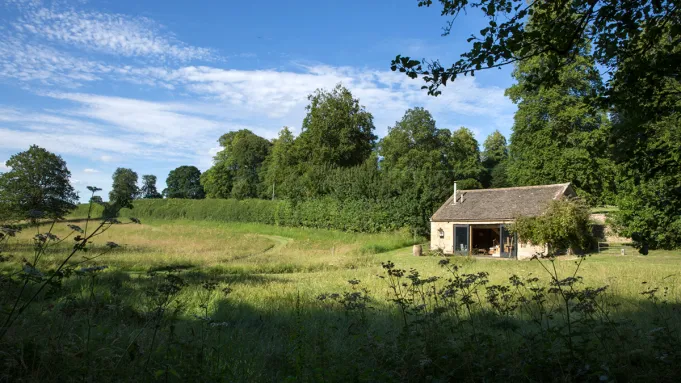
On the Hampshire-Sussex border, where a grassy chalk ridge rises into beech hanger trees, a bucolic scene unfurls. Wildflowers line the country path, birds sing noisily and ducks paddle on the little pond. Close to the boundary wall of a village churchyard, a half-acre plot houses an 18th-century cart shed and stables, recently transformed from ruins into a highly crafted family retreat.
The living room of Osgerby’s renovated cart shed; the two Mariposa sofas were designed by Barber Osgerby for Vitra, the Zero-In table for Established & Sons and the Bellhop floor lamp for Flos. The pair of Spanish chairs are by Børge Mogensen for Fredericia © Kensington Leverne
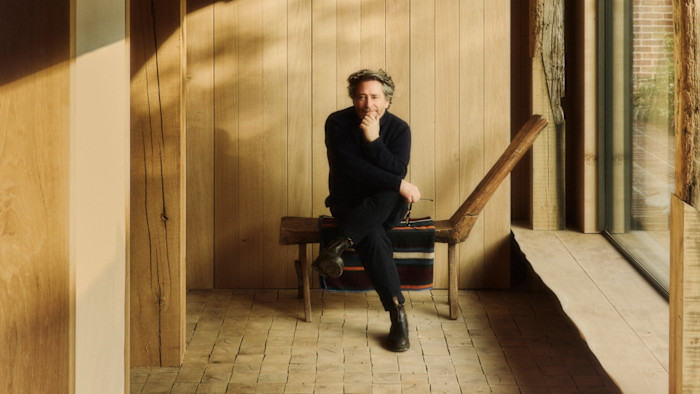
“What attracted me to this place was that it already had a life,” says designer Jay Osgerby, who bought the property in 2021 with his wife Helen. “It carries centuries of use; it has seen estate farming, labour, weather, neglect. It isn’t a blank canvas, it remembers.” Following an intense five-year project, its proportions – 37m long with a soaring 8m-high roof – still feel connected to the landscape, which for Osgerby was precisely the point.
Osgerby is one half of design studio Barber Osgerby. He met Edward Barber at the Royal College of Art and since 1996 they have created rigorous furniture and lighting for an illustrious list of brands: Vitra, Knoll, B&B Italia, Mutina, Fredericia among them. In 2001 they co-founded architectural practice Universal Design Studio and a decade later added Map Project Office, a design consultancy. Their work is often defined by structural clarity and economy of material; their biggest hits include the 2012 Olympic torch, a £2 coin for the Royal Mint and the Bellhop lamp for Flos.