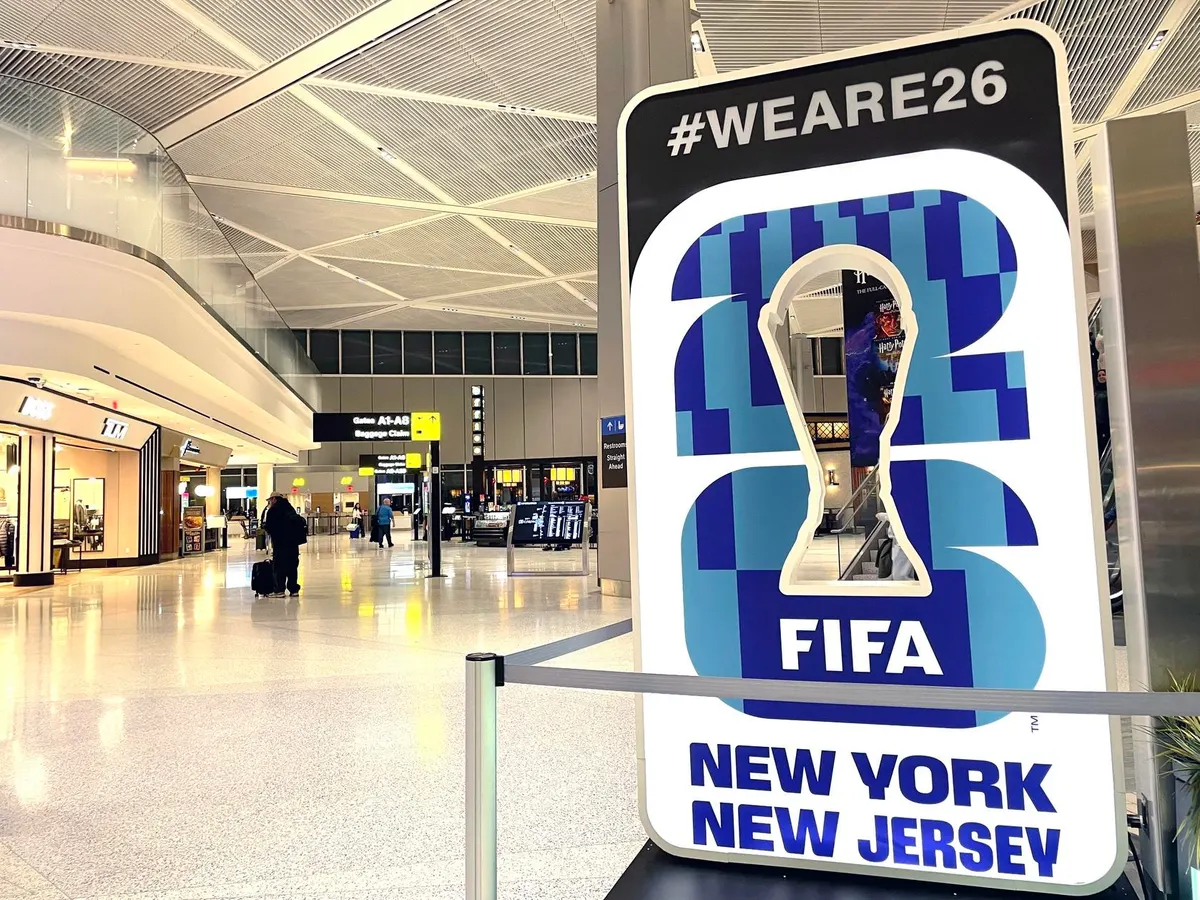
ToplineAs the World Cup draws closer, hotel associations in host cities tell Forbes they are resigned to seeing a smaller economic lift than FIFA had promised.A FIFA World Cup ad at Newark Liberty International Airport welcomes travelers to the New York City area. (Photo: Deb Cohn-Orbach)UCG/Universal Images Group via Getty ImagesKey FactsThe heads of hotel associations in three World Cup host cities—New York City, Philadelphia and San Francisco—told Forbes they have not seen a World Cup surge in demand so far.In recent weeks, FIFA cancelled tens of thousands of reserved rooms in host cities across the U.S., Canada and Mexico.“The tea leaves are showing us that the demand the World Cup was meant to drive isn’t materializing, at least right now,” Evan Saunders, senior vice president of travel at the location intelligence firm Azira, told Forbes.Crucial Quote“My hunch is the World Cup will be a huge success as a sporting tournament. On TV, the stadiums will appear full or almost full—but that's not necessarily the same thing as a tourism success,” Alan Fyall, associate dean at the University of Central Florida’s Rosen College of Hospitality Management, told Forbes. Demand Fails To Live Up To Fifa Hype Some World Cup host cities are grateful they didn’t put all their eggs in the World Cup basket. “Contrary to the massive hype” accompanying FIFA’s World Cup announcement a year ago, when the soccer body forecasted millions of international visitors would deliver a $30.5 billion economic boost to the U.S., “demand has certainly not been at anywhere near that level,” Vijay Dandapani, president and CEO of the Hotel Association of New York City, told Forbes, adding that forward hotel bookings in New York for June and July are virtually identical to the same period last year. “Now, could all of that change and we see a rush of business? We all certainly hope so, but hope is not an expectation.” Philadelphia hoteliers “weren’t thrilled” when FIFA recently cancelled roughly 2,000 room reservations for the tournament, Ed Grose, president and CEO of the Greater Philadelphia Hotel Association, told Forbes. “But at the same time, there's still a lot going on in Philadelphia this year. We are still hoping for an awesome FIFA World Cup, but even without that, we’re still having a banner year” thanks to two citywide conventions hosted while the tournament is taking place. In California’s Bay Area, many hotel leaders gauged World Cup demand more conservatively because they remember the last time the U.S. hosted the tournament in 1994, Alex Bastian, president and CEO of the Hotel Council of San Francisco, told Forbes. They tracked team placements and match schedules and “brought a clear understanding of the nuances and the true financial impact of the tournament,” he said, “and as a result, they adopted a more conservative forecasting strategy. That being said, we remain excited about the event, not only for its economic potential but because it will put our city in a global spotlight.” Expectations Of International Visitation Have Fallen ShortTourism officials were initially bullish on the World Cup’s potential to help reverse a dramatic 6.3% downturn in inbound international tourism since President Trump took office, driven mainly by his tariffs, America First rhetoric and immigration policies. Last year, FIFA advised World Cup host cities to expect a 50/50 split between domestic and international visitors. The projected $30.5 billion economic boost hinged on the assumption the U.S. would receive an influx of international visitors, who spend four times as much as domestic travelers. But two months before the tournament kicks off, it’s still unclear if foreign visitors will come in the numbers necessary to drive the promised economic boost. Airline bookings made in January and February for the World Cup host cities in June—when the tournament begins—were down 5% from Europe compared to last year, down 3.6% from Asia and essentially flat (up 0.2%) from South America, according to Cirium data. As of now, there is “no evidence hotels will be able to increase average daily rates and length of stays thanks to the World Cup,” Saunders told Forbes. “Everything points to the contrary right now.”What We Don’t KnowWill hotels see a last-minute boost in demand? “I think it's going to come right up to the wire, I really do,” Fyall told Forbes, noting that the tournament tends to start slowly. “But if their national team starts doing well, people literally will jump on a plane and spend whatever money is in their savings account to get there,” he said, noting that “unfortunately, it’s not easy for international travelers to visit the U.S. at the last minute.” Dandapani says it won’t be long before he has a sense of whether the World Cup will be a boom or bust for New York hotels. “We won’t know for sure until 30 days ahead—so by the middle of May.”Further ReadingU.S. Hotel Industry Starting To Worry About The World Cup (Forbes)World Cup Uncertainty Grows—Here’s Why The Promised Tourism Boon Is Under Threat (Forbes)
Hotels Aren’t Seeing The World Cup Boon They Were Promised
With just over two months until the World Cup begins, the hotel industry doesn’t see the promised economic boon on the horizon.
829 words~4 min read