JEDDAH: Calotropis procera, commonly known in Arabic as ushar, is a resilient shrub widely distributed across Saudi Arabia.
It grows in deserts, open landscapes, roadsides, and disturbed areas, where it is often characterized as poisonous. Native to the Arabian Peninsula and the broader Afro-Asian arid belt — spanning tropical and northern Africa through the Middle East to South Asia — the species is well adapted to extreme environmental conditions. It thrives under intense heat, prolonged drought, strong sunlight, and frequent soil disturbance.
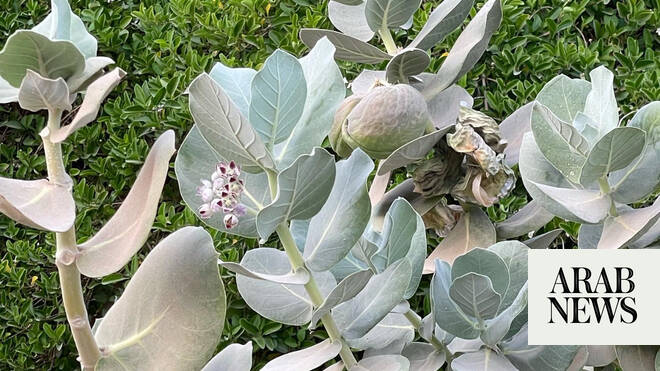
The plant is typically found in warm lowlands, plains, wadi systems, and agricultural margins, where water runoff and exposed soils create favorable conditions. Its thick, felt-like leaves — earning it the nickname “felt plant”— protect against wind damage and ultraviolet radiation while aiding moisture retention.
An evergreen shrub, Calotropis procera demonstrates exceptional persistence. Its vigorous root system enables it to resprout following disturbance, supporting long-term establishment in harsh environments.
The plant produces inflated pods containing numerous silky-tufted seeds that are easily dispersed by wind; historically, this floss has been used as a soft stuffing material.