ARAR: The Northern Borders region of Saudi Arabia harbors a quietly remarkable story of botanical diversity, one written in the resilience of desert plants that have learned to thrive where little else can. Among them is the “daqqaqa”, a species that embodies the ingenuity of life in one of the Kingdom’s harshest landscapes.
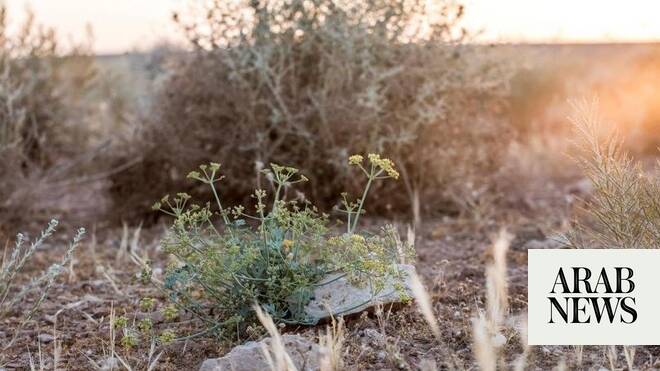
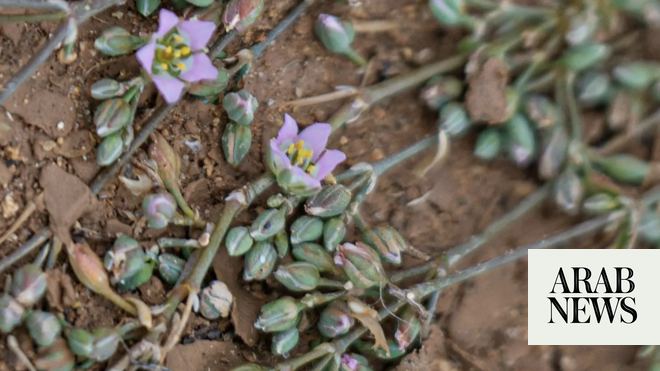
Known scientifically as “Microparacaryum intermedium,” the daqqaqa is a delicate annual herb with a slender, cylindrical stem that branches outward and reaches no more than 10 to 15 centimeters in height. In the rocky, unforgiving terrain where it takes root, the plant often leans against stones for support, the Saudi Press Agency reported.
Its ribbon-shaped leaves, ranging from 1.5 to 3.5 centimeters in length and 0.3 to 0.7 cm in width, transition from stalked to sessile along the stem, an adaptation finely tuned to arid conditions. The plant favors the clay-bottomed floodplains of the region’s villages, where soil retains moisture longer than the surrounding desert, giving the plant just enough to sustain its brief life cycle.
Nasser Arsheed Al-Majlad, chairman of the Aman Environmental Association in the Northern Borders, described the daqqaqa as one of the region’s rare wild plants and a marker of genuine ecological wealth. “Its appearance in only a handful of sites,” he said, underscores the distinctiveness of the local environment and the urgency of protecting it.