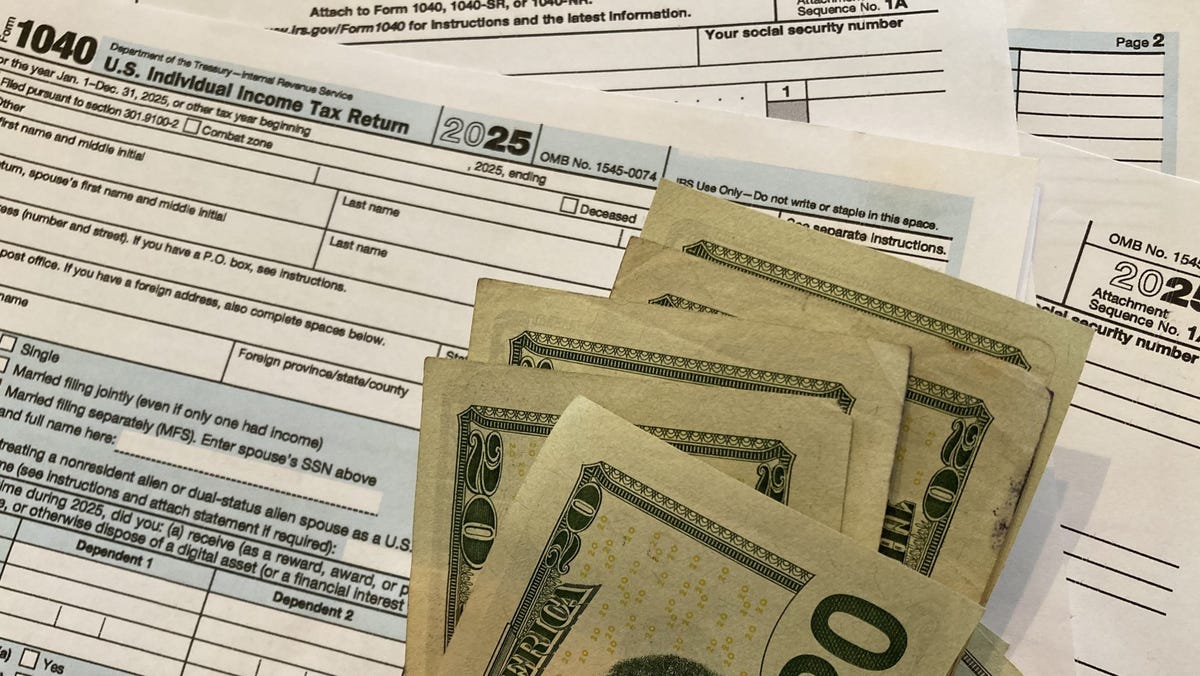
Most tax refunds no longer come as a paper check—they are direct deposited. (Photo by Spencer Platt/Getty Images)Getty ImagesThe IRS has released filing season data, including the average tax refund, through March 20, 2026, bringing taxpayers even closer to the April 15 deadline. And while the season continues to roll on, the latest numbers indicate that the pace still hasn’t quite caught up with last year.As of March 20, the IRS had received 78,893,000 individual income tax returns, compared to 79,616,000 at the same point in 2025. That’s a 0.9% decrease in filings.Tax season filing and processing numbers still lag as compared to 2025.Kelly Phillips Erb Processing totals tell a similar story. The IRS has processed 77,801,000 returns, down from 78,675,000 at this point last year—a 1.1% decrease.One key factor is that early filers tend to submit simpler returns—usually those claiming the standard deduction and mainly reporting wage income from Forms W-2. Returns that include business income, rental activity, or complicated itemized deductions often come in later during the season. If that pattern holds, the IRS could still see a late-season surge of more complex filings.How Taxpayers Are FilingThe IRS continues to encourage taxpayers to e-file, emphasizing that electronic filing is faster, more secure, and less error-prone than paper returns. So far this season, the IRS has received 77,574,000 e-filed returns, compared with 77,266,000 at the same point last year—an increase of 0.4%.The split between professionally prepared returns and DIY returns is fairly even.Kelly Phillips ErbOf those e-filed returns, 39,738,000 were filed by tax professionals, down 1.0%, while 37,836,000 were self-prepared, up 1.9%. The split between professionally prepared and self-prepared returns remains relatively even.If you’re a DIY preparer and don’t want to pay for software, the IRS Free File program remains an option—but taxpayers should review each provider’s terms carefully. Some Free File offers include state preparation, while others charge additional fees, which must be disclosed on the provider’s Free File landing page. Eligibility can also narrow as income rises or returns become more complicated.There are other options to file for free, but you won’t find Direct File. The IRS shut down its Direct File program in 2026.IRS.gov Web Visits If filing activity has been slightly slower, taxpayer curiosity clearly hasn’t.Traffic to IRS.gov continues to surge this season. As of March 20, the website had logged 380,292,000 visits, compared with 244,432,000 at the same point last year—a 55.6% increase.Visits to the IRS website have increased dramatically compared to 2025.Kelly Phillips Erb That spike likely reflects taxpayers searching for answers about refund timing, new tax rules, and filing changes affecting 2025 tax returns.For refund updates, the IRS continues to point taxpayers to the “Where’s My Refund?” tool. The tracker provides three key updates:Confirmation that the IRS received the returnNotice that the refund has been approvedThe projected date the refund will be issuedRefund status information is typically available within 24 hours of e-filing, three to four days after the IRS receives a prior-year e-filed return, or about four weeks after mailing a paper return. The tool updates once per day—usually overnight—so checking repeatedly during the day won’t speed things up or produce new information.Tax Refunds While filing numbers remain slightly behind last year, refund amounts continue to climb.The average refund is now $3,571, compared with $3,221 at this point last year—an increase of 10.9%. However, despite the promise of bigger refunds, tax refund check amounts have actually fallen in March. A month ago, the IRS reported that the average tax refund was $3,804, while last week it was $3,623.More taxpayers are taking home bigger refunds compared to 2025.Kelly Phillips ErbThe total number of refunds has also increased compared to 2025. The IRS has issued 56,729,000 refunds so far, a 1.8% rise from 55,716,000 at the same point last year. Overall, the IRS has refunded $202.595 billion this season, a 12.9% increase from $179.469 billion at the same point in 2025.Direct deposit refunds show even stronger growth. The IRS has issued 57,281,000 direct deposit refunds, up 6.5%, totaling $203.960 billion—a 15.5% increase year over year.What’s Behind Those Refund Numbers?The One Big Beautiful Bill Act (OBBBA), which took effect in mid-2025 and expanded several tax benefits, including a higher standard deduction, larger child tax credits, and new deductions tied to overtime and tip income. The bill was retroactive to the start of 2025, but withholding tables were not updated during the year.To help taxpayers adjust for 2026, the IRS has updated its Tax Withholding Estimator, a free tool that helps estimate how much federal income tax to withhold from paychecks. In addition to no tax on tips and overtime, the calculator accounts for other OBBBA-related provisions, including car loan interest changes and expanded deductions for seniors. According to the IRS, it also better reflects updates tied to family credits, homeownership, and charitable giving.Some increases were expected, but early results have left some taxpayers and practitioners underwhelmed. Congress and the White House had suggested that OBBBA provisions could push the average refund up by $1,000 or more this year. So far, the data tells a much more modest story.2026 Tax Filing Season With the April 15 deadline approaching, the filing season is entering the stretch when millions of taxpayers traditionally wait until the last minute to file. For the latest tax season information (including tax refund information), check out our Forbes Tax Guide.ForbesWhen Will Your Tax Refund Arrive? What To Know This Tax Filing SeasonBy Kelly Phillips ErbForbesForbes Last Minute Tax Guide: How To Navigate The Changes On Your 2025 ReturnBy Kelly Phillips Erb
Tax Filings Lag While Tax Refunds Fall Short Of Early Hype
Refunds are still higher than last year following the 2025 changes to the tax law, but recent data shows little additional growth as the deadline approaches. Average refunds are up $350 from last year.
919 words~4 min read