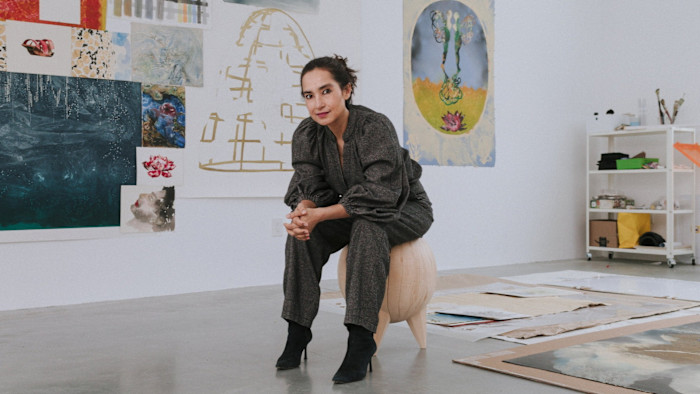
The artist Shahzia Sikander is behind the wheel of a slush-splattered SUV on a bitter-cold afternoon, driving along winding roads towards the property she is renting in upstate New York. The Hudson Valley has become an increasingly popular rural base for artists in recent years, but finding this particular home and studio felt a bit like fate for the Pakistani-American.
The two structures, she explains en route, were built by Marcel Breuer for the mid-century abstract painter Sidney Wolfson, who convinced the Bauhaus-trained architect to incorporate a silver-hued trailer into the house’s cantilevered design. That charming eccentricity would excite virtually any contemporary artist, but the provenance has even deeper resonance for Sikander, whose meticulously executed paintings blend ancient Asian techniques with contemporary themes of gender, geopolitics and social justice — and references ranging from the Muslim veil to cowboy boots.
Sikander outside her house in upstate New York. The architect Marcel Breuer incorporated a silver trailer into the house’s cantilevered design. © Landon Speers for the FT
Breuer was born to a Jewish family in Pécs, Hungary, and grew up not far from the 16th-century Mosque of Pasha Qasim, a domed landmark that was converted to a Catholic church after the Ottomans were driven out of the ancient city. It’s the type of cultural mélange that Sikander sees reflected in Breuer’s light-filled, geometric designs — and in her own life story. Born in Lahore, Pakistan, in 1969, and raised Muslim, she attended a Catholic school there, moved to the US in the early 1990s and has continued to criss-cross the globe for months or years at a time — from Japan to Laos to Italy — in the interest of deepening her multidisciplinary practice, which spans painting, drawing, mosaic, glass, video and sculpture.