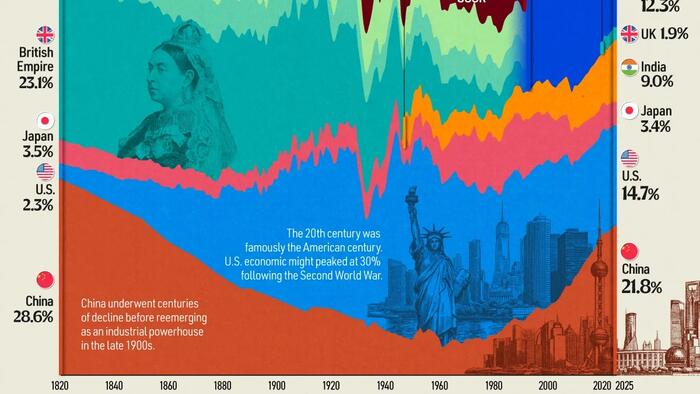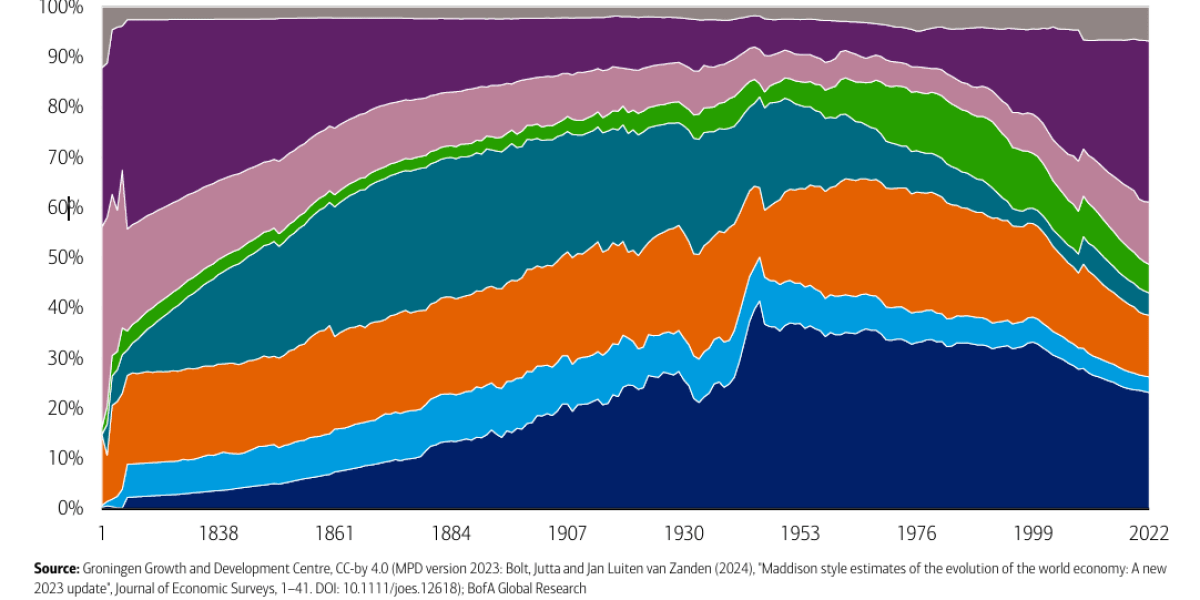
For roughly 1,800 years, the world’s largest economy sat somewhere along the Yangtze River. A new chart from the Bank of America Institute — spanning 2,000 years of global GDP data — shows that America’s moment at the top wasn’t destiny. It was an accident of history. And it’s ending.
The United States emerged from World War II as the undisputed economic superpower, accounting for nearly a third of global GDP at its postwar peak. Prophetically, in 1941, Fortune founder Henry Luce dubbed this era “the American century.”
The U.S. spent the better part of the 20th century treating its position at the top of the economic order as something close to a birthright. “American exceptionalism,” the idea that the country was fundamentally distinct from — and often superior to — other nations due to its unique founding principles, political institutions, historical development, and perceived moral mission in the world, dates back to the precolonial days and John Winthrop’s 1630 articulation of the country as a “city upon a hill.”
But in economic terms, America’s exceptional share of global GDP was a very real thing from the 1860s through the 1950s, as calculated by the Bank of America Institute, citing thousands of years of data from the Groningen Growth and Development Centre‘s Maddison Project database, one of the most comprehensive long-run economic datasets in existence.