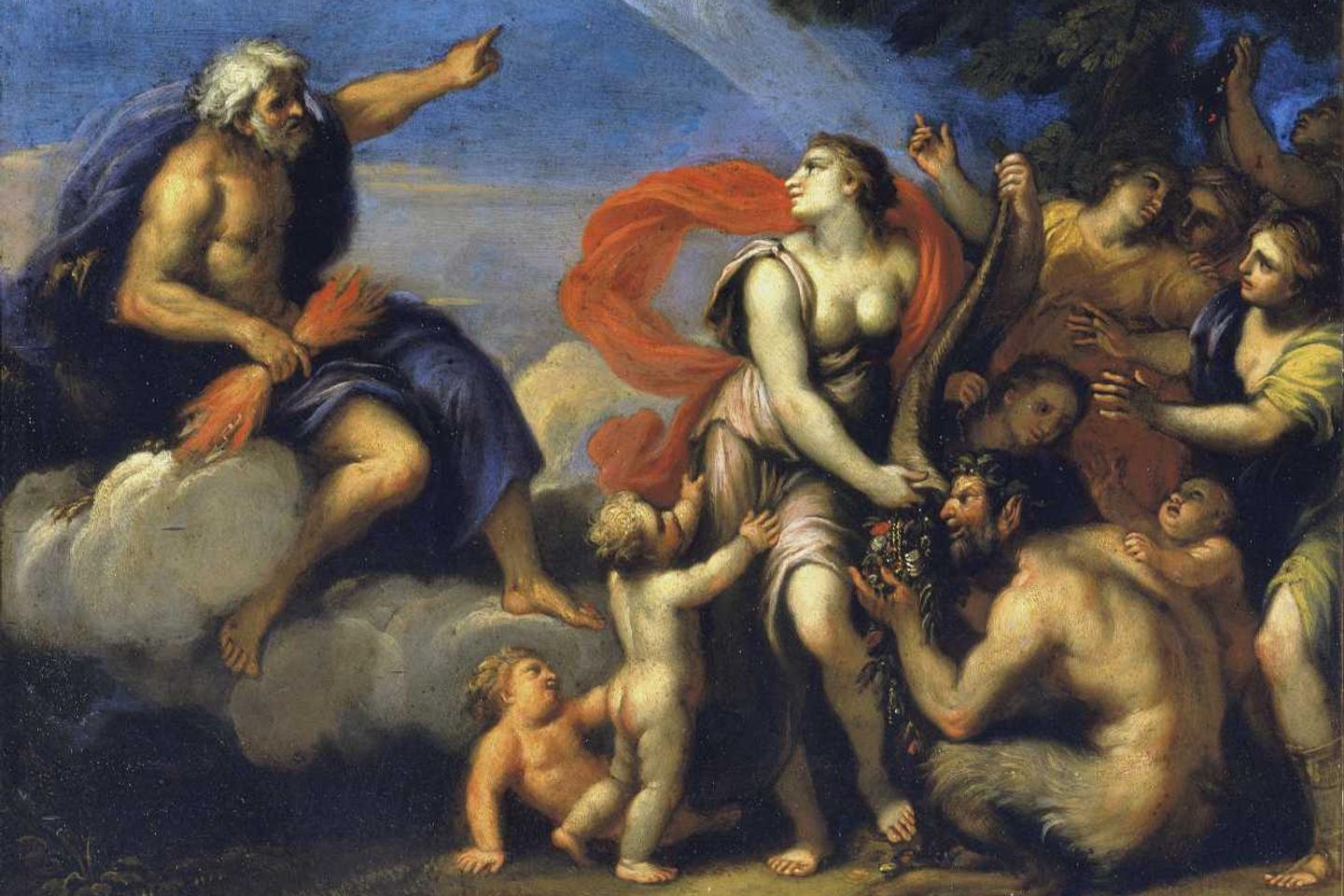
'Jupiter and Pandora' (circa 1600-1640), oil on canvas by Francesco Albani (1578-1660), held at the Pinacoteca Nazionale di Bologna (Italy). ALINARI ARCHIVES/OPALE.PHOTO
"Son of Iapetus, surpassing all in cunning, you are glad that you have outwitted me and stolen fire – a great plague to you yourself and to men that shall be. But I will give men as the price for fire an evil thing in which they may all be glad of heart while they embrace their own destruction." This dark prophecy was recounted in the 8th century BCE by the Greek poet Hesiod, in his two works Theogony and Works and Days, both of which tell the same story of Pandora.
The myth says that, in the beginning, men and gods lived together in innocence, in a kind of marvelous paradise where "they had all good things." Men, present from the earliest times when Cronos, father of Zeus, still ruled the world, did not need another sex to be born. This life without women unfolded in bliss until Zeus, having become ruler after distributing honors among the gods of Olympus, decided to separate mortals from the gods. He tasked a titan, Prometheus, with carrying out this division.
But this rebellious and cunning spirit was determined to favor humans. While gods and mortals gathered in assembly, mingling together, Prometheus brought forth a freshly slaughtered ox and divided it into two portions, each meant to establish the status for the gods on one side, and for men on the other, thus sealing their fates. In the first lot, he placed only bare bones, wrapped in a thin layer of enticing white fat. In the other bundle, he put what appeared edible: the flesh covered with the hide of the sacrificed animal, all packed inside the ox's stomach, the gaster.