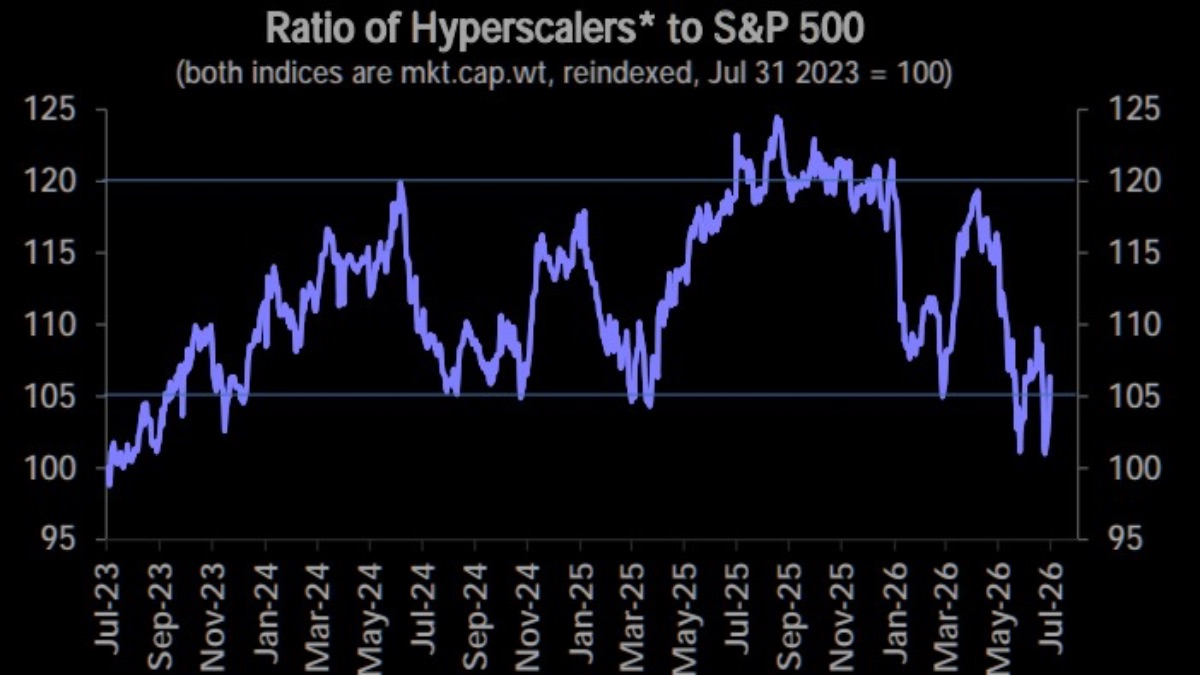
“Increasing capex is forcing companies to spend significantly more of their cash flows, and raise debt, to continue investing for the future. Debt-driven expansion has sent jitters through the market, but signs of AI systemic risks still remain largely absent. Broadly, leverage continues to remain healthy,” Emanuel and his team advised clients.
However, they noted, “debt has been rising, highlighted most recently by GOOGL (Alphabet) raising $30 billion–plus last week. That has meant that on aggregate, hyperscalers now hold more debt than cash.” Nonetheless, corporate debt levels remain below the median of the S&P 500 companies, he said.
It’s free cash flow (FCF) that is the looming problem, Emanuel et al. wrote. Based on current trends, the big AI hyperscalers are spending so much of their free cash flow on AI capex that it could be about to go negative:
“One ‘yellow flag’ though has now been triggered. While FCF generation remains positive on aggregate, ongoing spending to build gen AI’s ‘railroad tracks’ is becoming a key issue. Hyperscalers’ 12-month forward FCF has now plummeted below the ‘yellow flag’ 2022 cycle lows … Amazon’s $200 billion in capex for 2026 was higher than feared—and means 2026 is likely a negative FCF year for Amazon. FCF turning negative for the hyperscalers on aggregate would signal a major ‘red flag,’” they wrote in a note seen by Fortune.