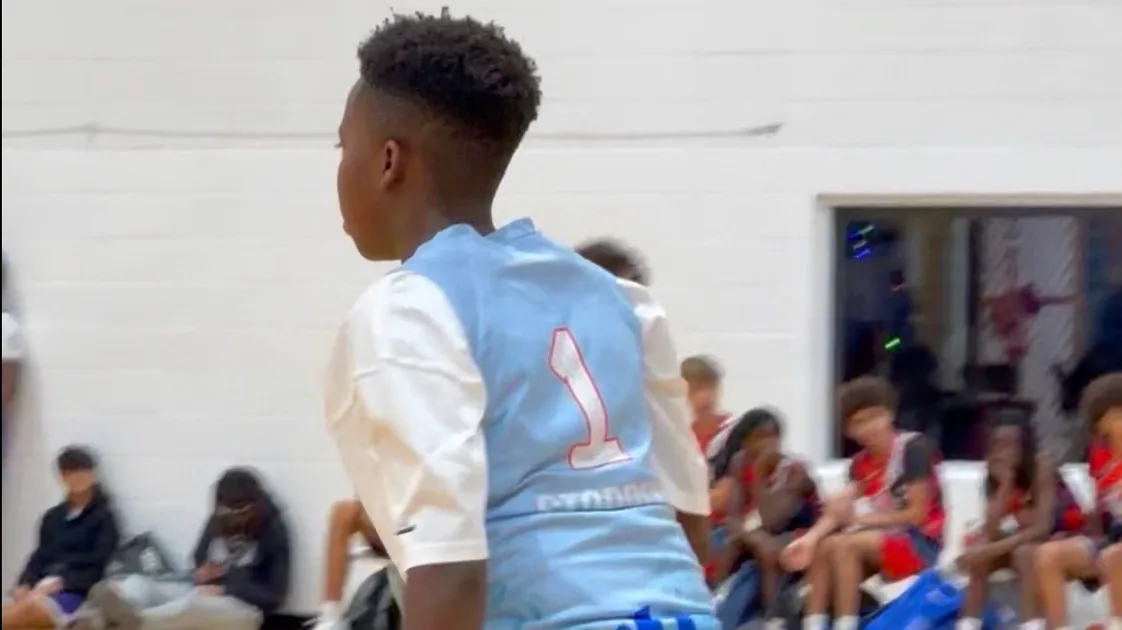
Last Saturday, at an Amateur Athletic Union basketball tournament in Miami, I found myself doing something no mother should have to do: defending my child against an adult.My son is 11 years old. In the span of six months, he shot up from 4 feet, 11 inches to 5 feet, 6 inches. But he is still very much a child — curious, playful, learning how to regulate his emotions, and growing into himself one awkward inch at a time. The world, however, no longer seems interested in seeing him that way.After his sixth-grade team won their game, a coach from the opposing team approached my son’s coach and said, “You cheated.” Gesturing to my son, who was standing near enough to hear the whole exchange, he said, “You’ve got older kids like this one playing on a sixth-grade team. He must have been reclassed.”As a mother, my instinct to defend him kicked in immediately. But before I could step in, my son spoke up for himself: “Hey, I’m only 11. I’m actually the youngest sixth-grader on my team.”This moment wasn’t an anomaly. It was a reflection of a larger, well-documented problem: Black children are routinely perceived as older than they actually are.This phenomenon has a name: adultification bias. Research published by the American Psychological Association found that Black boys as young as 10 are perceived as significantly older and less innocent than their white peers of the same age. And as the National Black Child Development Institute warns, adultification bias “robs Black children of the presumption of childhood,” exposing them to harsher treatment, diminished empathy and adult consequences long before they are developmentally appropriate. In other words, my son’s experience on that basketball court wasn’t about basketball. It was about perception fueled by racial bias.As a mom, I see this play out far beyond sports. My son is spoken to with more authority, more expectation and less grace than a white 11-year-old would be. He is expected to “know better,” to be more composed, to take on more responsibility — not because of his age, but because of his race. At a recent Christmas party hosted by one of my closest friends, my son was the only one who was asked to carry tables from the house to the yard, despite being surrounded by adults and non-Black children who were older. He wasn’t there as help; he was there as a guest — and a child. Yet the responsibility landed on him.I have seen this dynamic repeat at my workplace. When my son attends events with me, he does so as my child. And yet he is often asked to carry boxes or assist with setup and breakdown — even when adult staff members are present. These moments are rarely malicious. They are casual, comfortable. And that is precisely the problem. The expectation that Black children should shoulder adult responsibilities — and be held to adult standards their white peers are not — is deeply rooted and widely normalized. I know this because I lived it myself.As a Black girl attending schools in Miami Beach composed of predominantly non-Black students, I was always expected to be older, to know better and to do what was “right.” When I made mistakes, the response was heavier.Once, a group of us stayed for a second lunch period to socialize with friends, arriving late to class as a result. We were all given detention. But when detention ended, my classmates’ parents picked them up and took them home. When my mother arrived, she made me sit in the back of a school resource officer’s car — not as punishment, but as preparation. To show me what could happen.The author and her 11-year-old son.Photo Courtesy Of Natalie WilliamsAdultification bias doesn’t live only in institutions. It lives in our expectations, our fears and the lessons we pass down in hopes of keeping our children safe. That moment was driven by fear — a fear many Black parents know intimately. Fear that the world will not extend the benefit of the doubt to our children when they make childlike mistakes. Fear that the margins of error will be thinner and the consequences harsher. That’s why sometimes, in trying to protect our children, we participate in puncturing their innocence. In 2023, Ralph Yarl, a 16-year-old Black boy, was shot after ringing a doorbell at the wrong house in Kansas City, Missouri. Researchers and advocates noted then how adultification bias played into his being perceived as a threat rather than a child capable of an innocent mistake. The perpetration of violence against Black children for this perception is not a new story, from 17-year-old Trayvon Martin in 2012 all the way back to the abduction and lynching of Emmett Till in 1955, when he was just 14. And when these tragedies do happen, we then have to watch adultification bias play out in the court of public opinion and in the actual court system, where those responsible are rarely held accountable. In schools, the pattern is also alarming. Black children are disproportionately disciplined, more likely to be suspended and punished more severely than their peers for similar behaviors — a disparity researchers link directly to adultification and racialized perceptions of maturity. When Black children are viewed as older, their behavior is more likely to be criminalized rather than corrected. That criminalization may eventually bring them into involvement with the criminal justice system, where the same adultification bias means they are more likely to be tried as adults in court, and to be sentenced to adult institutions. It’s also clear from horrifying cases like that of 12-year-old Tamir Rice — shot by a police officer while playing with a toy gun in a park in 2014 — what can happen when members of law enforcement perceive Black children as adults. The danger of adultification isn’t just physical — it’s also psychological.As an early childhood professional, I know that consistently treating a child as older than their age creates unrealistic and unhealthy expectations. An 11-year-old is suddenly expected to manage emotions like a 15-year-old. Mistakes are met with punishment instead of guidance. Growth is rushed. Innocence is stripped away.What troubles me most about what happened at that basketball game is not that an adult made a mistake — it’s how easy it was for him to make it. How comfortable he felt looking at a tall Black boy and assuming deception. How natural it seemed to feel to him to question my son’s legitimacy.As parents, especially Black parents, we spend our lives teaching our sons to advocate for themselves while also bracing them for a world that sees them as older, tougher and less deserving of empathy. If we care at all about equity on the basketball court, at school or in society, we must start by seeing Black boys as what they are: children. And, like all children, they are deserving of protection, patience and care.No mother should have to defend her child’s right to simply be 11.Natalie Williams is an early childhood educator and senior director of education at the Miami Children’s Museum. She is also a Public Voices fellow of The OpEd Project in partnership with the National Black Child Development Institute and the proud mother of an 11-year-old son.Do you have a compelling personal story you’d like to see published on HuffPost? Find out what we’re looking for here and send us a pitch at pitch@huffpost.com.
I Watched My 11-Year-Old Son Defend Himself Against A Grown Man. I Wish I Could Say It Was An Anomaly.
"In the span of six months, he shot up from 4 feet, 11 inches to 5 feet, 6 inches. But he is still very much a child."
1,239 words~6 min read