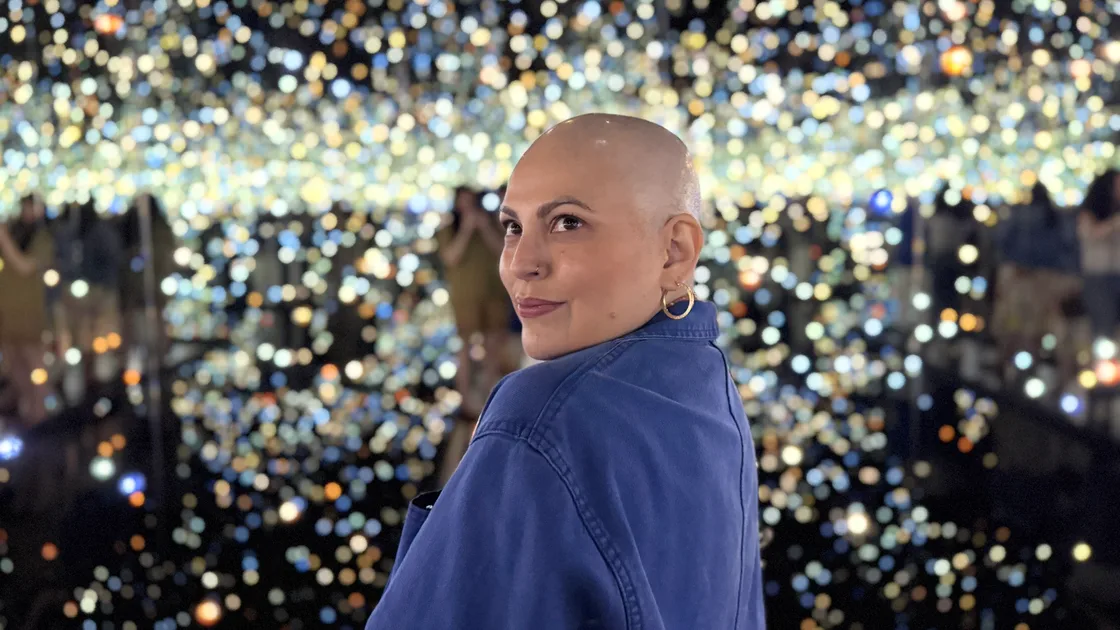
For weeks, I kept a close watch on my hair. Every morning I’d inspect my pillowcase, counting the strands its cottony trap had claimed in the course of the night and wondering if it was time to wave the white flag. On the day that answer finally became “yes,” I woke up to my pillowcase covered more than ever before. I couldn’t count the strands; there were far too many. I got into the shower. As the water washed over me, I became engulfed in hair ― in my eyes, in my mouth. I was choking on my hair, drowning in it.I gently ran my hands over my head and looked at my hands. They were gloved with my dark brown clumps that I couldn’t shake off. Hair was stuck to me like leeches. I had been consumed by my hair for weeks, in thought but also in every crevice of my house, but this was a nightmarish crescendo I hadn’t anticipated. It was time to shave my head.For people with cancer, women in particular, losing our hair can be especially traumatizing for a number of reasons, personal to each patient’s cancer journey. Fifty-eight percent of patients consider hair loss to be the worst side effect of chemo, with many women forgoing chemotherapy treatment to avoid it altogether, according to several studies. It’s an unimaginable choice, though once you experience life as a sick, bald person out in the world, you begin to understand.Chris McQueen was diagnosed with T-Cell Acute Lymphoblastic Leukemia in May 2022. McQueen, who identifies as nonbinary, plays in punk bands in San Diego and is covered in tattoos. As they put it, having a shaved head wouldn’t be out of the ordinary for them. Even with McQueen’s comfort with baldness and a look that wouldn’t immediately flag them as a person with cancer, they still deal with their identity being reduced to their illness.“You have this clear marker that you’re sick,” McQueen explains. “People feel entitled to speak about your illness in a way that I’m not sure others with chronic illnesses that are less visible experience. Your humanity is replaced with this tragic figure. You kind of flatten from this multifaceted person to this 2D figure: cancer patient.”Chemotherapy works by slowing or killing fast-growing cells. It doesn’t discriminate between these cells, however. So while it’s blessedly attacking cancer cells attempting to literally kill you, it’s also going after other fast-growing cells, including those found in hair follicles, leading you to look like a Sphinx cat or Uncle Fester, as I sadly noted when looking in the mirror, two to three weeks after starting chemo."It’s easy for people to remind you that you have your life, that hair doesn’t matter," Zaragoza says.Courtesy of Alex ZaragozaThose in oncology who work with patients recommend cutting your hair in stages to ease oneself into baldness. “If you’re going to lose your hair, don’t wait until the hair loss starts,” suggests Natalie Schaitmann, executive director of the department of supportive care medicine at City of Hope, one of the world’s leading cancer hospitals and research centers. “Our recommendation is to cut it short beforehand. Because if you have long, gorgeous hair and it starts falling out in big chunks ― which it will, it can happen with some chemos very suddenly ― that is a really traumatic experience.”Despite knowing hair loss was coming, and I chopped my own long, dark hair into a pixie cut before starting chemo, the loss was still upsetting and shocking. Coming to terms with simply not looking like yourself is one major emotional hurdle. Within weeks of getting a life-changing diagnosis, you lose all of your hair. And I mean all your hair. Even your pubes, which I was wholly unprepared for. It’s a shock to the system, especially as the toll of cancer and chemotherapy impacts your body in other ways.Molly Ruben-Long, a 36-year-old comedian in Brooklyn, loved her long, brown hair and heavy bangs. It was her “calling card” ― such an important part of her identity that she never even wanted to dye it. That is, until breast cancer. Ruben-Long was diagnosed with Stage 2 triple negative invasive ductal carcinoma in December 2023. The breast cancer diagnosis led her to experiment with her hair, dyeing it magenta, then cutting it into a bob and then, just two days after that, shaving it off. At first, she was into it, feeling “pretty cool with a bald head.” Then the side effects of her steroids, often prescribed to cancer patients, kicked in, caused her to gain 30 pounds. “Do you remember that toy from ’Toy Story’ that was like a demon toy that had a baby doll head shaved with mechanical legs? I looked like that baby doll,” she jokes.The fear of baldness led Kelly Davis, a journalist in San Diego, to save as much of her hair as possible. “I watched my mom lose her hair when she underwent chemo and was pretty traumatized,” she explains. “She handled it fine, but it was deeply upsetting for me.”Davis, who was diagnosed with breast cancer in 2013 at age 40, chose another route: cold capping, or scalp cooling. Patients wear freezing cold haircaps before, during and after chemo to constrict the blood vessels in the scalp, lessening the amount of chemo drugs that reach the follicles. That prevents the hair from falling out. It can reduce hair loss by up to 50%, according to the MD Anderson Cancer Center. However, the process can be challenging, and doesn’t always work.“The cold was incredibly painful, but then you lose feeling in your scalp,” recounts Davis, who through cold capping only lost about 30% of her hair. “I was physically shivering the whole time. We’d bring blankets, but it was never enough. I remember a nurse asking, ‘Why are you doing this to yourself?’”Even with the pain, and still losing some hair which led her to wear a headband to cover a bald spot, Davis says she would cold cap again. “My red hair is one of my defining features, and I don’t have the bone structure to pull off a bald head,” she says. And keeping her hair allowed her to maintain a semblance of normalcy during a difficult time. “I did not want to be The Girl Who Has Cancer,” she says.Giving women going through cancer that choice is fundamental to Hope Rugo, an oncologist and researcher at City of Hope, who along with a team conducted the clinical trials and research to lead to the U.S. Food and Drug Administration’s approval of scalp cooling caps.In the process of seeking FDA approval for cold caps, Rugo encountered fellow researchers and colleagues who didn’t believe that saving women’s hair matters. “They were all men who said that, I have to say,” she recalls. But offering cold capping is imperative to providing well-rounded supportive care.“Not everybody wants to do a cold cap, but just having that option is so incredibly important,” Rugo says. “We need, as oncologists, to be a provider who sees the whole patient and not just what we want to see. We need to see the world through our patient’s eyes. What are their goals of therapy? What are they afraid of?”It’s easy for people to remind you that you have your life, that hair doesn’t matter. And for many that is true. Several people I spoke to said their worries about their hair paled in comparison to the other extremely gruesome effects of their cancer, while still sharing that going bald sucks and has its own negative effects on their mental health. For those who feel down about losing their hair, Schaitmann says acknowledging that emotional burden allows the space for normalization of different experiences within cancer. “However you feel about losing your hair is how you feel about your hair. You have nobody to answer to for that, [while still] holding in one hand when possible that it will grow back,” she adds. “That doesn’t minimize the psychological emotion of it. It’s just reminding yourself, ‘OK, my hair falls out because the treatment is working, but it will come back.’”
This Life-Saving Cancer Treatment Forces Us Into An Unwanted Spotlight — And We Need To Talk About It
For women dealing with cancer, this side effect can be especially traumatizing.
1,357 words~6 min read