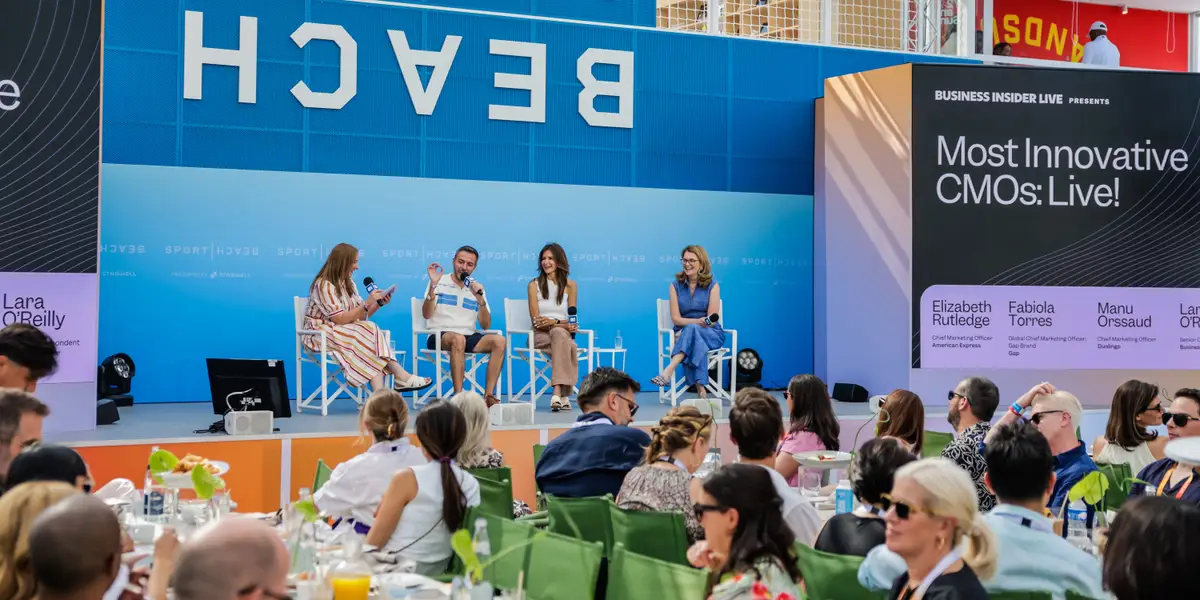
Differences that don't matter.getty(What follows is some of what I shared in keynote remarks given at this year’s Forbes CMO Summit, in Aspen. The video of the full speech is below.)The greatest threat facing businesses globally isn’t geo-political instability, cyber-security, currency or tariff fluctuations, or supply-chain disruptions.It’s irrelevancy. It’s not mattering. But the reality is that many don’t matter much, or at least not much more than the others in their competitive set. The reality is that most of the nearly 1 billion products and services making up the global marketplace each meet acceptable thresholds of performance. Most are good-enough-enough and because true innovation is rare, they’re interchangeable and functional customer switching costs are de minimis. Think about your phone, the detergent under your sink, the clothes in your closet, the car in your driveway, the apps on your home screen, your bank, the agencies, and even the game-changing AI platforms, sure, you’ve got preferences, but at a functional level are they materially different than the others from which you could choose? They’re not.We can trace this good-but-undifferentiated current state to several things but directly to an exponential increase in the number of products and services introduced over the past 20 years. Consider that since 2005: MORE FOR YOUThe number of companies globally has almost doubled.The number of service businesses globally has doubled.The number of products on shelves physical and digital has increased 3000%, thirty-tupling to 600 million globally. (Amazon and Walmart each sell what’s been estimated to be near 500 million SKUs.)That’s a lot more consumer choice, confusion, competition, and over 40x new but undifferentiated products, services and brands; every single one of which needs marketing. And here’s where it gets worse for CMOs and the companies whose brands and businesses they help steward. In 2005, global marketing spend was $400B annually. Today, it’s $1.2T. While this reflects a 300% increase in nominal dollars, it’s only a 55% increase in real dollars. So, while the total number of companies and service businesses each doubled, and the number of products increased 30x, the marketing budgets supporting this exponential proliferation are up only 55%. To quote Taraji P. Henson, “the math ain’t mathing.”Alas it gets worse still for CMOs and the companies whose brands and businesses they help steward. Because, as Theodore Levitt wrote in The Marketing Imagination, when similarities are abundant, meaningful difference becomes essential, but proliferation without this, without meaningful differentiation, has placed a two-decade burden on marketing to often be the sole-source of meaning and difference. Of why one good-enough-enough product matters more than another. Of course, creating meaning, distinction and difference in service of driving growth is what marketing does. It’s what a brand does—or should do—in partnership with a great product or service. Yet in a world where “innovation” often shows up as an incremental improvement, product and service parity has placed an unrecognized burden on CMOs and marketing. Because the more products there are, and the more they start to work and feel the same, the more “meaning,” which is often subconscious and almost always emotional, becomes the only thing that matters. What’s happened is that too often marketing is tasked with putting lipstick on a pig, or at least with making the extraordinarily ordinary seem above average. But when choices explode and meaningful distinctions among “products” don’t, the inevitable result is a deficit of difference and perceived commodification, both of which are stepping-stones to market irrelevancy. Yet few are the CEOs, CFOs, and Boards—so very few of whom have any marketing background 0r experience—who understand or see it this way. Still, you can be certain these same CEOs, CFOs and their Boards are planning for and around geo-political instability, cyber-security threats, supply-chain disruptions and any number of other operational risks. You can be equally sure that too few are considering the greater, extinction-level threat of not mattering. If they did, marketing budgets wouldn’t be up only 55% over 20 years and down nearly 40% over the past five years, but they are. The British would rightly call this penny wise and pound foolish, and Taraji P. Henson, would rightly say “the math ain’t mathing.” …(The preceding is some of what I shared in keynote remarks given at this year’s Forbes CMO Summit, in Aspen. The video of the full speech is below.)
Perceived parity among products and services threatens businesses.
In remarks from Seth Matlins' keynote speech at the 2025 Forbes CMO Summit in Aspen, he speaks about the deficit of difference among products and services globally.
718 words~3 min read