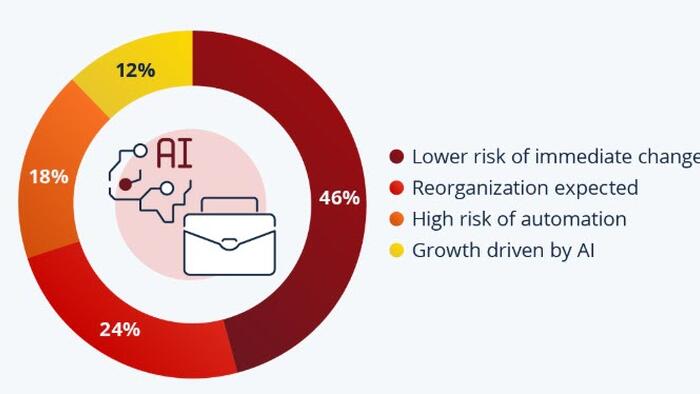
Artificial intelligence is now advanced and cheap enough to perform work equal to nearly 12% of U.S. jobs, according to a new MIT study—news that’s likely further to intensify pressure on employers, workers, and policymakers to prepare for rapid shifts in business and the economy.
MIT’s research, written in October but released on Wednesday, estimates that current AI systems could already take over tasks tied to 11.7% of the U.S. labor market, representing about 151 million workers and roughly 11.7% of total wage value, or around $1.2 trillion in pay. Unlike earlier estimates that focused on theoretical “exposure” to automation, the MIT research focuses on jobs where AI can perform the same tasks at a cost that’s either competitive with or cheaper than human labor.
The findings come from Project Iceberg, a large-scale labor simulation developed by MIT in collaboration with Oak Ridge National Laboratory, home to the Frontier supercomputer.
The model creates what researchers describe as a “digital twin of the U.S. labor market,” simulating 151 million workers as individual agents, each with specific skills, occupations and locations. It tracks more than 32,000 skills across 923 job types in 3,000 counties and maps them against what current AI systems can already do.