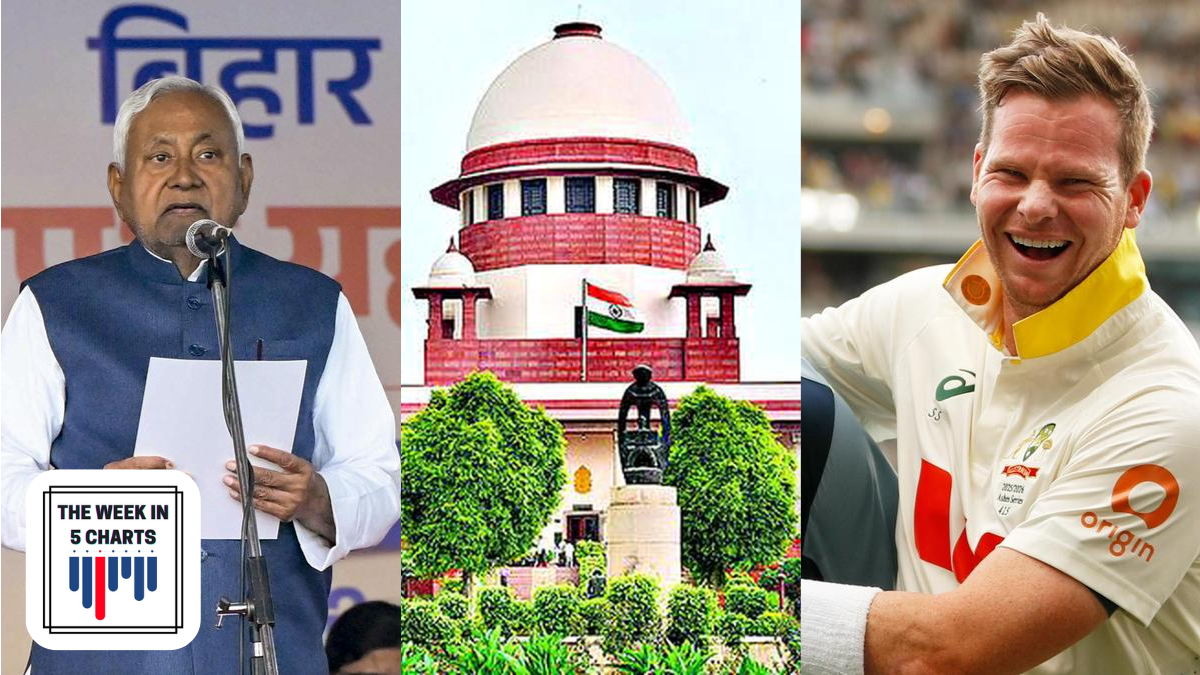
(1) New Bihar Cabinet gets MinistersFollwing an NDA sweep in the Assembly polls, Chief Minister and JD(U) veteran Nitish Kumar took oath once again for the tenth time, along with 26 Ministers (three women and one Muslim). Among them, nine Ministers came from the JD(U), 13 from the BJP, two from the HAM(S) and LJP each and one from RLM. The BJP became the largest party after bagging 89 seats, closely followed by the JD(U) with 85.Mr. Kumar became the longest-serving Chief Minister in Bihar, with nine terms in his belt. His previous nine terms included a 7-day term in 2000 as well as a tenure over 1,800 days in 2005. However, at an all-India level, Mr. Pawan Chamling of Sikkim has served around 25 years as Chief Minister. Here is a look at other Chief Minister tenures across the country.(2) Presidential Reference: Supreme Court’s responses to President Murmu’s 14 questionsA five-judge Bench of the Supreme Court opined that the apex court cannot fix timelines for Governors and the President to deal with State Bills under Articles 200 and 201.However, the Bench clarified that Governors could also not use their discretion to resort to “prolonged and evasive constitutional inaction” in a deliberate bid to thwart the people’s will expressed through proposed laws passed by State legislatures.Here is how a Bench headed by Chief Justice B.R. Gavai, also comprising Justices Surya Kant, Vikram Nath, P.S. Narasimha and A.S. Chandurkar, responded, in its 111-page opinion, to the 14 questions from President Droupadi Murmu in a Reference issued by her on May 13, 2025.(3) Bangladesh Prime Minister sentenced to deathMore than a year after the student uprising and subsequent government action in 2024, former Bangladesh Prime Minister Sheikh Hasina was sentenced to execution by a Bangladesh court on November 17, 2025. The court found Ms. Hasina guilty of crimes against humanity.Reacting to the verdict, Ms. Hasina said that while she had lost control of the situation, but it was a misreading of facts to characterise what happened as a “premeditated assault on citizens.”The events in question began in 2024 after a wave of student protests erupted in the country against a jobs reservation made for descendants of those who had participated in the country’s Independence movement. Protesters saw the reservation as favouring Ms. Hasina’s party Awami League and demanded a restructuring.From there, the protests grew larger and eventually led to the ousting of Ms. Hasina and the appointment of a caretaker government in roughly a month. Here is a timeline showing the sequence of events.(4) Australia beats England in first Ashes testAustralia defeated England in the first test match in the famed ‘Ashes’ test series on November 21, 2025. England scored a total of 336 runs across their two innings while Australia reached this target by scoring 132 runs in the first and then 205 in the second innings.The series has been a defining bi-yearly event for cricket fans in both Australia and England, as well as cricket fans in other parts of the world, with history dating back to 1882 when the first series was played. Through the years, the series between England and its former colony has been marked by heated competition between the teams and heavy symbolism.For instance, a British newspaper published a satirical obituary after England’s first defeat at the hands of Australia in 1882 that the body of English cricket will be buried and its ashes taken to Australia.Here is a look at who the winners in successive years have been.(5) Left-wing extremism in declineThirteen Maoists were killed Andhra Pradesh’s Alluri Sitarama Raju district across two encounters last week on November 18 and 19. Among those killed were top Maoist commander Madvi Hidma, who was the Central Committee Member and South Bastar Battalion Commandant of the banned CPI (Maoist), his wife Madakam Raje, the Chhattisgarh State Zonal Committee Member, and Metturi Joga Rao alias Tech Shankar, a top Maoist leader who was the CPI (Maoist) Central Committee Member in charge of Andhra Odisha Border (AOB).Since 2004, the CPI (Maoist) Party has been responsible for the majority of violence and killings among those perpetrated by Left Wing Extremists, as per the Ministry of Home Affairs. However, the movement appears to be dwindling. Incidents related to LWE violence are seeing a decline since 2010, when the insurgency was at its peak in the Red Corridor and the UPA-led government made the push for a massive counter-insurgency offensive.This decline has continued under the NDA-led government, whose multipronged approach — outlined in the 2015 ‘National Policy and Action Plan to Address LWE’ — has now reached a stage where the Union government aims to make all affected districts “Naxal-free” by March 2026.There are around 38 districts that have been identified as those which are affected by LWE, as per Mr. Rai’s answer in the Lok Sabha in December 2024. Fifteen of these are in Chhattisgarh. Mr. Rai’s March 2025 response cited above also states, “The LWE-affected districts have been reduced from 126 to 90 districts by April 2018, further to 70 by July 2021 and then to 38 by April 2024.”Deaths due to incidents related to LWE have also declined since 2010, as shown in the graphic below. Published - November 26, 2025 01:52 pm IST
Bihar Cabinet 2025, Supreme Court's response to President Murmu, Left Wing Extremism in decline and more
The top charts from the past week include the new Bihar Cabinet, Supreme Court's answers, and the declining trend of Left Wing Extremism
874 words~4 min read