By JORDANA SEAL, NEWS REPORTER Published: 00:53 BST, 9 October 2025 | Updated: 01:06 BST, 9 October 2025
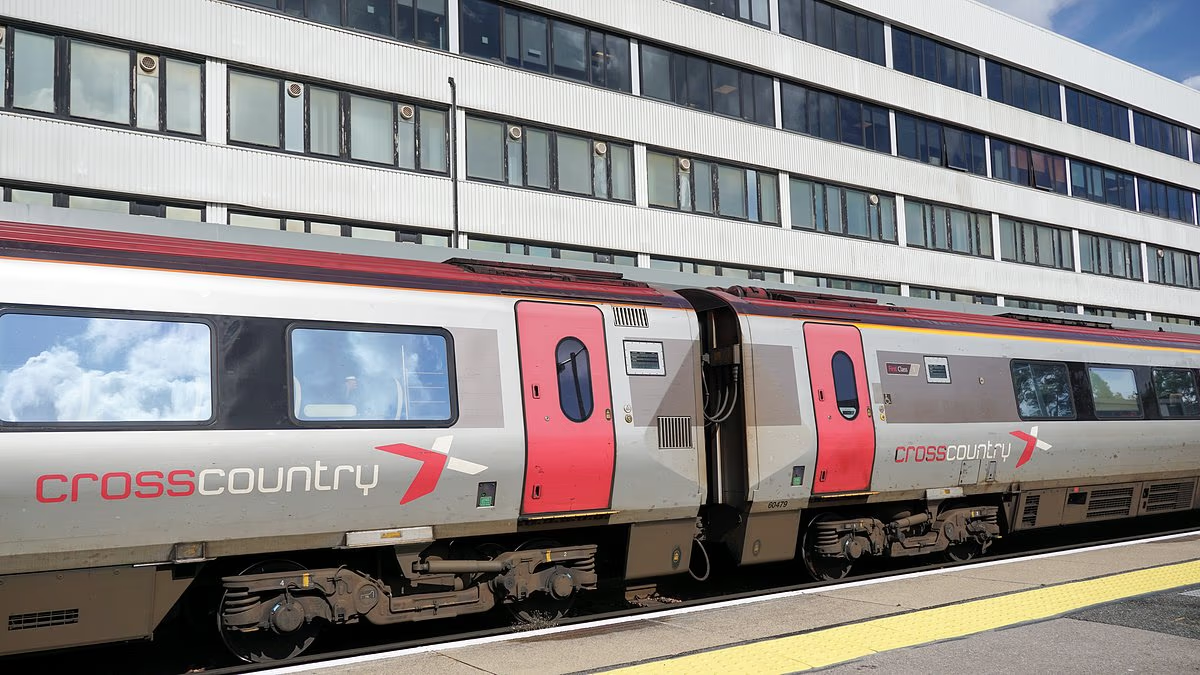
Passengers commuting on British trains experience slower Wi-Fi speeds than their Romanian counterparts, new figures have revealed. In fact, UK trains have the third slowest Wi-Fi speeds in comparison to 18 major European and Asian railway networks.Meanwhile the Wi-Fi available onboard Irish trains is 25 times faster. The research conducted by Ookla found British trains have average upload speeds of 1.07 megabits, which usually only allows for basic internet browsing and emails. It suggests that this is because multiple rail operators are still using older Wi-Fi 4 based connectivity.Luke Kehoe, a researcher at Ookla said: 'Europe and Asia's rail networks, long heralded as a backbone of economic competitiveness, are now judged not only on punctuality and comfort but on the quality of the digital experience onboard. 'High-quality train Wi-Fi has shifted from nice-to-have to essential rail infrastructure. Commuters expect a home broadband-like experience for streaming, work calls and gaming while crossing the Swiss Alps or skirting Mount Fuji.' In comparison, Swedish rail networks have set the pace for high quality onboard Wi-Fi, delivering a 64.58 median download speed. Passengers commuting on British trains experience slower Wi-Fi speeds than their Romanian counterparts, new figures have revealed Swedish rail networks have set the pace for high quality onboard Wi-Fi, delivering a 64.58 median download speed The research conducted by Ookla found British trains have average download upload of 1.07 megabits, which usually only allows for basic internet browsing and emailsIt is followed by Switzerland with a 29.79 median download speed.Britain's median download speed is a mere 1.09 while Romania's is twelve times that. Railway networks are considered a challenge for telecoms operators because metal carriages are hard to penetrate with mobile signals.On top of that, it is hard for the signals to carry as trains pass through tunnels, cuttings and valleys.Train operators are exploring whether Elon Musk's broadband service Starlink could be used to plug coverage gaps.It is currently being tested on some ScotRail routes. Network Rail has also signed a deal with two private telecom firms to see 4G and 5G connectivity boosted on trains and in stations. The Department for Transport said work is set to begin next year and be implemented by 2028. Network Rail's chief financial officer Jeremy Westlake said the investment model would 'deliver the necessary upgrades to our telecoms infrastructure faster whilst offering significant value-for-money for the taxpayer and stimulating wider economic benefits across the country'.He told the BBC's Today programme that passengers would 'start to see the benefits from early next year actually because the roll-out will be progressive, but we will be starting straight away with not-spots in particular'. But it is not only the Wi-Fi that is slow onboard British railway, it is also notoriously slow. Last week it was revealed that CrossCountry was the UK's worst major train operator for cancellations this year.According to new analysis, nearly one in ten CrossCountry trains have been cancelled this year.