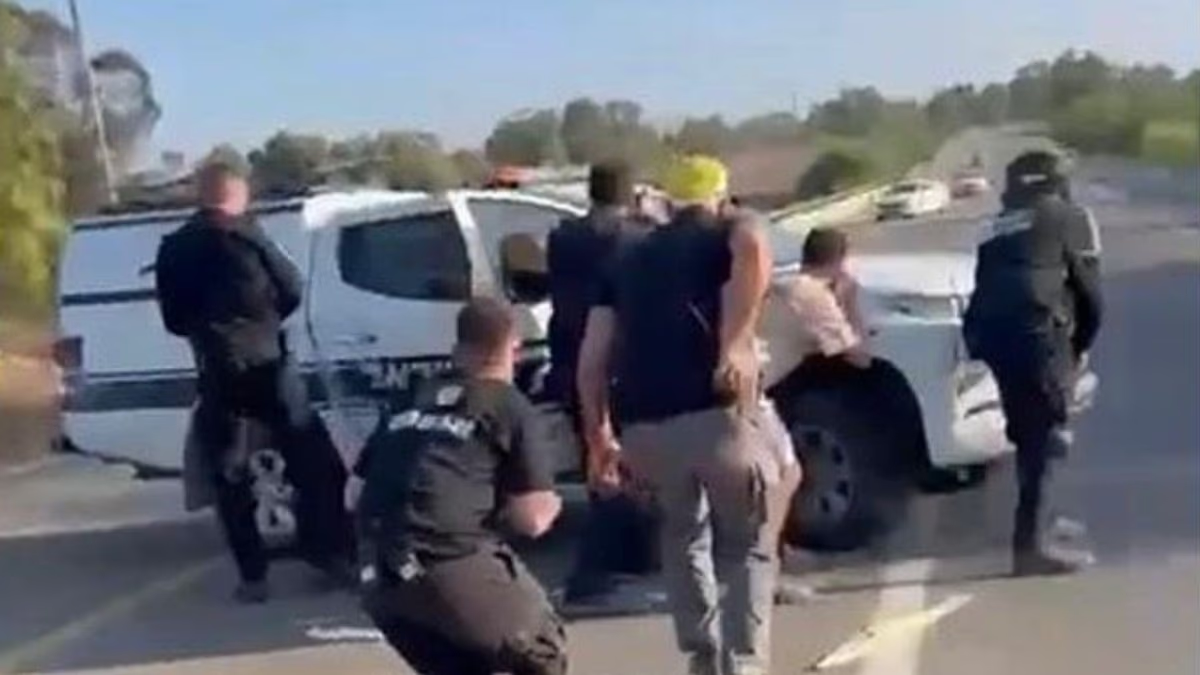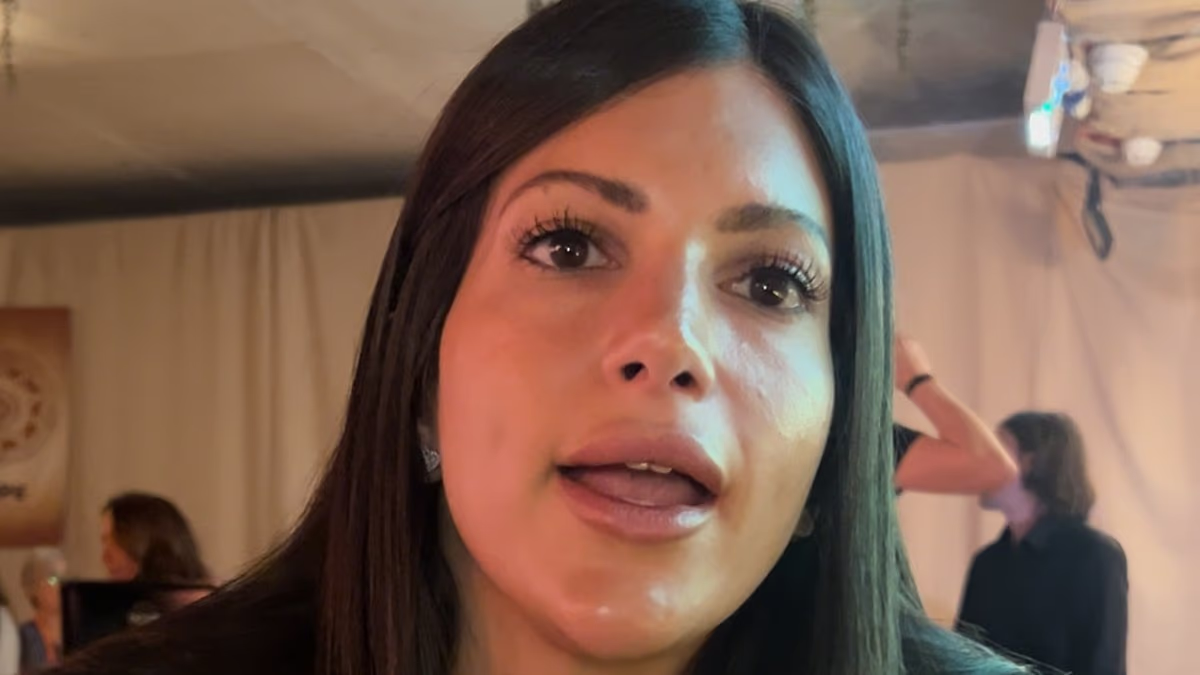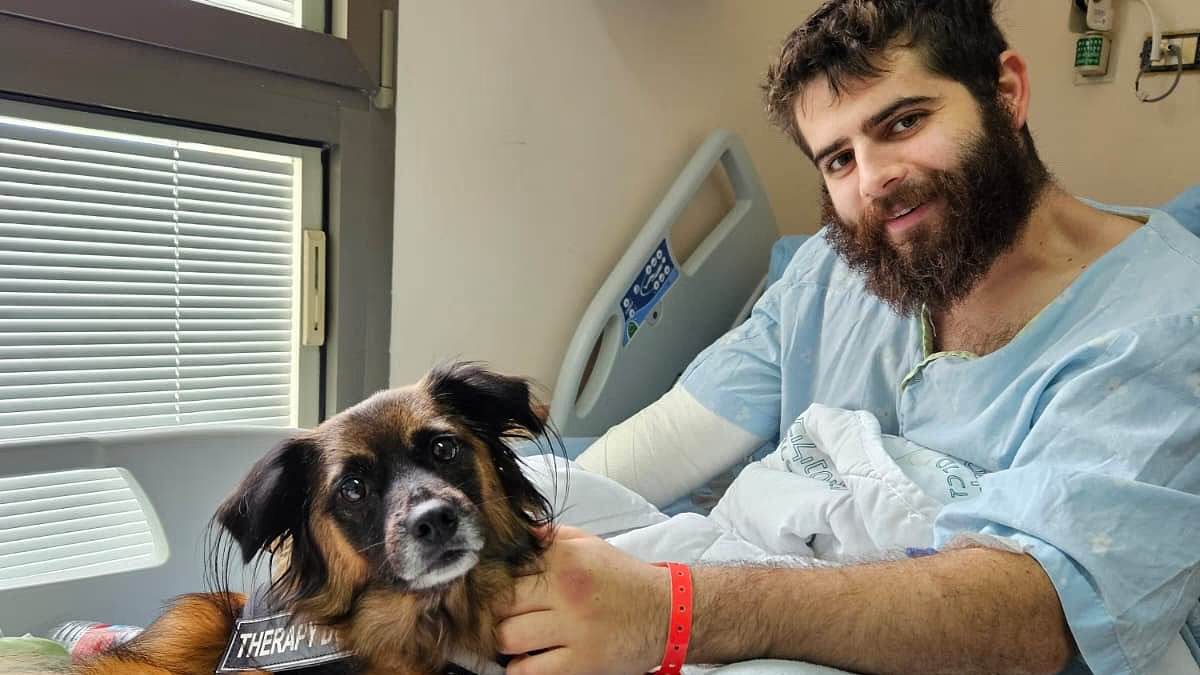
Two years have passed, but Yoav Haver says he will never be able to unsee the trail of corpses on the blood-soaked roads as he fled for his life during the Nova music festival massacre. The 24-year-old was shot three times and nearly lost his hand when he tried to escape from machine gun-toting terrorists as they murdered 378 people, mostly partygoers, during the October 7, 2023, attack. He was forced to crawl through swarms of dead bodies to hide from Hamas gunmen after they stormed the Supernova trance music festival in the Negev desert, also taking 44 people captive. The electrical engineering student and his friend Tomer were ambushed by terrorists on three occasions as they attempted to flee through roads filled with lifeless bodies in a makeshift getaway car.He was shot in the arm when lying in bushes and later shot again as he hid in a medical tent before eventually being escorted to a hospital eight hours later, at which point his hand had turned black from blood loss.'We heard the alarm at around 7am and drove away for a minute before four armed terrorists jumped out of a bush and just started shooting and spraying us,' he told the Daily Mail.'Me and Tomer, each of us was hit with three bullets. I got two in my left arm and one in my right and Tomer got all three in his right arm.'Tomer performed a U-turn to avoid being shot further but the car broke down 30 seconds later, leaving the pair forced to flee on foot, reaching one of the festival's medical tents. Yoav Haver (pictured with therapy dog Teddy) was shot three times and nearly lost his hand when he tried to escape from the Nova festival massacre Machine gun-toting terrorists murdered 378 people, mostly partygoers, after they stormed the music festival Hamas gunmen then stormed by just 15 minutes later, with the friends separated as Yoav ran to shelter in bushes for two hours.'Every time I had to move from hiding spots I saw people getting shot, and I saw dead bodies on the floor,' he said. 'I had to crawl between dead bodies so I wouldn't be seen.'There was one body of a dead girl that I cannot forget. She was shot right in the middle of her forehead. She had a big hole right there. Her knees and head were on the ground but her hip was up, like a scorpion.'That was one image I can never unsee.'There's also this image I have of the road filled with dead bodies, burnt people and broken cars on every side. It was really everywhere you looked.'I also remember looking down at my hand which had turned black. It was very graphic. Most people who saw my injury couldn't believe that my hand works now, let alone that I even have it.'When I was hiding I thought I would get kidnapped - that's the worst case. Or I could die, that's the good case.'After hiding in the bushes, the student found two medics who wrapped his badly bleeding arm with a tourniquet. Yoav was forced to crawl through swarms of dead bodies to hide from Hamas gunmen on October 7 Since leaving hospital Yoav has adopted a dog of his own, which he named Nova Pictured: An armed Palestinian militant leading a man away during the Supernova music festivalThey tried to evacuate him in a festival-goer's Mazda but it was again targeted by gunfire and he later hid in the besieged Kibbutz Re'im.'We went to Kibbutz Re'im but we didn't know it was completely occupied by Hamas,' he said.'The second our car got inside the gate, all of the terrorists just started spraying us again. They were hiding at home so we couldn't see them at that time.'They were hiding in buildings and apartments, and they sprayed us and very luckily we were able to get through that.'But we got locked in the kibbutz. We were hiding there, we were four people we had no way to escape, and we were waiting and waiting, and after two hours, there I saw, my hand was in a point that it was getting black and I was afraid to lose it.'Israeli soldiers eventually took control of the kibbutz nearly three hours later and Yoav was rushed to hospital, where he was reunited with Tomer.Nova festival, which was meant to be a celebration of love and spirituality for around 3,500 Israelis and foreign visitors ended with 378 murdered as men with Kalashnikovs marched through the campsite, unleashing bullets indiscriminately at civilians while rockets flew overhead.Many who survived the festival massacre witnessed extreme violence, including rape and mutilation and have suffered from severe trauma.Last October, survivor Shirel Golan died by suicide at her family home on her 22nd birthday after developing PTSD and depression after the attacks.Yoav has credited Teddy, a therapy dog he met during his recovery, in helping him start to heal. Teddy helps his owner Keren Matry (pictured), a Senior Nurse and Dog Therapy Specialist at Rabin Medical CenterTeddy has helped his owner Keren Matry, a Senior Nurse and Dog Therapy Specialist at Rabin Medical Center, since age two and is used as part of a pioneering medical approach developed alongside Michal Leowenstein, a nursing manager and Animal Assisted Therapist.While therapy dogs are often used in hospitals, Teddy is uniquely used in all forms of clinical treatment, from intensive care to neurology.He has helped more than 100 injured patients by accompanying them through treatment since the beginning of the Israel-Gaza war, including families of hostages held by Hamas.Ms Matry told the Mail: 'He sees them in a situation as they are, as is, with no judgment, no negotiation, and he loves them without any preconditions, which is very, rare in the atmosphere between humans.'At one stage, patients start to worry about the dog, because they feel very connected to him. So instead of being patients, they are the ones who are taking care of the dog.'Yoav added: 'The first few months after the attack were really hard. I didn't have much time to focus on my mental issues because I was focusing on physical recovery. After about six months, I was able to start addressing my mental issues.'I met Teddy when I was hospitalized and I love dogs. A lot of the time I was lying in my bed thinking about what happened, and I was very sad or angry, Teddy would come and it would make me smile. Teddy has helped more than 100 injured patients by accompanying them through treatment since the beginning of the Israel-Gaza war, including families of hostages held by Hamas.Another patient, also a Nova survivor, had severe injuries all over her body after hiding in a tunnel for nine hours during the massacre.'She was in a very low mood as many of her friends were murdered,' Ms Matry said. 'She wouldn't talk about her experience at first but her confidence grew after meeting Teddy.'When she later talked about October 7 she was looking at me but talking to Teddy.'He has also helped families of hostages.'There was one case where a father was a hostage who was killed in captivity while his wife was pregnant,' Ms Matry said.'We were with the kids when they arrived and were informed of his death. They really hugged Teddy which helped bring a bit of light into a positive situation.'Dr. Jonathan Reiner, Senior Neurologist and Head of Neuromodulation and Deep Brain Stimulation Service at Rabin Medical Center said: 'Teddy has been a valuable member of our team, no doubt.'We can see the effect he's had on patients has been phenomenal, to enable us to assess and engage with patients after strokes, after very debilitating conditions. To see how the dog is able to actually elicit some kind of emotional response or movement or motor response from these patients.''With neurodegenerative disorders and movement disorders, there's more and more use of dogs. Through their sense of smell, they're able to diagnose different conditions. While therapy dogs are often used in hospitals, Teddy is uniquely used in all forms of clinical treatment, from intensive care to neurology'Hospital environments are very sterile and clinical and often put people in a position where they feel vulnerable and alone. It's always nice to see how using these therapeutic dogs breaks the ice and allows for some emotions to come through.'We know about the use of these dogs with patients who suffer from epilepsy, and how these dogs are able to detect changes in mood and behavior and call out for help before the seizure actually occurs.'It's been invaluable to see the effect and how it changes everyone's state of mind and mood on the ward.'Since leaving hospital Yoav has adopted a dog of his own, which he named Nova.'She got me to wake up from bed and to go outside and walk and not just stay home and get in a depressed situation, and has really lifted my spirits.He added: 'Obviously I think about the attack every day and a lot of times I look at my hand and I remember but I don't let it break me.'I also think of my grandfather who survived Auschwitz and the Holocaust and was always a happy man with a smile - after everything he went through.'Now I am a student. I am studying electrical engineering. I just finished my second year and have two left. It means way more now. It's more than just completing my degree. It's winning against those who tried to kill me.'
Nova music festival survivor tells of his escape for the first time
EXCLUSIVE: Two years have passed, but Yoav Haver says he will never be able to unsee the trail of corpses on the blood-soaked roads as he fled for his life during the Nova music festival massacre.
1,593 words~7 min read